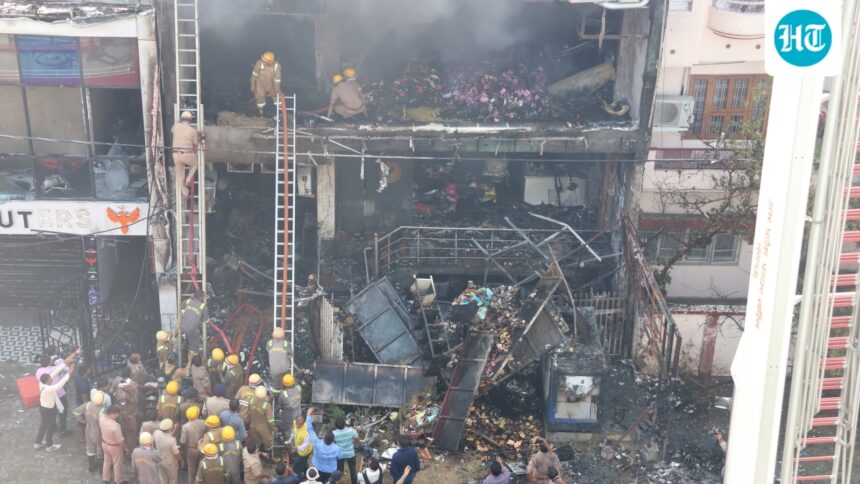
On a hot day in late May 2024, the Delhi Fire Service received 220 emergency calls, its busiest of the year. Officials said at the time that about 70% of the incidents they responded to were fires caused by an electrical short. During that summer, fire emergency response calls doubled compared to the previous year to exceed 9,000, and deaths more than tripled compared to the ten recorded during the same months the previous year.

Parts of Delhi that summer saw temperatures approaching 50 degrees Celsius, and scientists later confirmed that 2024 was the warmest year on record in world history.
It has been a harsh year, but heatwaves are becoming increasingly common across much of northern India. Every summer, the region experiences the same grim cycle of deadly fires blamed on “short circuits,” electrical faults, and air conditioning.
On June 3 this year, a fire at a bed and breakfast facility at Hauz Rani in Malviya Nagar claimed 23 lives, including the lives of foreigners who were visiting Delhi for medical treatment. Less than a month later, on June 22, a fire broke out in a multi-storey building in Lucknow’s Aliganj area, killing 15 people, most of them young men.
In both incidents, fire officials suspect short circuits were one of the causes of the fires, which then spread quickly into firebox structures that violated building and safety standards, and lacked proper ventilation and emergency exits.
While the final cause of the fires will not be announced until investigations are completed, these incidents raise a question worth investigating: What turns a wire or air conditioner into the spark that starts a fire, and why is summer so often associated with it.
Read also: The Indian dream that ended with the Hauz Rani fire: How three generations were wiped out
Short circuit
Electric current flows when positive and negative charges are connected; Even then, the circle is incomplete, and there can be no passage. When electricity passes through a wire – any wire – it generates heat.
Wires are designed to handle this heat to a certain extent, which is determined by their thickness, insulation and the amount of current they carry, which is why they are supposed to be imperceptible to human touch. Stay within these limits and the heat is harmless. If you exceed it, the insulation begins to deteriorate – slowly at first, then faster, until it can catch fire.
A short circuit is what happens when current finds a sudden, unintended path with very low resistance, bypassing the device it was supposed to power, and heading toward that easy path instead. As it rises, heat quickly builds up, creating sparks that can ignite anything nearby.
This is the version that most modern homes are protected against: The circuit breaker in the fuse box is designed to sense a surge and cut off the power before the heat can start a fire.
But fires often start more quietly, and the arsonist doesn’t even notice.
This unfolds over a long period. It starts with the same frictional heat inherent in any wire, but at a specific weak spot on the path: a loose connection, or a thin wire feeding a heavy device. As resistance builds in that spot, more and more heat is generated there. The flux is usually too small to trip the breaker, so nothing turns off; Simply the chefs are wrong. Eventually, the heat in that spot can build up until it sets the surrounding material on fire.
From there it becomes a trap that intensifies itself.
The danger point is usually a joint — where two wires meet, or where the wire attaches to a switch, plug, or socket. When this joint heats up, it slowly loosens, in the same way that a nail loosens under repeated pressure, and a very thin gap can open between the two pieces of metal. Electricity does not stop at this gap; She jumps, and every jump can be a spark. Heat damages the joint, the damage widens the gap, and the wider gap exacerbates the spark, fueling the cycle itself.
Read also: Lucknow tragedy: A loophole in height left the building exempt from fire inspections
Why summer balance tips
Each wire can hold a limited amount of electricity before it gets hot, and this limit is not fixed. The wire stays safe by radiating its heat into the surrounding air. Safe limits are usually calculated assuming the ambient air temperature is around 30°C. When it is hotter, the wire must carry less electricity. In the Delhi summer, when temperatures soar, the heat has nowhere to go, and the wire gets dangerously warm as it goes about its daily work.
In a 2023 review published by EDP Sciences, authors Santhosh Kumar and Balachander say much of India’s electrical equipment is intended for a daily ambient temperature of around 33°C, while summer now routinely sees temperatures exceeding 45°C outdoors. This erodes the safety margin with which the wires were quietly installed, i.e. a cable passing through a hotter environment loses endurance and overheats, deteriorating its insulation towards a short circuit.
In plain terms: Wiring is pushed to its limits in the summer months, right when every home is running its heaviest appliances for long hours.
AC fires
In May, a retired IAS officer died after a fire broke out at his house in Hauz Khas in south Delhi. Fire officials said the fire was suspected to have been caused by an air conditioner explosion. Air conditioner fires have been reported in residential complexes in Delhi and the National Capital Region, including Noida and Ghaziabad, over the past few years.
An air conditioner combines many electronic malfunction risks into one device.
In order for the compressor motor to spin, the air conditioner needs a large boost of energy at startup—a boost that operates at several times its normal power—delivered by a part that stores the energy and releases it into that boost (a capacitor). This part is sensitive to heat, and in the outdoor unit, the sun alone can heat it up, as well as hours of running without rest. When the capacitor is weak, the motor overworks, overheats and can burn out.
In some cases, the part itself gets hot enough to start a fire. When it fails, it can spark or cause a short in the motor and wiring.
The above review added a mechanical tract that’s easy to overlook: the constant vibration of an air conditioner can cause its connections to vibrate, creating bad connections that lead to short circuits. The early warnings are normal and routinely ignored – strange noises, the unit turning on and off, a burning smell, or smoke.
Air conditioners in India are also shifting from non-flammable refrigerants to newer gases that can burn — for example, R-32 is slightly flammable and only ignites at certain concentrations. Some units also use a gas that is primarily propane, which is flammable.
Gas never ignites a fire on its own; An electrical error occurs. But a refrigerant leak around the outdoor unit, where the compressor and electronics sit together, can create an explosive atmosphere that can then find a spark. However, common gas tests produce a flash, not an explosion.
What data and studies show
In India’s National Crime Records Bureau’s (ADSI) accidental deaths and suicide data for 2022, there were 7,566 fire incidents – the lowest in 25 years, but the share blamed on electrical faults and short circuits rose to 21%, up from just 3% in 1996.
Delhi fire officials say about 70% of the incidents they respond to are caused by accidents Electrical damage – overloads, short circuits, overheating – occurs in wiring that is too old to handle 24-hour appliances.
The EDP review puts this figure at about 80% and says the 2016 National Building Code gives too little weight to fire risks from electrical installations and appliances, and that defects in air conditioners play a large role in short-circuit fires.