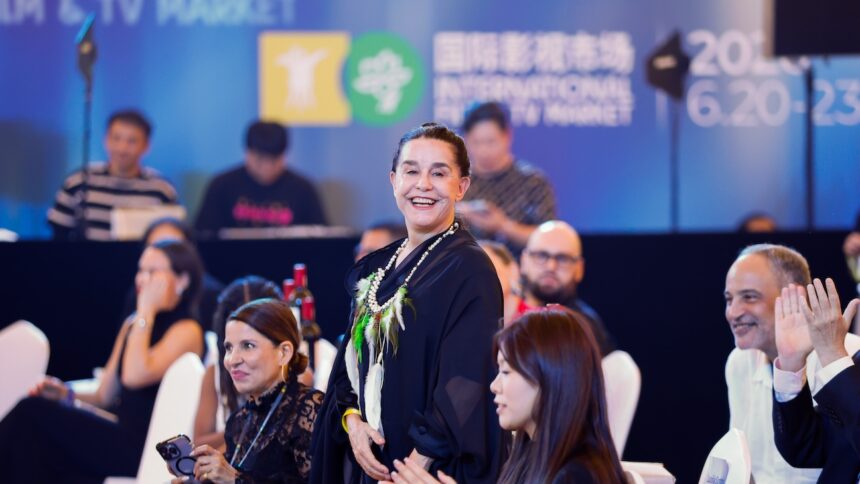
Lucilia Santos shakes her head and laughs as if, even today, she is still trying to comprehend the sheer numbers. But when the Brazilian actress arrived in Beijing in 1985, it was because more than 300 million people had voted for her at the annual China Television Golden Eagle Awards.
Moreover, the series in which Santos starred — Escrava Isora (Isora: The gentle girl) – became a cultural sensation in the country at a time when watching television was still very much a communal experience, with more than 450 million viewers tuning in each week.
“Honestly, I was shocked by that response,” Santos says. “It’s something I knew I would cherish for the rest of my life, but in terms of all the emotions, I couldn’t really comprehend it at the time. It wasn’t until I was in transit out of Hong Kong that I was able to stop and think about it, and let my emotions subside.”
Santos returned to China last week as part of a healthy Brazilian contingent attending the Shanghai International Film Festival and the Shanghai International Film and Television Market. There were performances of Brazilian classics – nominated for an Oscar Central station (1998) and Star hour (1985) Among them – in the Brazil Focus section, the two countries celebrate by choosing 2026 as the “China-Brazil Year of Culture,” celebrating more than 75 years of diplomatic relations.
There has been a big push for Brazilian content as the South American country tries to open paths to global markets.
Slave girl Santos appeared in the titular role and followed her daily struggles in the Brazilian Empire in the 19th century. It ran more than 100 episodes, and by its end, it had been shown in an estimated 80 countries.
While China has been reforming for less than a decade, the program was first broadcast on Beijing Television in 1984, but thanks to its immediate popularity it quickly reached a nationwide audience on China Central Television.
“I think people can recognize the contrast between people who are oppressed and those who are being persecuted,” Santos says. “In general, people from different backgrounds, cultures and nationalities, they certainly have this in common. Who is this pioneering figure[in[inSlave girl]From her experiences, people recognized the struggle between those who have power and those who do not, and I think that resonated well with audiences from all over the world.
When Santos first arrived in China, the Golden Eagle Awards had only been held three times, and an award had never been handed out to a foreign actress before. But Santos’s popularity was so great that organizers created a special one for her.
“Before I came to China, I had almost no knowledge of the country,” she says. “The two countries were different at that time in many ways. At that time, I remember it being a fairly horizontal or flat country without a lot of skyscrapers and all these high-rise buildings. In terms of the clothes that people wore, everything was quite uniform. The color was blue pretty much everywhere, and that reflects all the differences that we had at that time visually and also aesthetically and culturally.”
Santos later used her popularity in China to help develop cultural and trade ties between the two countries, and in 2004 she was awarded the China Jewel Medal for her work. Even today, she says, her fellow Brazilians still find it difficult to understand how popular she was – and still is – on the other side of the world. However, Santos finds it easy to return to her normal life.
“I’m a simple person, which means my lifestyle is simple and straightforward,” Santos says. “It’s very hard for me to be carried away by the fantasy of being a star. My father was a worker and I didn’t grow up with a silver spoon. I remember the importance of work, and it’s very hard for me to be enamored with the idea of being a star. I’m always humble so it’s very easy for me to go back to my normal lifestyle. I still do the chores in my family, so, you know, life remains simple.”