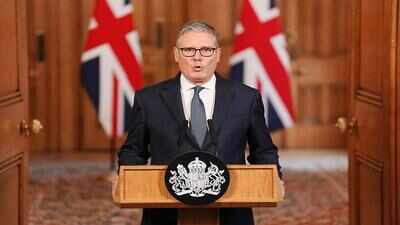
Keir Starmer’s resignation sparks battle to become Britain’s next prime minister/File photo
Britain’s political landscape was thrust into new uncertainty on Monday after Sir Keir Starmer announced he would resign as prime minister and leader of the Labor Party, bringing an abrupt end to a turbulent period in government and opening the door to a high-stakes leadership contest.In an emotional statement, Starmer said he accepted that many within Labor no longer believed he was the right person to lead the party at the next general election. He said he would accept the ruling “in good faith” and would remain in Downing Street only until a successor was chosen.The resignation comes less than two years after Starmer led the Labor Party back to power in a historic general election victory, ending years of Conservative rule.
His departure now paves the way for another major change at the top of British politics and raises questions about the future direction of the Labor Party.
Why did Keir Starmer resign?
Starmer’s decision comes after months of political pressure, internal party divisions and disappointing election results that have steadily weakened his authority.Labor suffered heavy losses in local elections earlier this year, including setbacks in England, Scotland and Wales.
The results sparked growing unrest among Labor MPs, government ministers and party activists, with many of them saying the government had lost touch with voters.Several ministers and parliamentary aides have resigned in recent months, while dozens of Labor MPs have publicly called for Starmer to step down. At one point, senior Cabinet figures reportedly urged him to set a timetable for his departure.Although Starmer has repeatedly insisted that he will fight to remain in office, pressures have continued to mount in the wake of political disagreements, the government’s resignation and declining public support.
Starmer’s final message
Speaking outside Downing Street, Starmer defended many of his government’s achievements while acknowledging the political reality he faces.He pointed to progress on economic growth, NHS reforms and efforts to reduce child poverty, saying Labor had achieved tangible change since entering government. However, he admitted that many people were still unconvinced and that the party needed a fresh start.Starmer thanked his Cabinet colleagues, members of the Labor Party and his family for their support during one of the most challenging periods in modern British politics. He also confirmed that he informed King Charles III of his decision.His resignation speech was noticeably emotional, reflecting the scale of the political crisis that ultimately ended his premiership.
Who can replace Keir Starmer?
Attention now turns to who will become the next British Prime Minister.Labour’s National Executive Committee is expected to open nominations for the leadership race in early July. If just one candidate receives enough support, a new leader could be confirmed within weeks.The front-runner is Andy Burnham, who recently returned to Westminster after winning the closely watched by-election in Makerfield. Burnham has long been seen as one of Labour’s most popular figures and is widely seen as the front-runner to succeed Starmer.It is possible that other potential rivals will emerge, but many political observers believe Burnham currently enjoys the strongest support among Labor members and MPs.
What’s next?
Despite stepping down, Starmer will remain prime minister on a caretaker basis until Labor chooses a replacement. Parliament is expected to remain focused on government business while the leadership contest unfolds.The outcome of the race will be closely watched not only within the Labor Party but across the entire political spectrum.
Opposition parties, including the Reform Party and the Liberal Democrats, have seized on the resignation as evidence of growing instability at Westminster.Whoever succeeds Starmer will inherit a government facing economic challenges, pressures on public services and a rapidly changing political landscape. The next Labor leader will also need to convince voters that the party can regain its momentum before the next general election. Keir Starmer will step down as Prime Minister and Leader of the Labor Party.