Regional parties have suffered from orchestrated or self-induced divisions after electoral defeats. The Trinamool Congress (TMC)’s split following its defeat in the 2026 West Bengal Assembly elections has sparked speculation that other parties, particularly the Samajwadi Party (SP), could be next.

Uttar Pradesh Deputy Chief Minister Keshav Prasad Maurya has pointed out the defections of SP MPs, adding seriousness to the speculation, after claims by Om Prakash Rajbhar, an ally of the ruling Bharatiya Janata Party, were met with skepticism.
Follow updates on Shiv Sena (UBT) division here.
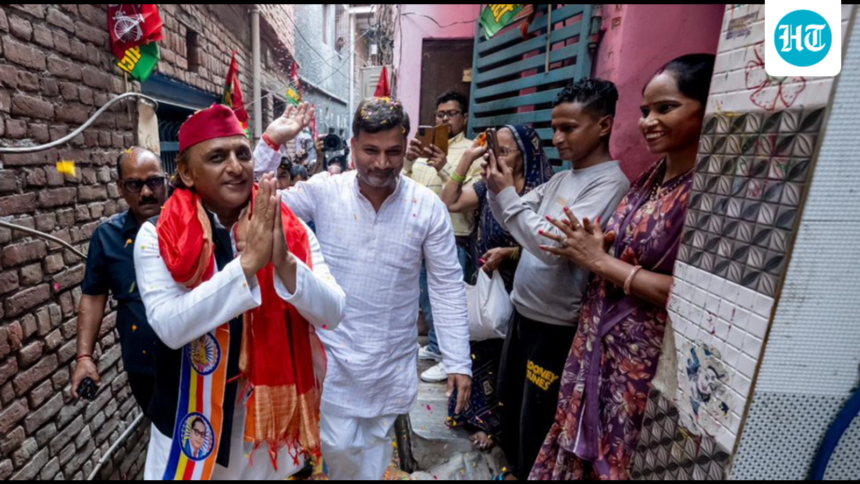
Carrots have clearly been thrown to the weak SP MPs, as party chief Akhilesh Yadav remains busy with the Assembly elections scheduled for next year. Yadav has so far dismissed all speculations, saying the SP is determined to fight all such attempts.
The Socialist Party is a regional powerhouse and the third largest party in Parliament. It registered its best performance in the 2024 national elections, winning 37 of the 80 Lok Sabha seats in Uttar Pradesh. The BJP’s seats in the state fell from 62 in 2019 to 33, as the party’s overall tally fell below the majority mark in Parliament, leaving it dependent on the Telugu Desam Party (TDP) and Janata Dal (United) or JD(U) to retain power.
The BJP won 240 seats in the 543-member Lok Sabha. The Congress-led opposition alliance won 234 seats. The TDP’s 16 seats and the JD(U’s) 12 helped the NDA cross the majority mark, reaching 293 seats.
On Sunday, two of the Shiv Sena’s six rebel MPs (UBT) announced their defection to the Shiv Sena led by Eknath Shinde, a member of the Bharatiya Janata Party-led National Democratic Alliance (NDA). Four more defections are expected to follow.
The Shiv Sena’s (UBT) split came days after 20 TMC MPs announced their defection to the little-known Nationalist Citizen’s Party of India (NCPI), which is allied with the NDA. There is little clarity about NCPI’s leadership. The party, which was founded in Tripura in 2023, has a registered office in Howrah in West Bengal. The National Voters’ Congress is an unrecognized party that contested two seats in the Tripura Legislative Assembly and received a few hundred votes.
The defections came against the backdrop of the National Democratic Alliance government’s keenness to approve the border demarcation bill. The National Democratic Alliance Party suffers from a shortage of 46 members, which is the number needed to obtain a two-thirds majority in the Lok Sabha. The TMC and Shiv Sena (UBT) played a major role in defeating the Constitutional Delimitation Amendment Bill earlier this year.
The Congress, Left Front and TMC dominated West Bengal politics until the BJP came to power in 2026. The BJP does not expect a major challenge until the Left and Congress revive. The future of the TMC is uncertain amid speculation about its merger with Congress.
The TMC rebels, regardless of their numerical strength, are unlikely to face immediate exclusion. Presidents often kept anti-defection cases pending for years until the end of a House term. The courts refused to intervene in legislative matters or did not provide immediate relief.
History seems to have come full circle in West Bengal. In 1998, Mamata Banerjee ended her 23-year association with the Congress and launched the TMC, which continued to demolish the Left Front’s 34-year rule. The Congress party has yet to recover from the shock, while Banerjee has become the invincible leader of Bengal.
It is too early to write an obituary for the TMC, as it may still be relevant if it decides not to merge with the Congress. Banerjee has time and again shown her determination to fight, but age is not on her side.
The collapse of the TMC has sparked debate about the future of regional parties that have grown in the past three decades and dictate and dominate politics at the center and states. Some have ailing leadership, others face succession battles.
The political and negotiating power of regional parties has diminished in the last few elections, with the BJP being the main beneficiary. The majority of regional parties, which dictated the country’s politics for a decade between 1989 and 1999, came under the larger umbrellas of the BJP-led and Congress-led alliances. Very few parties operate independently of it. Discussions about the need for a third or fourth front do not stop.
Regional parties grew as the Congress and BJP failed to develop or retain a fully Indian base. The Congress party’s loss of power was the regional parties’ gain until the BJP returned to power at the center in 2014.
Regional parties dominated the major states of Uttar Pradesh, Bihar, West Bengal, Tamil Nadu, Andhra Pradesh and Odisha, winning 247 of the 543 Lok Sabha seats. In 2026, the BJP took over the government from the JD(U) in Bihar and demolished the TMC in Bengal. Biju ousted the Janata Dal from power in Odisha in 2014 and has his own chief minister leading the government in Maharashtra.
The Socialist Party remains the strongest regional party. In 2027, a weakened Aam Aadmi Party faces Assembly elections in Punjab after losing power in Delhi.
In Tamil Nadu, a new regional party, the Tamilga Vetri Kazhagam, defeated the Dravida Munnetra Kazhagam and the All India Anna Dravida Munnetra Kazhagam, suggesting that regional parties are here to stay. Andhra Pradesh is governed by the LDP, and another regional powerhouse, the YSR Congress, is the main opposition party.
The BJP was in direct competition with the Congress on barely 200 seats in the 2024 national elections and on 243 seats with regional parties. In the remaining 100 seats, the BJP was not in the fray at all. In 2029, the BJP will face almost no challenge in states like West Bengal and Odisha, even though it would be too early to predict the demise of regional parties.
Regional parties often split but survive, as regional aspirations will remain strong in a country as diverse as India.