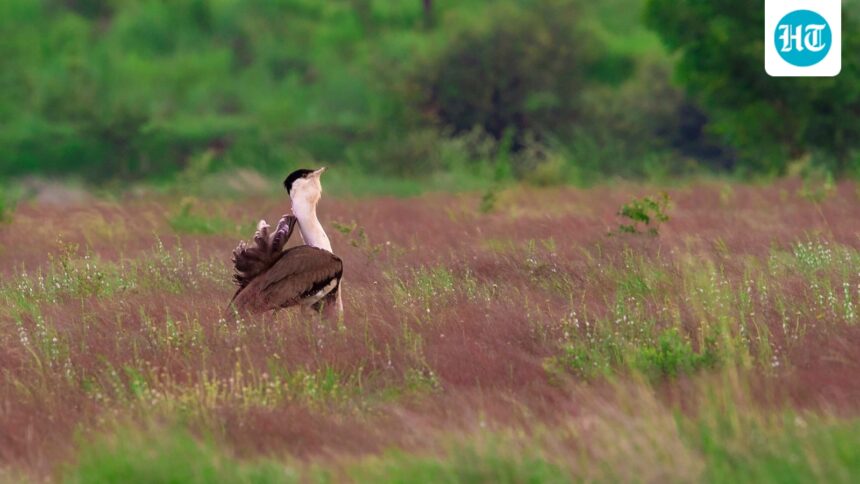
Congress leader Jairam Ramesh on Sunday shared an old post, recalling then Prime Minister Indira Gandhi’s trip to Udaipur in Rajasthan, a trip that included a Hindustan Times report that led to a conservation program for the great Indian bustard, known locally as the Godawan.

The great Indian bustard, scientifically named Ardeotis nigriceps, is a critically endangered bird. It is often considered an indicator of the health of our grasslands.
In a post on the
“On the morning drive to Udaipur, I came across the daily edition of the Hindustan Times. The front page had an unusual picture – that of the great Indian bustard that was on the verge of extinction. There was a news report on the fourth page which I also read,” Ramesh added.
Read also | Great Indian bustard chick disappears in Kutch: forest officials
The Congress leader further said that after reading the report, Gandhi reached Udaipur and met some bird lovers led by Harsh Vardhan, who was a member of the Rajasthan Wildlife Board at that time.
“This sequence of events led to the launch of the Great Indian Houbara Conservation Program as well as steps to establish the sprawling Desert National Park near Jaisalmer and Barmer,” Ramesh said.
Pointing out that the endangered Great Indian Bustard still faces many threats, the Congress leader said hopes for its conservation have remained alive since Indira Gandhi’s trip to Udaipur on June 21, 1976.
Ramesh also said that the great Indian bustard was also proposed as the national bird by famous ornithologist Salim Ali in 1961.
“However, two years later, the Indian Wildlife Board headed by former Maharaja of Mysore Jayachamarajendra Wadiyar chose the peacock as the national bird for historical, mythological, cultural and religious reasons,” he added.
The great Indian bustard and its preservation
The Great Indian Bustard was brought under the Wildlife (Protection) Act, 1972, but it did not receive adequate attention and remained BPL (Below Protection Line).
The main reason for the rapid decline in their numbers has been habitat loss due to conversion of grasslands to other uses, bioturbation caused by human activity and related bioturbations during the breeding season, and frequent poaching of the species as game, according to the Forest Department of the Rajasthan government.
Read also | Mann ki Baat: Prime Minister Modi lauds the conservation of the great Indian bustard
The Great Indian Bustard is a grassland species and is often considered an indicator of the health of grasslands, which are often neglected and often considered barren land.
On June 5, 2013, the Rajasthan state government launched a conservation program called the Great Indian Bustard Project.
In 2023, the Union Environment Ministry said in a press release that the Center is taking various measures to conserve and protect the Great Indian Bustard in the country, including Rajasthan.
The procedures announced by the Ministry are:
1. Since the Great Indian Bustard is listed in Schedule I of the Wildlife (Protection) Act, 1971, it is afforded the highest degree of legal protection from hunting.
2. Important habitats of the Great Indian Bustard have been designated as national parks/reserves for their better protection.
3. This species has been identified for conservation under the “Species Recovery Programme” category of the Centrally Sponsored Program – Wildlife Habitat Development.
4. Bird breeding and conservation was carried out in collaboration with the forest departments of Rajasthan, Gujarat and Maharashtra and technical support from Wildlife Institute of India, Dehradun.
5. Sites for establishing breeding centers for the Greater Indian Bustard and Lesser Florica have been identified in consultation with the forest departments of Rajasthan and Gujarat, the Wildlife Institute of India and international experts.
6. The Ministry provides financial assistance to states/union territories under the Central Welfare Scheme: Development of Wildlife Habitats for the Conservation of Wildlife, Including the Great Indian Bustard.