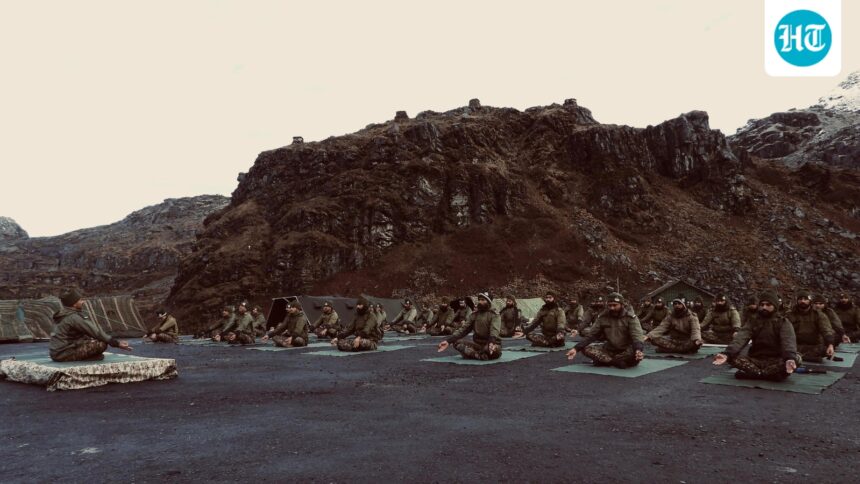
Long before yoga became a global symbol of health and wellness, it was seen in India as a path to mental clarity, emotional balance and self-control, indispensable qualities for a warrior. The eternal relationship between the yoga and the soldier finds its most profound expression in the Bhagavad Gita. Faced with doubt and moral conflict on the battlefield of Kurukshetra, Arjuna found himself unable to fulfill his duty. Through Lord Krishna’s teachings on Karma Yoga – the yoga of selfless action and steadfastness in duty – he regained clarity of purpose and resolve to fulfill his responsibilities. It is therefore no coincidence that the Indian Army, one of the largest and most experienced in the world, has emerged as a leading ambassador of yoga, bringing the wisdom of ancient India to military communities around the world.

Few traditions have traveled the world with credibility, acceptance, and transformative impact Yoga has. Scientific studies have shown that practicing yoga regularly improves flexibility, cardiovascular health, stress management, and mental resilience. In recognition of its global appeal, the United Nations General Assembly adopted a resolution in December 2014 declaring June 21 as International Yoga Day. Since its first celebration in 2015, yoga has seen an extraordinary global reach. Today, yoga centers, institutes and spas flourish across the continents, promoting a practice that originated in India thousands of years ago. While diplomats, cultural organizations and health institutions have played an important role in this journey, the Indian Army has quietly emerged as an equally important contributor.
Read also | ‘Age does not diminish a person’s potential’: PM Modi leads International Yoga Day celebrations in Bengal
Traditionally seen as an instrument of national hard power, the Indian Army has increasingly become a carrier of India’s soft power through yoga. In addition to its role in national security, it has helped provide Yoga is for military personnel from all over the world, turning them into a bridge connecting soldiers from different countries, cultures and backgrounds.
the The Indian Army participates in approximately 20 to 25 bilateral and multilateral military exercises annually and frequently conducts yoga sessions for troops from friendly foreign countries. A recent example of this is the multilateral exercise “Pragati 2026” in Meghalaya, which brought together more than 400 military personnel from India and 12 friendly foreign countries. Besides professional military interactions and training activities, participants learned about Indian cultural traditions, including yoga. Through these exercises alone, the Indian Army collaborates with military personnel from dozens of countries every year, providing a unique platform to share India’s health and wellness traditions.
The scope of the Army’s outreach extends beyond military exercises. Indian Army units deployed in UN peacekeeping missions have qualified yoga instructors as part of their units. These trainers regularly organize yoga sessions involving fellow peacekeepers and local communities, attracting enthusiastic participation from individuals of different nationalities and local residents alike. Throughout the mission areas, Indian peacekeepers have used yoga not only as a fitness activity but as a means of community engagement, cultural exchange and promoting well-being.
Read also | Chandigarh: This International Yoga Day raises an important question: Where are the youth?
Another important but lesser-known contribution comes through military education and training institutions. Established in 2000, the Center for United Nations Peacekeeping (CUNPK) in New Delhi is a UN-recognised training institution that prepares military personnel from around the world for peacekeeping missions. Since its inception, CUNPK has provided training and capacity building to around 10,000 Indian peacekeepers and over 2,000 foreign peacekeepers from 98 countries. As part of its comprehensive approach to military readiness, yoga is regularly integrated into these programs. The Foundation continues to introduce 70 to 80 international participants annually to yoga, making it one of the most important platforms for the Indian Army to promote yoga within the global military community. Likewise, 2,500 to 3,000 foreign military trainees attending pre-commissioning academies and specialized Army schools and colleges each year are introduced to yoga during their training in India. For many officers and cadets, their exposure to structured yoga training comes through the Indian Army.
Yoga awareness in the Army is further enhanced through International Yoga Day celebrations attended by Defense Attaches of friendly foreign countries and their families at military establishments in New Delhi. Indian military training teams deployed in friendly foreign countries add another dimension to this effort. While these teams impart professional military skills and expertise, they also promote Indian culture and values among partner militaries. Through its interactions with partner militaries, yoga becomes a natural and effective means of sharing India’s cultural heritage, extending its reach beyond formal diplomatic channels.
The response from international participants was generally positive. Foreign military personnel and trainees often describe yoga as an effective tool for stress management, physical conditioning, mental resilience, and emotional balance – qualities that are equally important on the battlefield and in peacekeeping operations. At a time when armed forces around the world are placing greater emphasis on mental health and overall fitness, yoga has found increasing acceptance among military professionals around the world.
This is where the Indian Army’s contribution becomes truly unique. While it remains a symbol of Indian military strength and national security, it simultaneously serves as a messenger of peace, wellness and cultural diplomacy. Through yoga, the Army demonstrates that hard power and soft power are not mutually exclusive. The soldier who guards the borders can also carry to the world an immortal cultural heritage.
As the world celebrates the 12th International Yoga Day, the Indian Army continues to play an important role in taking yoga beyond India’s borders. Through multinational military exercises, UN peacekeeping missions, international military training institutions, engagements of military attaches and military training teams deployed abroad, the Army has quietly transmitted India’s cultural heritage to military communities across the world. In doing so, it reinforced the established truth that a nation’s strength lies not only in its ability to defend itself, but also in its ability to inspire others.
Lt. Col. Manoj Panwar is currently serving in the Indian Army. The opinions expressed are personal