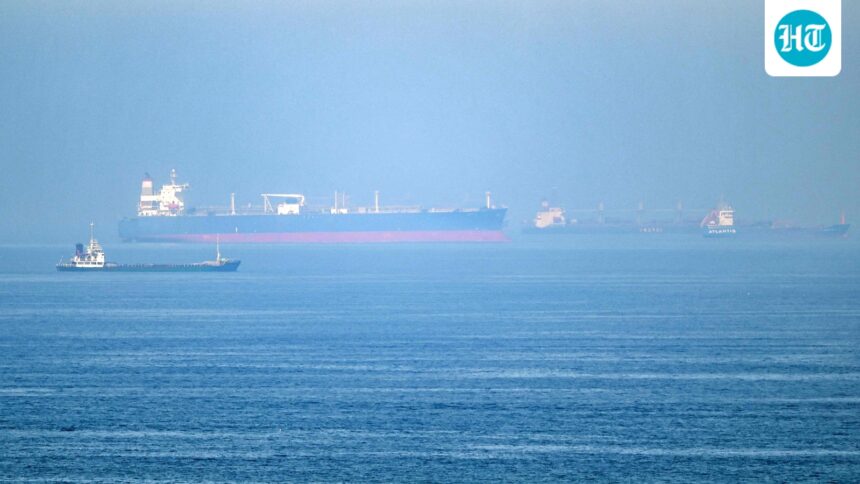
Three Indian-flagged supertankers crossed the Strait of Hormuz on Saturday and are sailing back home with a 94-member Indian crew on board — and now appear to have slipped away just hours before the Iranian military announced it was closing the strait again, citing Israeli strikes in Lebanon and accusing the United States of bad faith.

Tanker tracking data compiled by Bloomberg showed that one of the three ships, the Desh Vigor, was still maneuvering through the strait earlier in the day, after briefly turning toward the southern route recommended by the U.S. military and then turning back toward the Iranian coast.
Union Minister for Ports, Shipping and Waterways Sarbananda Sonowal confirmed in the evening that the three tankers – Desh Vaibhav, Desh Vibhor and Sanmar Herald – had crossed safely and were on their way to India.
Read also | Donald Trump says there are no casualties in the Strait of Hormuz, and threatens to impose a US tax if talks with Iran fail
The tankers are carrying more than 860,000 tons of crude between them – about 285,000 tons each – and are expected to arrive in India between June 24 and July 1, Sonowal said.
Desh Vaibhav is scheduled to visit Vadinar and Desh Vibhor at Sika, both in Gujarat, on June 24; The Sanmar Herald, the last of the three to cross, is scheduled to reach Paradip in Odisha on July 1.
“Our ministry is actively coordinating with all relevant agencies to ensure absolute safety of seafarers and the energy lifeline of Bharat,” Sonowal said, lauding the government’s “top priority” focus on maritime security under Prime Minister Narendra Modi.
Ten Indian ships remain in the Persian Gulf, on the western side of the strait that the three tankers had just crossed, according to the ministry’s latest situation update.
The Strait was reopened earlier this week after Washington and Tehran signed an interim agreement to end their war, under which Iran agreed to dilute its stockpile of highly enriched uranium in exchange for an exemption from US sanctions allowing it to sell oil freely.
The United States lifted its naval blockade of Iran on Thursday, ending a blockade that had left the strait largely unusable for months — though Iran has maintained all along that no ship can pass without its permission.
But on Saturday evening, Iran’s Joint Military Command said it would close the strait in response to ongoing Israeli strikes on Lebanon and what it described as American “bad faith” in failing to end the war, in a “clear violation” of its obligations.
Its statement, broadcast on state television, warned that “if the aggression continues, subsequent steps have been planned.”
Read also | PM Modi raises issue of safety of “hundreds of thousands of Indian sailors” in Hormuz during G7 meeting with Trump
The announcement came even as Iran confirmed that its negotiating team — including Parliament Speaker Mohammad Bagher Qalibaf, Foreign Minister Abbas Araqchi, and officials from the central bank and oil — was traveling to Switzerland for talks, a trip that was originally scheduled for Friday.
Pakistan, the main mediator, said that discussions at the technical level would begin on Sunday in Bürgenstock with the participation of Qatari mediators.
But Foreign Ministry spokesman Ismail Baqahi indicated that little would be achieved from the visit until Iran is convinced that the United States is respecting the agreement.
“This trip therefore aims to demand that the other side fulfill its obligations,” he said, adding that talks towards reaching a final agreement will not begin until the main obligations are committed.
If not, the MoU as a whole will be at risk.