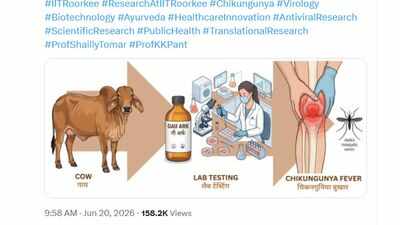
A post shared by IIT Roorkee on Saturday sparked a battle on social media after the institute highlighted research on the antiviral potential of Gau Mutra Ark, or Ayurvedic cow urine distillate. The study, led by Professor Shaili Tomar and her team from the Department of Biosciences and Bioengineering at IIT Roorkee, identified bioactive compounds in Gau Mutra Ark that showed antiviral activity against Chikungunya virus in laboratory conditions.According to the institute, the distillate reduced the viral load by more than 90 percent, while the formula based on a natural compound achieved up to 99.85 percent reduction in laboratory tests. The findings were published in the ACS Journal of Agricultural Sciences and Technology, with IIT Roorkee describing the work as an effort to explore Ayurvedic-inspired antiviral therapies through modern biotechnology.
This position reopened one of India’s most persistent fault lines – traditional practices versus scientific research. For supporters, the study was proof that knowledge rooted in Indian traditions deserves scientific examination rather than outright rejection.
One user described the findings as a “hard slap to leftists and anti-Hindu people”, thanking the researchers for continuing the work.Critics came out swinging, too. “We are a global laughingstock because of these people,” one user wrote. Another wrote: “Scientific institutions should follow evidence, not ideology.” People also asked whether leading institutes should spend time on projects that many people consider politically charged.
Some have claimed that research money would be better spent on diseases such as cancer and other major health challenges. The IIT Roorkee study comes on the back of the center’s scientific utilization through the Increased Research – Primary Products from Indigenous Cows, or SUTRA-PIC, programme. Launched by the Ministry of Science and Technology in 2020 with an approved budget of Rs 98 crore, the initiative is designed to support research on indigenous cows and cow-based products in the areas of health, agriculture and nutrition. Over the years, researchers at several institutions, including the Indian Institutes of Technology, have explored topics ranging from cow dung-based electrodes and water purification technologies to chemical profiling of cow urine and its potential industrial applications.