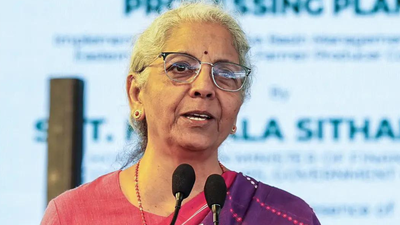
Union Finance Minister Nirmala Sitharaman on Friday said that externally supported projects (EAPs) should not be seen as mere financing instruments but as tools to help local products from the Northeast access global markets, enhance livelihoods and transform the region’s geographical challenges into economic opportunities.Sitharaman, who chaired a conference on ‘Leveraging Externally Supported Projects in North-Eastern States’, said assistance under Enhanced Action Schemes in the North-East has increased seven-fold under the Narendra Modi government.“The amount of support provided to the North East has increased from about Rs 9,000 crore during 2004-14 to nearly Rs 76,000 crore between 2014 and 2026,” she said.Highlighting the connectivity push in the region, the Finance Minister said over 10,000 km of roads have been built in the Northeast since 2014 at a cost of over Rs 1 lakh crore, while another 5,000 km of expressways are under construction.Farmers, artisans and youth in the Northeast have historically struggled to access markets, making infrastructure and connectivity crucial to unlocking the region’s economic potential, Sitharaman said.Describing the Northeast as “blessed like few places on Earth,” she said the region’s rich natural resources, cultural heritage and hard-working people deserved greater visibility and access to markets.
She stressed that externally supported projects achieve more than just funding. It also provides international best practices in project design, procurement, environmental safeguards and community engagement.“When we talk about soft action plans, we are not talking about loans or project costs, but rather about a development model that combines central support, government implementation and global expertise, all for the benefit of local communities,” she said.The minister added that institutions such as the World Bank and the International Fund for Agricultural Development (IFAD) contribute innovative technologies and proven development models derived from their experience in difficult geographical areas.Sitharaman also highlighted the Centre’s political focus on the region, noting that Prime Minister Narendra Modi has visited the Northeast more than 75 times since 2014, while Union ministers have made more than 700 visits.“The North East is no longer seen as peripheral to India’s development story, but rather is seen as central to India’s future growth, connectivity and prosperity,” she said.However, she cautioned that implementation challenges remain and called for stronger project management, improved last-mile connectivity, increased private sector engagement, and improved inter-agency coordination.
The organic spice unit displays a local and global vision
Earlier in the day, Sitharaman inaugurated the largest organic spice processing facility in northeast India at Re Bhoi district of Meghalaya.The organically certified unit, developed with an investment of around Rs 32 crore, can process over 10,000 metric tonnes of spices annually, including ginger, turmeric, black pepper and chilli.The facility is expected to directly benefit around 5,500 organic farmers across Meghalaya and the wider north-eastern region.Referring to her visit to the facility, Sitharaman said she witnessed the kind of intervention needed across the region.“I saw the kind of intervention the Northeast needs more of — processing local produce locally, getting better value for farmers and linking traditional strengths to modern markets,” she said.“Can there be anything better than local products popularized with outside help?” She added.Describing the facility as a “game-changing initiative”, Meghalaya Chief Minister Conrad K Sangma said targeted interventions over the past eight years have helped create sustainable income opportunities for thousands of farm families.The processing plant is the first organically certified spice processing unit in North East India and is certified under both the National Organic Production Program and EU Organic Standards, giving access to premium domestic and international markets.