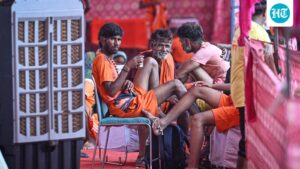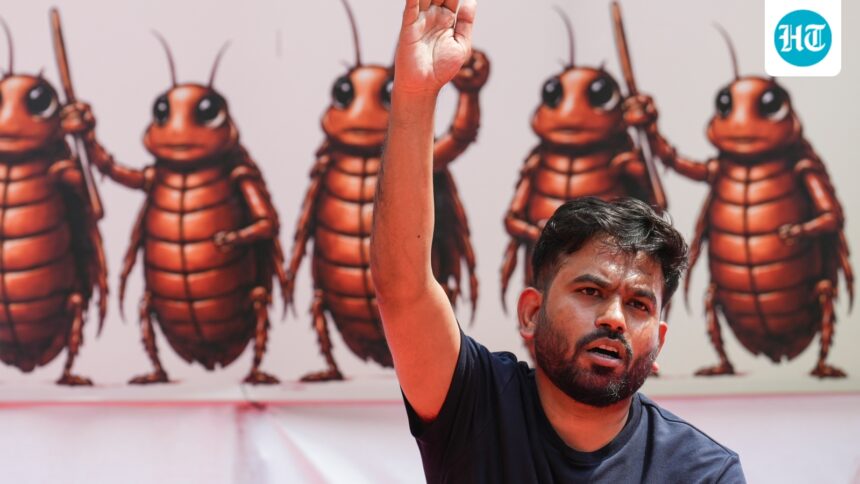
As the sun began to set over Jantar Mantar in Delhi on Saturday evening, police announcements blared over loudspeakers, informing protesters that the gathering had been declared illegal and that they should disperse.

Cockroach Janta Party (CJP) leaders and some protesters have shown little signs of backing down.
Protesters continued to beat plates and steel spoons, while CJP founder Abhijit Debaki posted a video urging his supporters across the country to launch peaceful “Jail Bharu” protests if he is arrested.
The demonstration centered on demands for the resignation of Union Education Minister Dharmendra Pradhan over exam-related controversies, and attracted students and supporters from several states, with protesters belting out thalis and chanting in unison, “Go Pradhan, go” — a reference to Prime Minister Narendra Modi’s 2020 call during the coronavirus lockdown.
But beyond the slogans and speeches, another question arose on Saturday: What’s next for a movement that has quickly grown from a social media campaign to a visible presence on the streets?
The answer is still far from clear.
Over the past few months, the Cockroach Janta Party has attracted a large online following and has organized demonstrations on issues such as exam integrity, alleged paper leaks, and employment concerns. Saturday’s protests showed the group can attract supporters beyond social media platforms. Whether it is able to maintain this momentum, expand its agenda, or evolve into a more organized organization, remains an open question.
The movement was born of anger and frustration
The CJP’s second protest at Jantar Mantar came a day before the NEET-UG re-examination and nearly a month after allegations of paper leakage and irregularities sparked a national debate over the examination process.
From the podium, speakers repeatedly targeted the National Testing Agency (NTA), accusing it of dropping students and evading accountability. Banners calling for the education minister’s resignation competed for space with posters questioning the credibility of exam systems that affect millions of aspirants every year.
The concerns resonated with many in the crowd.
Read also: #Melodi moment, ‘Panvel nikalna hai’: Meme-filled posters in spotlight at CJP protest in Delhi
“Every time there is a problem, the NTA blames it on technical glitches,” said Gautam Babu, 28, a law student from Bihar who now lives in Delhi. “The agency uses these technical glitches as a shield to evade responsibility.”
Others pointed to the emotional exam-related controversies that affected students.
“One of my friends took a drop in NEET last year. She prepared not only for the NEET entrance exams but also for several entrance exams for medical assistants. She was really happy after submitting the paper in May and was optimistic. Then we heard that the paper had been leaked,” said Hunar Jain, an 18-year-old college student from Delhi.
“It’s been more than a month that her family and friends have been counseling her. It’s not just NEET, she has lost the motivation to appear in other exams.”
Throughout the day, references to NEET, scrutiny pressures and accountability generated some of the loudest responses from the public, suggesting that these issues remain the movement’s strongest rallying point.
The rise of cockroaches?
The origins of the “cockroach” movement were visible everywhere in Jantar Mantar.
Many attendees said they first encountered CJP online. Some wore cockroach masks. Others live-streamed sermons and uploaded videos from the venue. Unlike traditional student movements that often emerge from campus, the CJP’s support base appears to have been largely assembled through social media.
This allowed it to attract people who may have never been involved in organized political activity before.
“I am from Mumbai,” said Neil Kobkar, 29, a professional worker who traveled to join the protest. “There was no RJD protest there, but the issues the party is raising resonate everywhere the students stay.”
Read also: ‘Missing motivation, no accountability’: What protesters said at the RJD’s Jantar Mantar protest
“The quality of education in private and public institutions is expanding every year.”
Many demonstrators described the movement as organic rather than organizational.
One young public policy specialist who attended the protest said one reason people connected with the CJP was that it did not emerge from a traditional political structure.
“The movement started on social media rather than in organized rooms,” he said. “It was organic and refreshing, which is why people connected with it.”
However, this same characteristic raises questions about its future. Social media can help build visibility quickly, but sustaining the movement often requires leadership structures, networks, and long-term goals beyond digital engagement.
Can CJP expand beyond exams and paper leaks?
As the day progressed, organizers increasingly tried to broaden the scope of the conversation.
The speeches touched on unemployment, governance and broader challenges facing Indian youth. Debke himself criticized what he described as divisive politics and questioned whether such discussions had helped address issues affecting students.
The question is whether supporters are joining the CJP itself or because of the examination-related issues that initially brought them together.
Many participants admitted uncertainty about the next direction of movement.
“Nobody knows exactly where this is going,” the public policy expert said.
Others have suggested that the appeal of the movement lies precisely in this uncertainty.
Read also: ‘Start Jail Bharu Andolan’: Abhijeet Debaki asks youth to continue protest if arrested
Unlike traditional political organisations, the CJP has so far remained largely focused on issues related to examinations, accountability and students. Expanding beyond this can attract a larger audience, but may also require the group to take positions on issues that currently fall outside its core agenda.
“We are first trying to fix this, fix our education system, but there is a lot more we need to do if we want a better future for ourselves,” said an 18-year-old protester.
Political movements often reach a point where they have to decide whether to remain issue-based programs or evolve into broader campaigns. The Justice and Development Party may soon face the same choice.
Beyond Abhijeet Deepaki
For most of Saturday, the protest revolved around its founder.
When Abhijit Debaki reached the venue, he was welcomed with loud cheers. His speeches attracted the largest crowds, and supporters often gathered near the stage to hear him speak.
At one point, he asked the crowd whether they wanted to end the protest at 5 p.m., when the police clearance expired, or continue until the education minister resigned. Many responded by calling for the sit-in to continue.
Later, after the police refused to extend permission, the majority left but some protesters formed a cordon around the theater while security personnel entered the area in larger numbers.
There is no doubt that Debke’s fame helped build the movement. But it also raises a question that many emerging organizations eventually face: Can they evolve beyond a single leader?
It seems that the call for protests was “jailed out.” Row” at the district level was an attempt to decentralize the movement and encourage local mobilization. Whether or not supporters accept this call may provide an early indication of how deeply rooted the organization’s support network is.
What happens when immediate demand is not met?
Perhaps the biggest challenge facing the AKP is the challenge facing many protest movements: what happens if the demand at the heart of the agitation is not met?
Despite weeks of mobilization, there is no indication that the government is considering the resignation of the Education Minister. However, many supporters insist the campaign cannot end there.
“Today there is a fire in the hearts of the youth, but they are holding a peaceful protest only so that Dharmendra Pradhan can resign. But if that does not happen, I am sure they will all come together in Parliament,” a protester told HT.
Others felt that the issue extends beyond one minister.
“The government has used all its mechanisms right from airlifting of Re-NEET papers to banning Telegram. A lot of taxpayers’ money is going into this. Why can’t they do the testing on their own instead of outsourcing it to an agency that is not accountable to anyone, including Parliament,” said Ranvijay, a 32-year-old PhD researcher at JNU.
Whether the CJP will remain an exam-focused pressure group, evolve into a broader platform for youth issues or struggle to maintain momentum after the NEET controversy fades remains to be seen.
Right now, even the cockroaches admit they don’t know exactly where they’re headed.
(With inputs from Gargi Shukla)