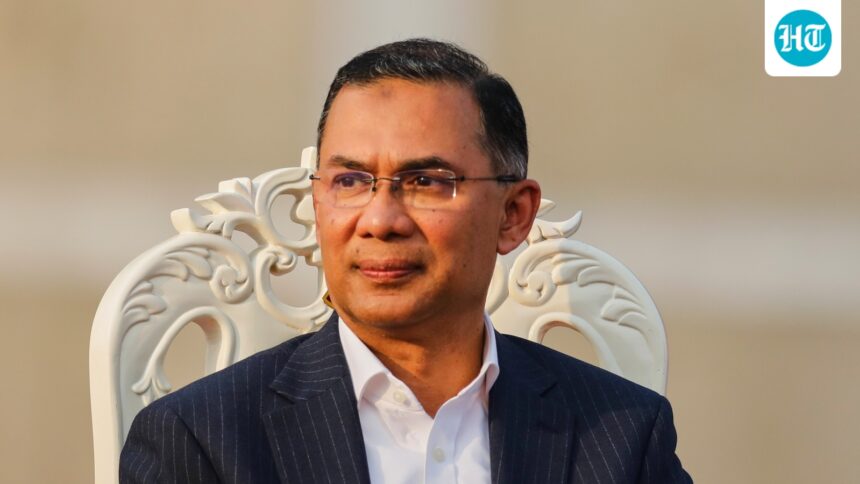
Prime Minister of Bangladesh Tariq Rahman chose Malaysia and China as his first foreign visit to expand business opportunities abroad and drum up investments, signaling his foreign policy priorities by bypassing India, which has traditionally been the destination for such trips.

Rahman is scheduled to begin his trip on Sunday, making a two-day visit to Malaysia, which is expected to focus on trade, investment, cooperation in energy and semiconductors and new avenues for Bangladeshi workers. He is then scheduled to travel to China for a four-day visit, during which he will participate in the annual meeting of the World Economic Forum’s New Champions, known as “Summer Davos”, and meet the president. Xi Jinping and Premier Li Qiang.
Bangladesh and China are expected to sign as many as 17 bilateral documents, including 13 memoranda of understanding and action plans, during the visit, Foreign Minister Asad Alam Siam told reporters in Dhaka on Saturday. He said discussions on a project to restore and manage the Teesta River through dredging and building embankments would be on the agenda. Another agreement concerns Chinese participation in the modernization of Mongla Port.
Siam said that the visit is considered a major diplomatic initiative aimed at strengthening Bangladesh’s economic partnerships, attracting foreign investments and strengthening regional connectivity.
Prime Minister Narendra Modi had extended an invitation to Rahman to visit India when Lok Sabha Speaker Om Birla traveled to Dhaka in February to participate in the swearing-in ceremony of the Bangladesh Prime Minister. This was part of New Delhi’s outreach to the BNP after its victory in the general elections.
In the months leading up to the official announcement of Rahman’s visit, there was speculation that he would make a South Asian country such as Bhutan or the Maldives his first foreign destination, before making trips to other countries.
Rahman’s decision to travel to Malaysia first is seen as part of his government’s delicate balancing act between India and China in line with its “Bangladesh First” policy. Malaysia is also home to about 800,000 Bangladeshi workers, nearly a third of the country’s foreign workforce.
Reports in Bangladeshi media said that Bangladesh and China are expected to issue a joint statement after nearly two decades, and Dhaka is expected to sign the Beijing Global Development Initiative, a major foreign policy framework unveiled by President Xi in 2021. These measures will help shift China’s cooperation with Bangladesh from project-based initiatives to deeper political and economic engagement.
The Indian side is cautiously monitoring Bangladesh’s efforts to reach out to China to develop the Teesta River, which is the only one of the 54 cross-border rivers on which New Delhi and Dhaka have yet to reach an agreement. India’s concerns are largely focused on China’s ability to access areas in Bangladesh near the Siliguri Corridor, the so-called “Chicken’s Neck” that connects the northeastern states to other parts of the country.
The Bangladesh government recently approved a $340 million infrastructure project for the China Economic and Industrial Zone in Chittagong, supported by soft Chinese loans.
Although relations between India and Bangladesh improved after Rahman’s election victory, tensions still remain in the overall relationship. The presence of former Bangladesh Prime Minister Sheikh Hasina in India remains a source of friction, and relations have been damaged by authorities in West Bengal and Assam “pushing back” people they consider to be illegal migrants across the border.