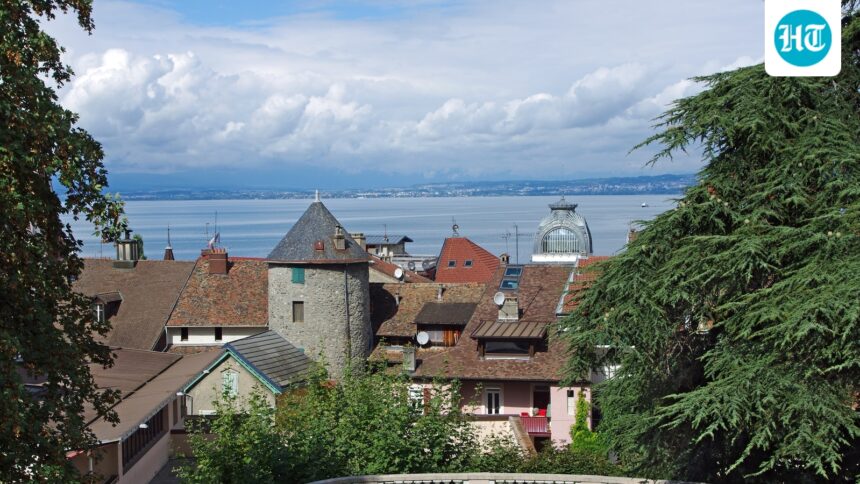
What do the Holocaust, a global bottled water brand, and the just-signed Iran-US peace deal have in common? The small town of Evian-les-Bains, on the shores of Lake Geneva in France, became the scene of all three of these cities. It hosted the Evian Conference in 1938, in which 32 countries participated, but only two countries – the Dominican Republic and Costa Rica – agreed to receive Jews who were forcibly evacuated from Nazi Germany by Adolf Hitler. The United States refused to increase its quota of Jewish immigrants from 10,000 to 30,000, and a few other Western countries also refused to increase their numbers.

Evian was a small village until the 1790s. Blessed with numerous natural springs and surrounded by Alpine forests and mountains, the city became a refuge for aristocrats fleeing the Auvergne and the French Revolution. Count Jean-Charles de Liser stayed in Evian from June 1790 to September 1792 at the house of his friend Gabriel Cachat and drank the local water every day. Within three months, he noticed that the pain caused by kidney stones had disappeared. Tests followed, and it was declared that water was useful for treating kidney and bladder problems. In 1809, a company was established to market the “magical” waters, and the city quickly developed into a luxury spa destination for the rich and famous. By the beginning of the 20th century, Evian les Bains had gained a global reputation for wellness, and the Hôtel Royal (venue of the 2026 G7 Summit) in particular had become the preferred residence of figures such as the Indian ruler Jagatjit Singh, the Maharaja of Kapurthala of France, King George V of the United Kingdom, King Fuad I of Egypt, and the Aga Khan III.
Evian Conference, 1938
After the Nuremberg Laws were enacted in 1935, Jews were stripped of German citizenship and systematically expelled from Germany and German-occupied Austria. They were left stateless, like many Rohingya today. Globally, Jews faced overt and covert hostility in a world still shaped by pre-modern religious and racial prejudices. Britain’s colonial power was on the decline, and in a desperate attempt to hold on to it, the British looked away even as Nazism flourished, as did the Soviets. Under President Franklin Roosevelt, the United States was leading a nation recovering from the Great Depression and widespread unemployment, and similarly ignored signs of the impending Holocaust. Although the nine-day conference was organized at Roosevelt’s initiative, it was marked by his absence, with the United States being represented instead by his friend, businessman Myron C. Taylor.
Golda Meir, who later became Prime Minister of Israel in 1969 (and who remains Israel’s only female Prime Minister to date), was allowed to attend as a representative of British Mandate Palestine, but only as an observer with no right to speak at the conference. Besides internal fears and racial prejudices, what led to the conference’s stunning failure to develop a plan to provide refuge for some 500,000 Jews was the lack of cohesion and unity among the various Jewish factions. What Taylor wrote in his memoirs provides insight: “Expectations that Jewish organizations would present a stable plan for immigration were not fulfilled when they proved unable to agree among themselves.” In the end, only dictator Rafael Trujillo, keen to introduce a white element into the racial stock of the Dominican Republic, provided 11,000 hectares of land for Jews to settle. Of the approximately 800 people who accepted the offer, only a few remained, with most eventually moving to the United States.
Evian Agreements, 1962: France and Algeria
Algeria, across the Balearic Sea, was a French colony between 1830 and 1962. Algeria’s Muslim majority were subject to a discriminatory regime, the Indigenous Law, which required them to carry permits at all times, and was denounced for forcing them to abandon their Islamic beliefs. The Algerian people fought for France during World War II. Once the war was over, the Algerian national movement demanded freedom, like movements in other colonies, including India.
However, under pressure from the large French settler community in Algeria – the Pieds-Noirs – the French government refused to relinquish control of Algeria. This led to the outbreak of armed guerrilla warfare by the Algerian National Liberation Front on 1 November 1954, a day now known as Toussaint Rouge (All Saints’ Red Day). By 1958, the war had helped bring down the Fourth Republic and caused widespread damage to France’s civilian and military infrastructure, both in metropolitan France and in Algiers. Circumstances were changing, and French public opinion increasingly favored a peaceful solution. In 1959, Charles de Gaulle returned as president of the Fifth Republic and paved the way for a negotiated settlement. This historic conference was held in Evian in 1962 and concluded successfully with the Evian Accords, which ended the war and formalized Algeria’s status as an independent state.
Between the failed conference of 1938, which effectively left Jews to their fate in Nazi Germany, and the recently concluded US-Iranian peace agreement, which brought a sigh of relief by reopening the Strait of Hormuz, Evian – the bottled water brand – also evolved. It was acquired by French multinational Danone in 1967 and has since held a prominent position in the global bottled water market. It remains among the most prestigious brands in its category, dating back to the time when the Maharaja of Kapurthala imported truckloads of Evian water into his kingdom. “…They’re selling more Evian water than they can bottle,” Ronald Howden wrote in Forbes. “No, the water won’t dry up — they’re using at most 10 percent of what’s in the rocks. But they’ve literally run out of bottle capacity.”
(HistoriCity is a column by Valai Singh that tells the story of a city featured in the news, by going back to its documented history, legends and archaeological excavations. The opinions expressed are personal.)