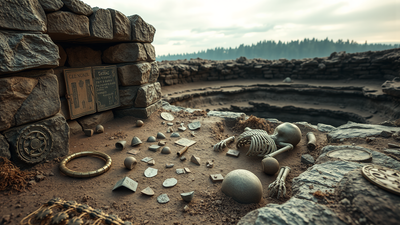
A routine survey ahead of the construction site of a new solar park in central Germany has turned into one of the most important Celtic archaeological discoveries the region has seen in years.
Near the town of Bad Camberg in the German state of Hessen, archaeologists have unearthed a more than 2,000-year-old burial chamber belonging to a high-ranking member of the Hunsruck-Eifel culture, an Iron Age Celtic community that once flourished across parts of present-day Germany. The tomb contains gold rings, weapon fragments and an imported Etruscan jug, along with metal fittings from a two-wheeled chariot, says government archaeologist Udo Riker, confirming the long-suspected presence of a local Celtic elite.
X-rays of the surrounding soil indicate that more artifacts remain buried and undisturbed.
How a solar park survey led to the discovery of a Celtic grave
The discovery came about almost by chance. District archaeologist Kai Mockenberger has ordered a routine geomagnetic survey of the planned solar park site near Bad Camberg, in the Limburg Weilburg district, as a precaution before construction begins. According to the official statement issued by the Hesse State Office for Monument Conservation, the survey revealed unusual lines and circular patterns in the ground indicating a structure much larger than expected.
What followed was the excavation of a previously unknown princely grave dating from the early La Tène period, in the mid-first millennium BC, making it the first Celtic elite burial ever documented in the Taunus area.
What archaeologists found inside the Celtic tomb of Bad Camberg
Inside the burial chamber, researchers found numerous gold ornaments that were described as simple but sturdy, along with the remains of weapons and a beaked bronze jug imported from the Etruscan lands in what is now Tuscany.
According to the Hesse State Heritage Authority, Professor Udo Rieker, the state’s chief archaeologist, said the Bad Camberg tomb allows researchers to confirm the previously assumed presence of a local Celtic elite, drawing clear parallels with other known princely burials in Central Europe, including the famous Celtic prince of the Glauberg site elsewhere in Hesse.
The collection of artefacts identifies the deceased as a high-ranking figure of his time, although the tomb artifacts of Bad Camberg are relatively simpler than those of Glauberg.
Why does the two-wheeled chariot make this burial so rare?
What distinguishes this grave is the presence of a two-wheeled cart buried next to its owner. Archaeologists found two pieces of wheel hub, hub cap fittings made of non-ferrous metals, and iron tire fittings, indicating that the Celtic warrior was buried with his chariot. According to Smithsonian Magazine’s coverage of the discovery, only three similar chariot burials have been documented anywhere in Hesse, and none of them match the quality of the artifacts discovered at Bad Camberg.
Conservators studying the wheel fittings believe the wheels themselves were probably 1.2 meters long, and were likely removed and placed upright on the wall of the burial chamber, with the hubcaps and hub fittings that may have once sparkled a reddish-gold colour.
What the Etruscan Beaked Jug reveals about Celtic trade networks
The presence of an Etruscan beaked jug, known in German as a Schnabelkan, among the grave goods is of particular interest because it indicates long-distance trade contacts extending from central Germany to the Etruscan lands in what is now Italy.
These imported vessels were considered luxury items among the Celtic elites of the Iron Age and are usually found only in the wealthier burials. Hesse State Minister for Culture, Christoph Degen, noted that the Bad Camberg discovery expands on the picture created by previous discoveries such as the Glauberg, offering a new insight into the social elites, craftsmanship, long-distance contacts, and burial customs during the Late Iron Age in the region.
What comes next for the Celtic Prince of Taunus
Only a small part of the burial site has been excavated so far. Archaeologists and restoration specialists are now examining the components of the recovered chariot and soil blocks at the State Office for the Conservation of Monuments in Wiesbaden, and according to the Hesse Heritage Authority, X-ray and CT scans of soil blocks already removed from the site indicate that there is more funerary property still to be interpreted and uncovered. The researchers hope that detailed analysis using modern scientific methods will provide new insight into Iron Age social structures, crafts and burial customs across the wider Celtic world, building on the image first drawn by the famous princely tomb at Glauberg, also in Hesse.