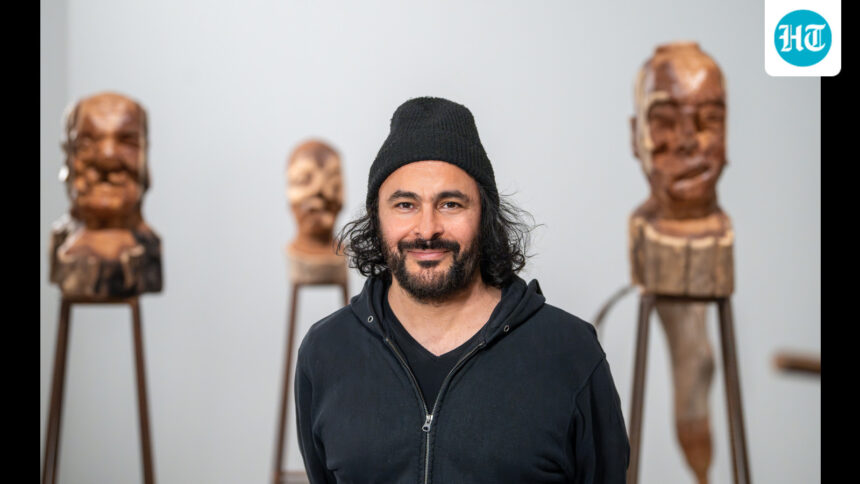
Venice: The Kochi-Muziris Biennale has announced its next curator: French-Algerian artist Kader Attia will be the first non-Indian to lead the only event of its kind in India.

Attia, who curated the Berlin Biennale in 2022, won France’s prestigious Marcel Duchamp Prize in 2016, and is currently exhibiting at the Venice Biennale for the second time, will curate the seventh edition of the Kochi-Muziris Biennale (KMB), in 2027-2028. (The sixth edition recently concluded, having been held from December 2025 to March 2026.)
The announcement was made by Jitesh Kallat, on behalf of the Kochi Biennale Foundation, on the sidelines of the pre-opening events of the Venice Biennale on Friday.
Attia, 55, has works in the permanent collections of the Center Pompidou in Paris, the Tate Modern in London, the Museum of Modern Art and the Guggenheim in New York. Among his most notable works is “Ghost,” a large installation featuring hundreds of kneeling bodies wrapped in aluminum foil, highlighting themes of societal silence and social and political erasure. Born to Algerian parents and raised in France and Algeria, his works tend to investigate the impact of Western modernity and colonialism on non-Western cultures.
HT spoke to Attia moments after Friday’s announcement, about his thoughts for the upcoming edition of KMB, his views on the evolving role of art, and his love for Kochi.
Speaking about what excites him most about his new role, Attia said: “I think I can sum it up in one word: The Kochi Biennale is the future.” Having appeared there as an artist in 2014, and lectured there at the recently concluded session, he added that a biennale that invites artists to be curators in each session, year after year, as KMB does, “understood everything about the role and essence of a contemporary art event.”
“I believe, for example, that the challenges we experience today, whether political or logistical, can be more easily discussed between the artist working as a curator and the participating artist,” he added. “It takes artistic sensibility and flexibility to appreciate difficult contexts and adapt to the economics of means.” “I come from a family that didn’t have a lot of books and art materials” (Attiya’s father was a construction worker, his mother was a housewife), “but I used to make my own games. I believe that creativity is not tied to things. It only means inspiration.
In a public speech given as part of the announcement event in Venice, Attia said one of the reasons he was excited to take on the role of coordinator was because of his love for Kochi. What does he like about the city?
“It’s amazing how you get direct feedback from locals as an audience at KMB,” he told this reporter. “In many biennales, after the opening days, you may not find many people attending. But Kochi receives a lot of viewers throughout its duration. I am happy to see many families with young children also coming here to see and interact with contemporary art. This tells you that the team behind the biennale has built something lasting.”
Kochi as a city also has an incredibly porous culture. Attia pointed out that, as is the case in certain cities around the world – Rome, London, Delhi and Venice itself – there is an ongoing, ancient and significant cultural exchange with the world. “The energy there is incredible. I admire how secular and layered it is.”
As for his plans for the biennale itself, the artist said he would like the context to be Kochi’s multiculturalism and its multi-layered accumulation of influences from around the world. “As a port city, constant movement has also shaped the shape of the city over the centuries. I would like to build the event on that foundation.”
He also realizes the need to invent a new artistic language. He added: “The world is changing very quickly and we must evaluate these changes fairly. Therefore, I would say – although I like technology, when it is used rationally – the problem of technology must be addressed as well.”
The Biennale can honestly address and discuss other challenges of our time as well. “Ultimately, there are few areas in society where one can introduce new ideas in a subtle way, and art is one of them; it is a vital field,” Attia said. “This is the focus of my practice and will serve as an organizing lens through which to view KMB.”
(Ridhi Doshi has been reporting from the Venice Biennale, which opens on Saturday and runs through November 22.)