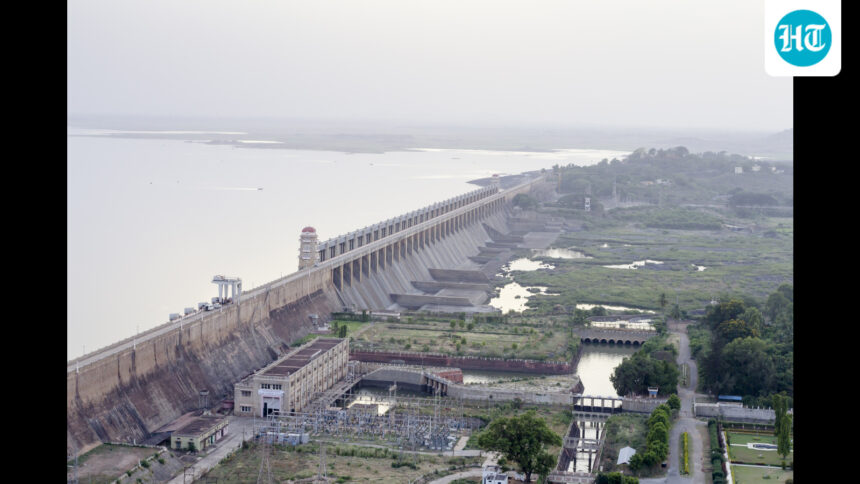
The financial year 2025-26 was a watershed moment in Karnataka’s long and storied hydropower journey. For the first time, the state’s strategically located hydropower stations – four each in Charvathi and Kali river valleys, two each in Varahi and Kaveri valleys, one in Krishna valley and one on Tungabhadra river – generated a record 15,509 million units of power. In an era when clean energy has become a currency, this was an excellent achievement, especially since some of these plants are among the oldest in the country.

The journey of hydropower in Karnataka began with the commissioning of the Shivanasamudra Hydropower Project on June 30, 1902, 124 years ago this month. Technically, this was India’s second hydropower project – the first, with a capacity of 130 kilowatts, came at Sidrapung in Darjeeling in 1898 – but with its original capacity of 4,320 kilowatts (today, 42 megawatts) propelling it to the status of Asia’s largest hydropower station at the time, Shivanasamudra was a different beast entirely.
The visionary trio of the Queen of Mysore, Maharani Kempananjamini, her minor son, Krishnaraja Wadiyar IV, and Dewan K Seshadri Iyer, have been lauded for the political support they have given to the Shivanasamudra Hydel project. However, as usual, the engineers behind the project have been largely forgotten. One of these brave people was the Royal Canadian Engineer, Captain Alain Chartier Joly de “Loupo” Lotbiniere.
The immediate reason for exploring the potential for electricity generation in Mysore was rooted in economics. To the north-east of Bangalore, Kolar was historically rich in gold. In 1880, the British mining company John Taylor & Sons obtained a lease to mine gold professionally in the area. But by the 1890s, the Kolar mines, deeper than any in the world and prone to filling with water, began to overwhelm engineers. It was clear that a greater power – electricity, which had been in vogue since 1882, when T. A. Edison opened the world’s first commercial power station in New York – was needed and had to be harnessed.
At about the same time that Edison was constructing his power station, Captain Lobo was graduating from the Royal Naval College in Kingston, Canada. In 1886, he joined the Royal Engineers and traveled to India. Once here, he was involved in numerous projects, including the massive project (completed in 1892) to bring water to Murree (alt. 2291AD; in today’s Pakistan). Soon after, at the request of the Mysore government, which had been shocked by the devastating drought of 1876-78, and was anxious to solve a similar problem of drinking water in Bangalore (alt. 965 AD), Lobo arrived in our fair city. In 1894, through the pioneering efforts of engineers like Lobo, the Chamarajendra Waterworks in Hesaraghatta was commissioned, bringing sweet Arkavathi water to Bengalureans as part of the city’s first piped water supply.
In 1899, Captain Lobo was appointed Deputy Chief Engineer at Mysore, where he reviewed the 1894 proposal to generate electricity from the Shivanasamudra Falls. Inspired by Tesla-Westinghouse’s Niagara Falls Power Station (1895), Lobo presented a practical version of the old proposal, demonstrating the commercial benefits to the kingdom of providing energy for gold extraction. The proposal was approved, and Lobo was immediately sent on a “study tour” to Britain and America at a per diem of £1.
In England, Lobo formed an expert committee for the project, and invited bids from the British electrical company Westinghouse, the Swiss companies Braun Boveri and Oerlikon, and Edison’s own General Electric. In America, he toured several hydroelectric projects, including the Niagara Project. Finally, General Electric obtained the contract to supply electric generators. Over the next two years, tons of heavy machinery arriving at Mormugao port were transported to Maddur by rail, and thence to Shivanasamudra, via kachcha roads, by Mysore’s daring bulls, horses and elephants. Until the largest hydroelectric power station in Asia was finally built.
(Rupa Pai is a writer who has had a long-lasting love affair with her hometown of Bengaluru)