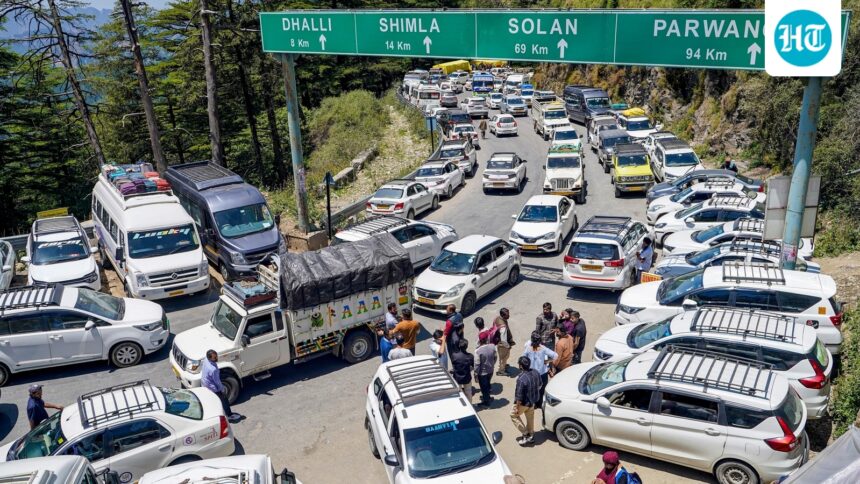
About 15,000 vehicles entered Shimla between May 1 and June 15, as police adopted a five-point strategy to tackle the summer tourist rush.

A senior police official said that traffic management measures include deploying additional force, strict monitoring, mapping alternative routes and encouraging public transportation.
With schools closed for summer vacation, tourists are heading to destinations across Himachal Pradesh. The heavy influx of refugees has caused frequent traffic jams along highways and linked roads.
According to hoteliers, the average occupancy at tourist accommodations across Himachal Pradesh last week was 60 to 70 per cent during weekdays, rising to 80 to 90 per cent on weekends.
“More than 15,000 vehicles have entered Shimla in the last 45 days and the police have come up with a five-point strategy to deal with the rush,” Superintendent of Police Gaurav Singh told PTI.
He said managing the influx of tourists would not be a problem if internal bottlenecks were addressed.
Superintendent of Police Gaurav Singh said the traffic strategy includes deployment of additional force, interceptor vehicles and personnel on bikes to regulate traffic, monitoring by gazette officers, use of alternative routes, and encouragement of public transport and awareness.
He said the breakdown of heavy vehicles such as buses or trucks on the KART road, the lifeline of the mountain town, is a major problem as they often cause long traffic jams. Bringing a crane on a single-lane road to tow a disabled vehicle is a time-consuming process, Singh said.
He said that three cranes were stationed in different sectors to quickly deal with such situations.
Five vehicles broke down on Tuesday, he said, adding that private buses stopping at unauthorized points often obstruct traffic flow. Idle parking is another issue being dealt with.
The traffic management strategy includes the deployment of 210 additional police personnel and home guards, in addition to volunteers. Traffic personnel were also deployed at main parking lots to ensure easy entry and exit of vehicles and prevent congestion.
The number of bicycle traffic personnel has been increased to 32 personnel to quickly respond to traffic-related situations. Interceptor vehicles are operated in several areas to enforce traffic rules and ensure prompt action against violations.
Shimla city has been divided into five sectors to ensure better traffic control and regulation. Each sector is assigned an official whose primary responsibility is to ensure smooth movement of traffic within the respective sector.
Furthermore, tourists are encouraged to use alternative routes to save time and reduce congestion within the city. Travelers heading towards Cauvery, Narkanda, Theog and Kinnaur are advised to use the Shoghi-Mehli bypass route.
Using the road reduces traffic pressure within the city and saves travel time, the official said, adding that at present, about 800 vehicles are diverted through the bypass road every day.
Shimla Police is also creating and sharing awareness and educational videos on social media platforms to provide traffic related information to tourists and the public.
To encourage the use of public transport, large vehicles such as commuters and other public transport have been allowed to operate on the KART route to reduce dependence on private vehicles and ease congestion.
Highlighting the effectiveness of the plan, SP Singh said that during the peak summer tourism season between April and June, there was no major traffic congestion in the region – especially in Shimla city and its environs.
He said that huge traffic jams were reported last year on the peripheral roads leading to Shoghi, Kufri and Bilaspur, besides the main city of Shimla.
Shimla Police, while warmly welcoming tourists, appealed to visitors and residents alike to follow traffic rules, use designated parking areas and adhere to alternative routes to ensure smooth flow of traffic in the tourist hotspot.