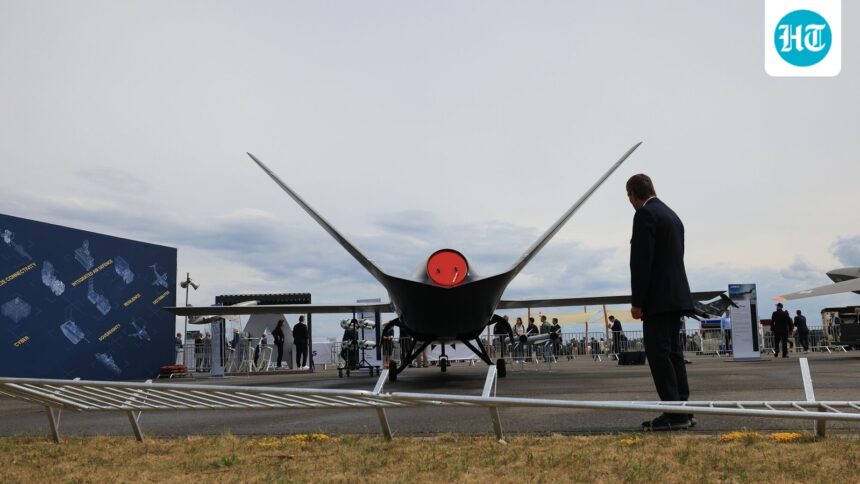
The Indian Army’s deployment of 106 jet-powered suicide drones, and the Indian Air Force’s separate move toward indigenous production of similar weapons, have put the spotlight on loitering munitions – cheap, precise unmanned aerial vehicles that have reshaped modern warfare.

What are kamikaze drones?
The origins of the term kamikaze go back to World War II, when Japan assigned pilots to fly their planes directly into Allied ships in what were called suicide missions. More than eight decades later, kamikaze describes a class of drones, or loitering munitions, that identify their targets and then collide or destroy them.
According to the Indian Ministry of Defense Production, these drones have two tactical advantages. They can respond quickly without having to place high-value military assets in an area beforehand.
Because they are primitive, and therefore cheaper, any losses in combat are not as painful for the army. These drones also allow flexibility in operations. Drones can be pre-programmed to strike a target, although strikes can also be modified or canceled mid-flight.
Launched in swarms, these drones can overwhelm enemy defense systems. According to the Indian Council of Global Affairs, “Powerful states are adapting to low-cost innovations, such as drones, loitering munitions, and electronic warfare systems.” This is due to economic and cost-benefit considerations.
Watch the Iranian woman meet the American Lucas
Defense analysts say the Iran-designed Shahed 136 was key to Tehran’s offensive against US military installations across West Asia after the US and Israel launched their attack in late February.
According to Reuters news agency, the cost of producing the Shahed 136 aircraft is approximately $20,000.
The Patriot defense system missiles used by the United States to intercept Iran’s Shahed missile in West Asia cost about $4 million per unit, the US Research Council on Foreign Relations said in an analysis published in March earlier this year.
The United States recognized this disparity before the conflict in West Asia. In 2025, Washington began developing similar drones, manufactured by Arizona-based Spekteworks, to counter the Shahed class of weapons. Within eight months after its unveiling at the Pentagon, according to Reuters, the LUCAS system, or Low-Cost Unmanned Combat Attack System — built at a cost of about $35,000 per unit — was put into action in West Asia.
Before West Asia
The record of the Shahad battlefield predates conflict in West Asia. The Wall Street Journal reported in June 2025 that Russia has deployed witness drones on a large scale, routinely launching dozens of such drones simultaneously.
Ukraine, which has been fighting Russia since 2002, eventually responded by increasing its domestic production of drones and developing low-cost interceptor drones to hunt down martyrs, the Associated Press reported. Kiev has also adjusted its defense against Russian drones and electronic warfare, according to an analysis by the Council on Foreign Relations published last week. For example, in addition to traditional air defenses, the Ukrainian Air Force also uses fiber-optic cables to direct attack systems in one direction to protect against jamming, and deploys nets to trap drones approaching key Ukrainian supply routes.
Ukrainian President Volodymyr Zelensky said in March this year that the US Pentagon had contacted Kiev for assistance in confronting Iranian drone technology.
Agnivej Hindi: What we know
India’s response to the proliferation of these drones in active conflict is the Agniveg – officially, Jet Based Peacekeeper – manufactured by local company SMPP.
At an event marking the delivery of 106 Agniveg helicopters to the Indian Army last week, Union Defense Minister Rajnath Singh said that in modern warfare, “even small forces can inflict huge losses with their small but dangerous weapons and new tactics.” Singh had raised the same concerns in March, stressing the strategic importance of drones and their anti-drone capabilities.
Agniveg is designed to strike high-value targets deep into enemy territory. Its jet engine gives it reach and speed. In user tests, its operating range reached 180 km.