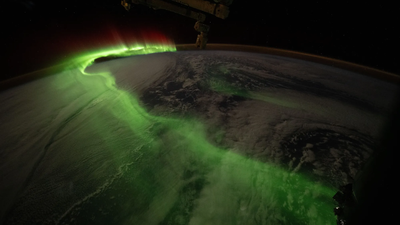
For most people, the southern lights are a rare sight to behold from the most remote corners of the Southern Hemisphere. As for astronauts orbiting hundreds of kilometers above Earth, this phenomenon appears from a completely different perspective.
A recent time-lapse image taken by NASA astronaut Jessica Meir provided the world with a stunning view of Aurora Australis as luminous green streaks stream through Earth’s atmosphere beneath a SpaceX Dragon spacecraft. The footage reveals the scale, movement and beauty of one of nature’s most powerful light displays, transforming a familiar astronomical event into something almost otherworldly. In addition to its visual appeal, the spectacle provides a vivid reminder of the dynamic relationship between the Sun and Earth, as streams of charged particles interact with our planet’s magnetic shield to create stunning displays visible from Earth and orbit.
A NASA astronaut reveals an unusual view of the southern lights hovering above Earth from space
The southern lights, scientifically known as Aurora Australis, occur when charged particles from the Sun collide with gases in the Earth’s upper atmosphere. According to NASA Earth Observatory:“When energetic particles from space collide with atoms and molecules in the atmosphere, they can cause the colorful glow we call the aurora.”These particles follow the Earth’s magnetic field toward the polar regions, where they interact with oxygen and nitrogen atoms, producing bright colors that can include green, red, violet and pink.
NASA points out that green auroras are usually associated with collisions involving oxygen atoms. This phenomenon is the southern counterpart of the aurora borealis observed in northern latitudes.From orbit, astronauts view the aurora from above rather than from below, allowing them to see enormous curtains of light stretching across the Earth’s curvature. This unique observation point reveals the true scope of geomagnetic activity unfolding along the planet’s magnetic field lines.
Jessica Meir This stunning satellite image of Earth shows the Earth alive with color and movement
NASA astronaut Jessica Meir recently took to the Describing her experience on social media, she wrote:“Unlike previous aurora borealis I’ve seen, this one danced and made its way directly below us, putting on a spectacular show. I’m in awe of this evocative phenomenon.”
The footage captures luminous green waves rippling through the atmosphere, creating the impression of a living river of light flowing around the planet. In contrast to ground-based observations, the orbital perspective reveals how auroral activity forms a wide ring around Earth’s magnetic poles.NASA has long documented similar views from the International Space Station. In one of the official descriptions of the image, the agency noted that the astronauts photographed Aurora Australis as it orbited approximately 265 miles above the southern Indian Ocean.
These observations provide scientists with valuable information about space weather and the interaction between solar activity and Earth’s atmosphere.
How does solar activity create some of the most spectacular aurora displays in years?
Scientists are currently observing increased solar activity as the Sun advances through the zenith phase of its approximately 11-year solar cycle. Increased solar storms and coronal mass ejections send larger amounts of energetic particles toward Earth, often resulting in stronger and more widespread auroral displays.NASA explains that the aurora offers more than just visual beauty. It is clear evidence of the relationship between the Earth and the Sun. The agency says:“The aurora shows the connection of our atmosphere to the heliosphere, which is the solar system-wide atmosphere of the sun.”As solar activity remains high, researchers expect more opportunities to observe exciting auroral events from Earth and space. Photographs taken by astronauts continue to provide a rare perspective, allowing people to appreciate the scale of these interactions beyond the limits of ground-based observation.For a few moments, Jessica Meir’s camera turns a scientific phenomenon into a natural work of art, revealing Earth not as a static world beneath our feet, but as a living planet wrapped in streams of cosmic light.