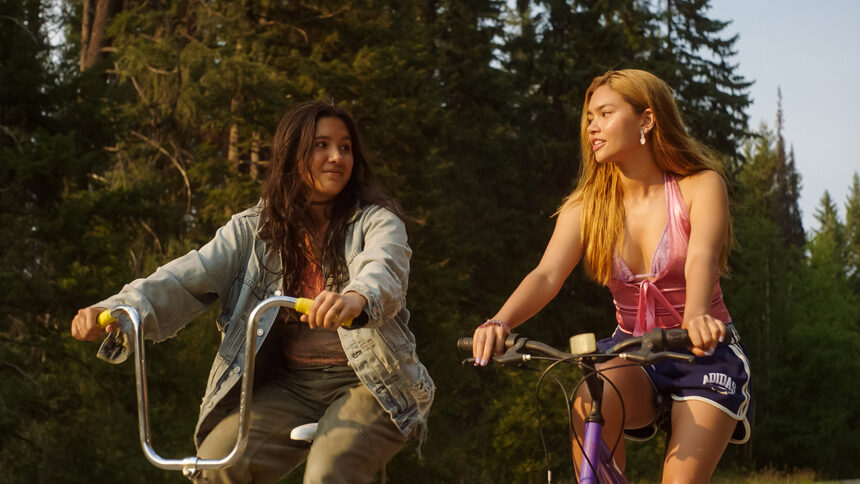
To paraphrase “Girls Like Girls,” the 2015 song by singer-songwriter Hayley Kiyoko that now inspired Girls like girlsthe debut feature film from writer-director Hayley Kiyoko, there is “nothing new” to the story at its core. There’s nothing unheard of about this premise, which chronicles the attraction between two teenage girls. There is nothing radical about the filmmaking, filled with intimate close-ups and bathed in summer light. There is nothing within it that is likely to astonish the viewer by its unpredictability, or astonish them by its originality.
But the fact that teenage love is “nothing new” has not prevented every generation of teenagers in human existence from feeling, however, as if they have stumbled upon something unprecedented. It’s that experience – discovering something you didn’t know you didn’t know, and finding yourself in the process – that Girls like girls It is depicted so completely that it seems, despite its familiarity, like a small advertisement.
Girls like girls
Bottom line Full of tenderness.
release date: Friday, June 19
ejaculate: Maya da Costa, Mira Molloy, Zach Braff, Levon Hawke
exit: Hayley Kiyoko
Screenwriters: Hayley Kiyoko, Chloe Okuno, Stephanie Scott
Rated R, 1 hour 34 minutes
The plot is so simple that it doesn’t even count as a plot at all for long stretches. In the summer of 2006, somewhere in the Pacific Northwest—press notes indicate Oregon, but the stray “U” in a convenience store sign advertising new soda flavors points to Canada, where the movie was actually shot—shy, sad Collie (Maya da Costa), who has just moved in with her father (Curtis, played by Zach Braff) on the outskirts of town, meets Sonia (Meera Molloy), a cheerful girl jogging with her father. Popular Mobilization Forces.
Despite their opposite personalities, the connection is instant. In a very short time, Sonia and Colley spend every spare minute of the day biking the tree-lined streets, playing in Sonia’s pool, or changing each other’s looks, and every evening chatting deep into the night from their own bedrooms. (Production designer Lindsay Moran did such an amazing job reproducing the sights and sounds of the mid-2000s as they would have been experienced by a bored teenage girl, and I, a millennial, felt the need to run to the nearest CRT monitor when Cooley’s computer beeped with the signature bubble AOL Instant Messenger.)
Girls like girls He excels at capturing the stubbornness of young love, from the allure of a crush’s closeness to the oppressive weight of rejection. Colley may not be much of a talkative person, but da Costa conveys a lot simply by the way she looks at Sonia, so dazed by the longing she feels that it takes real physical effort to avert her gaze. DP Sonja Tyspin’s camera follows in her footsteps, lingering on every strand of Sonja’s hair or flutter of her fingers against Jessica Rose Weiss’s dreamy score. (Somewhat surprisingly for a film directed by a musician, Kyoko’s own songs are used sparingly throughout the film.)
But da Costa is only half the equation. As Sonia’s initial warmth (she “likes strays,” as her gruff boyfriend, played by Levon Hawke, quips) gives way to deeper emotion, Molloy’s performance also becomes more complex and layered. If her attraction to Collie—her first real crush, we think—represents her coming of age, it also highlights the innocence of youth. Hesitation creeps into her usually confident personality. It’s one thing to casually throw your legs over a friend in the backseat of a crowded car when the energy is platonic. It is another much more dangerous thing to do when you begin to realize that it is not so.
Girls like girls It avoids the details that make up the rest of the girls’ lives, offering only vague hints regarding Sonia’s relationships with the other friends who wander in and out of frame, Collie’s social life in her old hometown, or their goals and passions outside of each other. But the chemistry between Molloy and Da Costa, easy and inevitable like nature, is more than strong enough to make up for those limitations. When they are together, there should be no other meaning because nothing else matters.
Of course, the course of true love doesn’t run smoothly in movies, because there wouldn’t be a movie if it did. Refreshingly, the screenplay (credited to Kiyoko, Chloe Okuno, and Stephanie Scott) refrains from throwing some horrific external obstacles their way. Instead, the biggest obstacle for girls to achieving happiness comes from within. When their friendship turns romantic, Sonia – the type to move on and unwilling to embrace this strange relationship for what it is – begins to distance herself.
Colley’s subsequent heartbreak is as cruel as her previous infatuation, and is further exacerbated by an irrelevant grief. As is revealed in bits and pieces, she has come to stay with her semi-estranged father after the death of her beloved but unstable mother; Sonia’s abandonment is thus the latest blow to a girl already struggling to recover from recent trauma. But despite Braff’s sweet, quiet performance as a man who earnestly wants to be there for his daughter but doesn’t quite know how, their familial bond is never fully fleshed out enough to be more than a footnote in Cooley’s romantic drama.
Maybe this is how it should be. First love has a way of swallowing its participants whole, and that part, Girls like girls He gets it exactly right. Beautifully shot and tenderly acted, putting all its faith in pure emotion rather than overly complex twists and turns, this is the kind of gem that feels all the more special when it appears, at first, so ordinary.