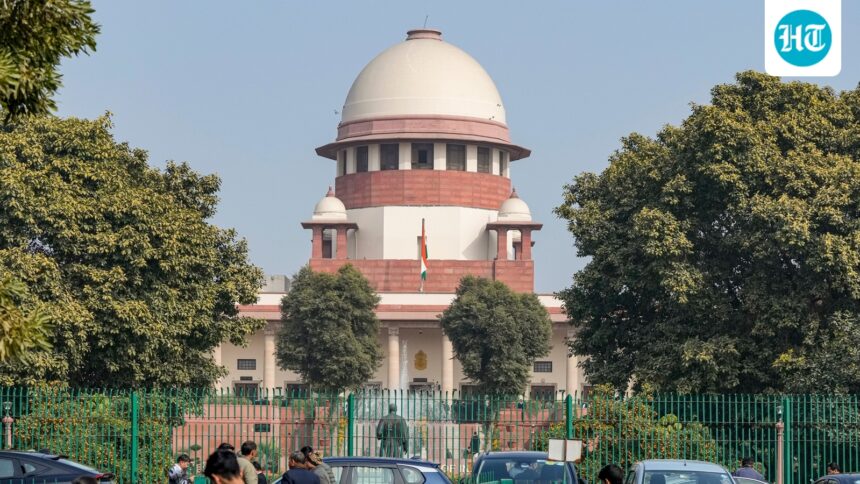
The Supreme Court slammed the State Bank of India and other banks for subjecting ordinary borrowers to what it called “borderline harassment” while processing small loans even while remaining “informal” in imposing sanctions on huge loans to larger entities that often end up defaulting.

A bench of Justices Ehsanuddin Amanullah and R Mahadevan said it had increasingly observed a worrying pattern in the banking sector where strict scrutiny was allocated to individuals seeking loans for their personal needs, while loans of large value appeared to be sanctioned with inadequate assessment of ability to repay.
“We point out that it has come to the attention of the court that banks in general, including respondent No. 1-SBI, are informal in giving loans of huge amounts to larger entities but at the same time are very demanding of small loans where common people come for personal requirements, subjecting them to more stringent conditions and tedious process, which may amount to borderline harassment, in some cases,” the bench said in its recent order.
While rejecting the petition filed by a Haryana based company which defaulted on its payment $A loan worth Rs 8.09 lakh crore was taken from SBI, however the court expressed strong dissatisfaction with the performance of the banks and urged India’s largest bank to reconsider its policies.
The bench had specifically called on the SBI to consider making the loan process “easier and fairer” for ordinary citizens and those belonging to weaker economic sections.
“It is worth noting that we are in no way proposing to relax the rules and requirements for loan facilities…but the procedure adopted can certainly be made easier and fairer for the loan seekers/applicants and thereafter in the recovery phase as well,” the court said.
The bench also suggested that lending and redemption policies should be redesigned to benefit those living at the lower end of the economic spectrum.
“With regard to benefits/incentives, the policy should be appropriately formulated/classified such that it provides maximum benefit to people who are at the bottom of the social/financial strata,” he added.
In a notable move, the bench asked Additional Solicitor General Archana Pathak Dev, representing the SBI, to convey the court’s concerns to the bank “at the appropriate level”.
These observations came during a dispute involving a company that obtained a loan $8.09 lakh crore from SBI in 2019 but defaulted almost immediately. According to the court, the borrower failed to repay even a single installment after availing the loan facility and the account was classified as non-performing asset (NPA) within months.
The court found the borrower’s conduct indefensible, describing his offer to repay only the principal after six years as “too little, too late.” IT then refused to interfere in the proceedings initiated by SBI under the SARFAESI Act to seize the secured assets of the borrower, even as it granted the company a two-week final protection to pursue remedies before the Debt Recovery Tribunal.
At the same time, the court wondered how sanctions were imposed on such a large loan in the first place.
“We have found that there was negligence on the part of SBI and its officials in granting/sanctioning a huge loan of $“We have paid Rs.8,09,00,000 to the petitioner company,” the court said, adding that the immediate default of the borrower was a “clear indication” that proper assessment of repayment capacity may not have been made.
These observations assume importance against the backdrop of some of the largest bank defaults in India over the past decade.
Public sector banks have grappled with a series of high-profile corporate loan failures that included companies such as the now-defunct Kingfisher Airlines, which left behind bank receivables exceeding $9000 Crores, and $13,000 crore fraud involving Punjab National Bank. Infrastructure leasing and financial services collapse with debts overrun $90,000-crore defaults by groups like DHFL and Essar Steel also exposed serious weaknesses in credit assessment and risk assessment within the financial system.
However, the Supreme Court stopped short of issuing any guidance in this case, observing that a more relevant issue with specific facts may warrant judicial intervention in broader banking practices.
“While we register our dismay at such acts, we leave it to a more appropriate case where specific orders may be sought against such practices from banks in general, including respondent No. 1-SBI,” the bench said.
SBI’s defense focused on the borrower’s conduct rather than the bank’s lending practices.
Defending the bank’s actions, Dave said the behavior of the borrowing company speaks for itself as it failed to pay a single installment after taking advantage of… $Loan worth 8.09 Crores on commercial terms. She further noted that the company had already challenged the recovery proceedings before the Dispute Resolution Tribunal, where its securitization application was still pending, and urged the court not to interfere in the matter.