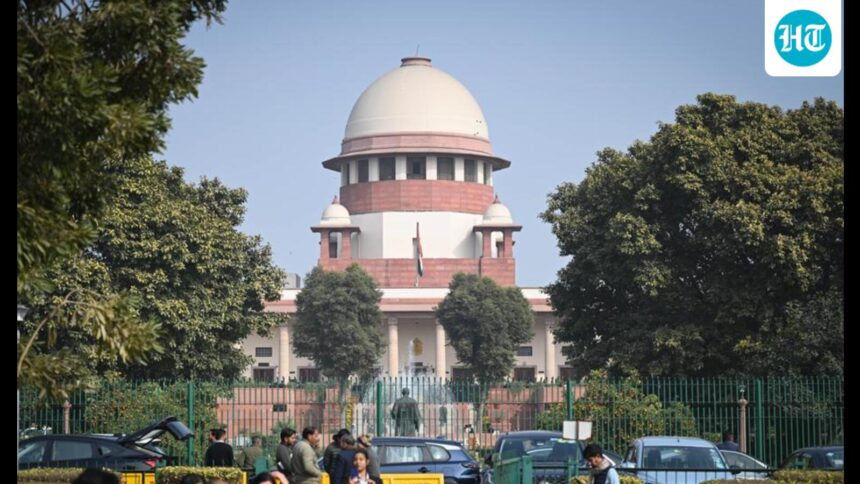
The Supreme Court on Monday stayed a June 4 order of the Himachal Pradesh High Court denying Members of the Legislative Assembly (MLAs) from voting as “ex-officio members” in the election of chairpersons and vice-chairmen of municipal corporations and nagar panchayats.

The state government appealed the order, arguing that it came in petitions challenging the constitutional validity of the Himachal Pradesh Municipal Act, 1994, which are still pending. She said the order deprived MLAs of exercising their right to vote in the middle of the electoral process.
“What the law does not provide, how can the court provide it with a judicial order?” A bench of Chief Justice of India Surya Kant and Justice V Mohana was asked to disapprove of the apex court’s order.
The Supreme Court made it clear that the votes cast by MLAs in the elections will be subject to the outcome of the proceedings in the Supreme Court.
Senior advocate Madhavi Divan, appearing for the state along with Additional Solicitor General Vaibhav Srivastava, said the 1994 Act was amended in 2000 to give voting rights to MLAs under the ‘ex-officio members’ category to elect chairpersons and vice-chairmen of urban local bodies.
Divan pointed out that the Supreme Court relied on the 2015 Himachal Pradesh election rules to indicate that the election of presidents and vice-presidents could only be done by the elected members. She explained that voting rights are only given to elected ex-officio members (MLAs), and not to nominated members. Only nominated members can attend the proceedings and participate in the discussions, Diwan said.
The state noted that a clarification has been issued confirming that MLAs have the right to vote for the election of chairpersons and deputy chairpersons of municipalities and nagar panchayats, recognizing the potential conflict due to the 2000 amendment and the 2015 rules.
The petitioners in the Supreme Court challenged the clarification and amendment of 2000. They filed an interim application in the Supreme Court to stay the operation of Section 10(3), which allows MLAs to have a say in the election of presidents and vice-presidents after the commencement of the electoral process.
This issue concerns a majority of nearly 49 municipalities and nagar panchayats. Among these, the president and two vice-presidents of two local bodies were appointed.