

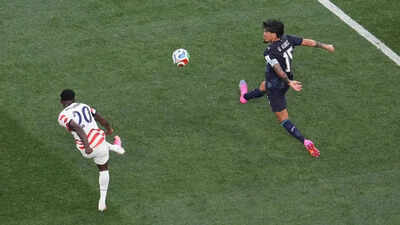
USA’s Folarin Balogun scores his team’s third goal against Paraguay during a World Cup Group D soccer match in Inglewood, California, near Los Angeles, Friday, June 12, 2026. (AP Photo)
TOI correspondent from Washington: There have been many heated debates in recent months about the US border, immigration, and naturalization. But one thing was clear in Los Angeles Stadium on Friday night in the United States’ 4-1 win over Paraguay in their World Cup opener: No one in red, white and blue will protest the bureaucratic decision made nearly 25 years ago to bar a pregnant woman from returning to England.Folarin Balogun, who scored twice on his World Cup debut, was born in Brooklyn to Nigerian parents after his pregnant mother was advised, while visiting her sister in America, not to return to Britain, where she was living at the time. In the more extreme corners of the MAGA world, that would make Balogun an “anchor baby” — born to someone visiting the United States. And on Thursday night, he was dubbed simply ‘Man of the Match’, the undisputed champion of a team that perfectly represents the beautiful, chaotic, boundless reality of modern football.
Balogun’s mother eventually returned to the UK when he was one month old. He then grew up in London, played youth soccer in England, and represented Monaco, pulling Nigeria down one sleeve and England down the other, before eventually deciding to play for the United States.There are few institutions better than exposing the absurdity of rigid nationalism in international football. The World Cup is a celebration of flags, anthems and tribal loyalties – organized by teams assembled from the glorious chaos of human migration.
The American team is a case study in this phenomenon.While Balogun’s journey has already become part of soccer folklore, Gio Reyna, who scored the fourth goal, was born in England while his American parents, former U.S. internationals Claudio Reyna and Daniel Egan Reyna, played there. Sergino Dest was born in the Netherlands to a Dutch mother and Surinamese American father. Yunus Musa represented England at youth level before moving to the United States.In other words, the American team looks suspiciously like America. This should not come as a surprise. The nation has spent centuries importing scholars, doctors, dreamers, strivers, eccentrics, entrepreneurs, and, on occasion, subversive strikers, strikers, and players. This beautiful paradox is not limited to the United States. Play any European powerhouse, and you’ll find teams packed with talent of African descent.
The French national team roster looks like a wonderful tribute to the sub-Saharan football pipeline, while half of Europe’s elite midfielders trace their lineage directly to Lagos, Dakar or Kinshasa.France won the 2018 World Cup with stars like Kylian Mbappe, whose father is from Cameroon and mother from Algeria, and Paul Pogba, who was born to Guinean parents. The England squad included Bukayo Saka, of Nigerian descent; Jude Bellingham, of African descent on his mother’s side; And many players whose family trees stretch across continents.
The modern football identity in Germany was shaped by players of Turkish, Ghanaian and Tunisian origins.
Football recruiters call it “talent scouting.” Anti-immigrant bigots call it… well, something less printable.But here lies the delicious contradiction. Many communities are increasingly concerned about immigration even as they jump to their feet to applaud the goals scored by immigrants and the children of immigrants.
The striker who buries the winner becomes “our boy.” An immigrant who is not a foreigner.Of course, football has not been completely immune from politics. The 2026 World Cup, co-hosted by the United States, Canada and Mexico, was a reminder that global tournaments do not take place in a diplomatic vacuum.Let us consider here the ongoing painful saga that the Iranian national team is experiencing. The bureaucrats subjected them to a harsh diplomatic war of words over visa approvals, forcing the team to abandon its planned training base in Arizona and move to Tijuana, Mexico.
Worse still, under restrictive visa conditions, Iranians are said to be required to enter and exit US soil on the same day as their matches – essentially treating elite international athletes like day laborers who must be out before sunset.Meanwhile, Omar Artane, who is set to become the first Somali referee to officiate at a men’s World Cup, was denied entry to the United States due to unspecified concerns about vetting, leading to his exclusion from the tournament.
FIFA confirmed that he will miss the competition. For a country hosting what is arguably the world’s greatest sporting event outside of the Olympics, this was not an ideal PR campaign. An unofficial World Cup slogan might be: “Please continue immigration control.
“Then again, perhaps football’s greatest gift is its refusal to fit entirely into ideological boxes. Balogun’s goals against Paraguay were not scored through immigration policy.
It was recorded by a talented football player whose life story passed through Nigeria, America, Britain and France. The beautiful game has always flourished because of such collisions between geography and identity. It’s a sport where a boy born in Brooklyn, raised in London and playing for Monaco can become the toast of Los Angeles.((Meanwhile, if the Americans suffer from excessive security aggression, the English national team suffers from its complete absence.
Before the Three Lions began their campaign against Croatia, Thomas Tuchel’s side fell victim to a classic Midwestern highway robbery. A transport van transporting the team’s equipment from their training camp in Florida to their base in Kansas City was ransacked. The thieves stole custom boots for Harry Kane and Jude Bellingham, tactical whiteboards, massage tables and almost every Championship ball in stock, leaving exactly one football behind.
Only football can produce a headline that includes balls lost before the first whistle blows.While local police have arrested two suspects, England is currently facing a hectic race to replace its bespoke equipment. It’s an absurdly chaotic start for the tournament favorites, proving that in the 2026 World Cup, whether you’re trying to get a visa, a referee across the border, or just a pair of shoes to Missouri, navigating the host country is the toughest match on the schedule.But in the end, the World Cup remains a delightful rebuke to the idea that humanity can be neatly sorted into discrete boxes. People move, families move, children are born while traveling, and careers cross oceans. Sometimes, as Balogun showed against Paraguay, they remind us that while borders may divide maps, football has a strange habit of connecting people – one glorious goal of helping migrants every time.