It was only a few months ago that I had my first full-time job in journalism, as a 24-year-old writer at a newspaper. New York Observer In 2013, when my boss informed me that I would be taking on a new responsibility: editing the newspaper’s provocative, irascible film reviewer, Rex Reed.
It was an unexpected mission that aroused terror and excitement. I was a relative veteran, still learning the basic mechanics of writing and reporting, and Rex, who died last month at 87 — well, his reputation preceded him. He was in his mid-seventies, and had enjoyed a distinguished career as a legendary critic and magazine writer, with a vivid resume of such luminaries as Ava Gardner, Tennessee Williams, and Warren Beatty in Respected It has been canonized as a classic of new journalism.
While I considered myself an old-timer and aspired to be a jazz critic—a music I knew Rex also loved—in truth, my new title didn’t come about simply because we were probably kindred spirits. He recently faced intense backlash over a scathing review in which he called Melissa McCarthy a “female hippopotamus,” among other criticisms that criticized her appearance, which he defiantly refused to disavow. Our editor, who had stood by Rex amid calls for his ouster, was too busy overseeing what was then a weekly print newspaper and a daily website to deal with the headache of regularly dealing with this stubborn but likable writer whom Nora Ephron once admiringly described as “a lewd, prying, quarrelsome man who sees with sharp eyes, writes with a mean pen, and succeeds in making us all voyeurs.”
So, the duty was passed on to me not only to manage the ego of the paper’s longest-serving contributor but to act as a kind of secret sensitive reader, scanning his copy for offensive words and phrases that could get him into trouble with an online audience that he undoubtedly considered irrelevant even in the age of cancel culture.
Although he didn’t know it at the time, I believe I was able to protect him from himself when I later discovered problematic language present in his copy that likely warranted scrutiny. I remember removing the phrase “savage Indians” from the review, for example. I felt like his penchant for “slut” was more of a calling. I usually err on the side of caution.
But as I quickly learned, when his reviews began appearing in my inbox every week in bold 20-point font, one of the biggest challenges in working closely with Rex for nearly three years was his growing anger and frustration at what he saw as a regrettable decline in the quality of modern cinema.
In my ongoing conversations with him, along with the scathing, desperate emails he regularly sent from his AOL address — many of which I saved to a Google Doc for posterity — Rex seemed to interpret the glut of mediocre films he had to endure in an endless series of hypnotic screenings as a very personal affront to the strict standards of taste, decency, and class — which he had cultivated in his travels through long-extinct old Hollywood.
“I have a lot of problems coming up with films,” he told me in one typically abrasive email, when I asked him to share his review schedule for the coming weeks. “There is a real dearth of anything decent to write about.”
“I don’t want to waste my time fighting copies trying to understand incomprehensible movies that idiots make,” he vented in another letter in which he urged the paper to let him write more theater criticism—a request our editor was happy to oblige. “So I will continue to push for some theatrical revisions to alleviate my torture.”
Rex was unaware of the strange image he had built. “I’m so afraid of getting a reputation as a scoundrel that I think I’m trying to find something—anything!—to be nice about,” he wrote to me after giving a positive review. “I wanted to give a nod to the actors.”
It felt appropriate to introduce me to Rex, who had never worked from observerHis offices were rarely visited, mediated primarily by phone and email in the initial period in which I found myself as his therapist.
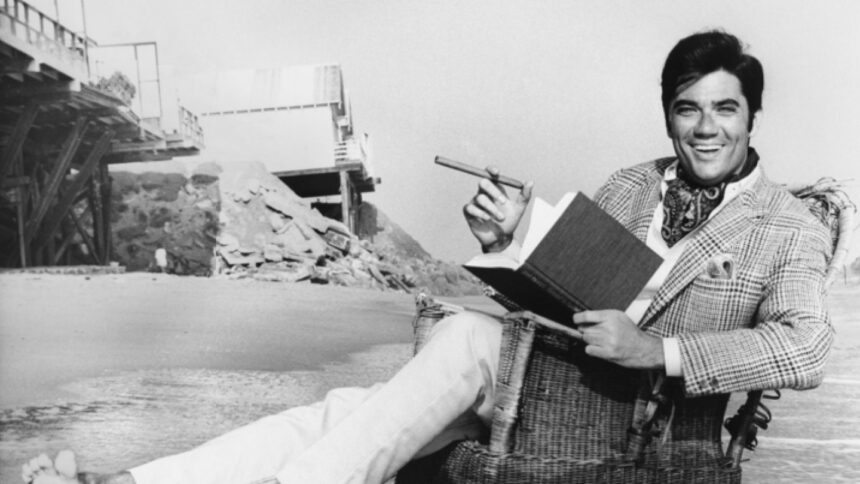
Although I was already familiar with some of his works, I immediately embarked on a deeper study, delving into them People are crazy herehis candid and delightful 1974 collection of celebrity profiles published before the entertainment industry was corrupted by gate-keeping publicists. I found his old appearances on Dick Cavett’s YouTube talk show, when Rex was a film critic vacation magazine. I was as struck by his nonchalant presence as by his jet-black hair, his jacket, and his jacket, which he called “Bill Plass’s little number.” I had come to regard him as a strange giant in the world of journalism, and I wondered if he would tolerate his arranged marriage to a junior who was only two years away from graduating from college.
A few weeks into our budding relationship, we met for the first time at La Rivista, a now-closed Italian restaurant on West 46th Street near Times Square, just off Main Street. observerHis offices are a short subway ride from his two-bedroom apartment in the Dakota, which he bought in 1969 for just $30,000.
The process of arranging dinner both amused and frightened me. “I love La Revista,” he wrote, “but there is a very loud and bad pianist, whom they have unwisely hired to destroy the peace and quiet of the place, and I think he works on Mondays and Tuesdays, but perhaps not until 8 p.m., so 7 p.m. is fine.”
When he arrived, he moved us to a separate table from the one I had chosen, saying it was his usual spot, and ordered a dish not on the menu, which the server took without objection, calling him “Mr. Red” with a solemn nod. It was raining hard outside that July evening, and we were the only ones eating in the dimly lit restaurant. I suddenly felt as if I was transported to the old New York that I had longed to experience but knew I had missed. I thought then that it was enough to see it indirectly through Rex, who seemed to act as if he were still there. Maybe it did it for him.
I was relieved to find that Rex was a pleasant dinner companion. He never spoke to me and treated me as if I was his equal, regaling me with stories about Mel Tormé, Liza Minnelli and many other stars he knew intimately. We bonded over our shared admiration for the somewhat unknown jazz baritone singer Johnny Hartman, whom I had recently written about.
“Thank you so much for receiving your check observer“I enjoyed having dinner with you,” he wrote in an email the next day. One of these days, we should have a music appreciation session. I can’t believe there’s anyone 22 years old who knows who Johnny Hartman is.
He misjudged my age by a few years, but I felt relieved that I had his approval, and I continued to meet him to further our relationship. I was fortunate, as I understood then, to have had the opportunity of knowing him—even at the latter end of his illustrious life.
In his heyday, Rex was close to a number of celebrities and enjoyed a brief acting career – most notably in the widely panned “Myra Breckenridge” with Raquel Welch. His end-of-year memorial piece commemorating forgotten stars who had died was a reminder of his comprehensive knowledge of the industry, not to mention his unique personal connection to a past magic that he increasingly glorified.
By the time we met more than a decade ago, I had the sense that he was reacting angrily to a world that had changed without his consent. I appreciated his flippant point of view, especially at a time when criticism seems to be softening and contradictions are in ever-smaller supply. But I hoped he would find it in himself to be less negative. Rex had a tendency, to cite one of his own tics, to describe the films he hated as “the worst ever”, often for small, unsavory films. Even negative superlatives are valid.
The week I asked him to review Blue Is the Warmest Color, he ignored my request and instead submitted a review of a forgotten horror film called Big Ass Spider! Rex later told me that he had no interest in watching nearly “three hours of lesbian sex.” There was no arguing with him.
His frustration extended equally to the stage. At one point, he sent me a review of Hand to God, which I found so bad that I decided to cut the last paragraph and didn’t tell him before publishing it. Rex was furious and accused me of sending his writing “through Cuisinart.”
“This surprises me because you are usually so cautious,” he said in a lengthy email. “It is the worst kind of editing in journalism and it cannot continue.”
Despite occasional tensions, I enjoyed his charming, anachronistic writing, and realized that reviewers like Siskel and Ebert were indebted to him, who helped formalize a highly personal style of film criticism that he pioneered. For example, Rex’s evocative metaphor describing “The Grand Budapest Hotel” as “one of Louis Cherry’s delicious lavender candy boxes from the turn of the century” is one line that still resonates in my ears.
Less forgivable, in my view, was his arrogant admission, over dinner one evening at the now-closed Un Deux Trois café in Times Square, that he had fabricated quotes in one of his first published interviews, with the French actor Jean-Paul Belmondo.
Rex, who sold the lot for $150 to New York Herald TribuneHe did not speak French when Bel Mondo, who did not know English, sat down to talk to him in 1965 at the Venice Film Festival. “I just made it up,” he said nonchalantly, eating the dessert. “I didn’t think he would see that.”
Despite his reliance on recording devices, Rex was increasingly struggling with technology. “Matt, everything I send you over the next three days will say it’s coming from” what he confusingly called one of his friend’s computers, he wrote in one email. “If there is any problem with anything, please contact me at my computer email address.”
For Rex, the Web was an abstraction, and it was a sign of continued relevance if publicists pulled quotes from his reviews for use in print movie ads. It seemed more important to him that Gloria Vanderbilt and the Hirschfelds read his reviews, as he bragged to me.
The last time I saw Rex, it was a week or so before Christmas in 2023, and he had just had serious dental surgery, which, as forewarned, made it difficult to chew on the right side of his mouth. I reached out to him after a period of disconnection, and was amused to find that he had not changed at all when he accepted my invitation and said he would be happy to “share a meal” with an “old friend.”
“It was a nice surprise to hear from you,” he said in response. “Thanksgiving was fun, but I had dinner at the house of two girls who couldn’t cook. My turkey was as tough as a baseball bat, the rest of the turkey was tasteless, the Brussels sprouts were burnt, and they forgot to put sugar in the pumpkin pie. I’m afraid it’s all indigestible.”
We met at Chez Napoleon, a classic French restaurant in Hell’s Kitchen, which, like many of his favorite restaurants, recently closed. He had rabbit stew. His lip was a bit loose as he told me about his efforts to travel more, including a cruise on the Nile River in Egypt. In his slightly Southern accent, he recalled his past encounters with the luminaries he described, including the aging theme of what he said was his favorite piece, Tennessee Williams. . “Dear me, I’ve been sick,” the playwright murmurs his famous first sentence.
For his part, Rex looked relatively healthy—with his round, flushed face, full head of well-coiffed white hair, and sharp opinions. He seemed grateful to continue writing into his eighties, even if his reviews were now published only online, a fate he once dismissed as distasteful.
When I told him that my wife and I were expecting our first child, a boy, his reaction was characteristically pessimistic. Instead of usual Mazel Tov I was used to it, Rex wondered if I would be comfortable bringing a child into a chaotic world like the one he lives every day, with rampant crime and war in the Middle East and partisan divisions infecting our politics. I didn’t feel it was a provocation. He seemed really curious.
While I found it somewhat disappointing to see him again, I was relieved that he didn’t seem to have changed at all.
“Don’t mess with history. Don’t change things. You’ll lose customers,” he once told me, while expressing his disappointment about a popular New Orleans restaurant that had made its way onto a growing list of establishments that he insisted had lost its touch.
I realize now that he could have been talking about himself.