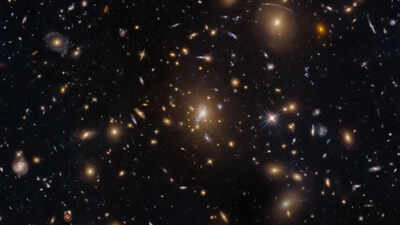
A new image released by NASA provides a dense view of one of the most massive structures in the universe, revealing a crowded cluster of galaxies whose gravity bends and amplifies the light coming from distant objects hiding behind them.The image, taken by NASA’s Hubble Space Telescope, focuses on the MACS0329-0211 galaxy cluster, a vast group of galaxies bound together by gravity. At first glance, the scene appears crowded and almost chaotic. Galaxies of different shapes and sizes fill the frame, creating a stunning reminder that the universe is organized on scales much larger than individual stars or even individual galaxies.According to NASA, galaxy clusters like MACS0329-0211 are valuable to astronomers because they preserve clues about how the large-scale architecture of the universe evolved over billions of years.
These massive systems also serve another purpose. Their combined mass could warp the fabric of space-time enough to bend the path of light traveling from much more distant galaxies.This effect, known as gravitational lensing, allows telescopes to observe objects that would otherwise remain too faint or too distant to study directly.
Hubble He sees a swarm of galaxies of different shapes and sizes
A closer look at the Hubble image reveals a variety of galaxy types occupying the cluster.
Parts of the field are dominated by large elliptical galaxies, appearing as smooth, bright elliptical shapes. Elsewhere, spiral galaxies can be seen from different vantage points. Some show their swirling arms face-on, while others appear as thin lines because they are viewed from the edge of the Earth.Lenticular galaxies, which share characteristics of both spiral and elliptical galaxies, are also scattered across the image. Together they form a crowded cosmic landscape that reflects the diversity found within mature galaxy clusters.In the middle of this group there are many foreground stars that belong to our galaxy. Their distinctive diffraction bumps make them easy to distinguish from the distant galaxies surrounding them.
Hubble sees a swarm of galaxies through the power of gravitational lensing
The most interesting details are not always the brightest. In one area of the image, faint curved lines arc across the background. These are not unusual structures within the cluster itself, but rather distant galaxies whose light has been stretched and distorted as it passes through the cluster’s massive gravitational field.A particularly prominent arc appears near a bright elliptical galaxy. Elsewhere, distorted white curves near the center of the cluster create an unusual shape resembling a twisted figure eight. NASA suggests that this feature may represent another background galaxy whose appearance has been dramatically altered by gravitational lensing.Such distortions provide astronomers with more than just visual curiosities.
By measuring how light is bent, scientists can estimate the distribution of matter within the cluster, including matter that cannot be directly observed.
How Hubble studied galaxy swarms
According to NASA, Hubble observed MACS0329-0211 as part of a program focused on galaxy clusters that emit powerful X-rays. These energetic emissions often indicate particularly large and active environments, making them attractive targets for detailed investigation.To examine the cluster, astronomers used both of Hubble’s primary imaging instruments: the Advanced Camera for Surveys and the Wide-Field Camera 3. Together the instruments combined observations in visible and infrared wavelengths, allowing researchers to build a more complete picture of the cluster and its contents.Observing across different parts of the electromagnetic spectrum remains one of Hubble’s strengths.
Features that are difficult to detect in visible light can appear more clearly at infrared wavelengths, helping scientists track the structure and evolution of distant cosmic systems.
What the Hubble swarm of galaxies reveals about the universe
Images like these extend beyond their visual appeal. Massive clusters like MACS0329-0211 effectively become natural observatories, amplifying light that has traveled through much of cosmic history before reaching Earth.By combining Hubble’s capabilities with the lensing power of these clusters, astronomers can access galaxies from earlier periods of the universe’s evolution. Each observation adds another piece to a much larger puzzle: how galaxies formed, how they changed over time, and how the universe got the structure visible today.A newly released rendering of MACS0329-0211 offers another glimpse into that story, capturing a region where gravity, light, and cosmic history intersect in a single frame.