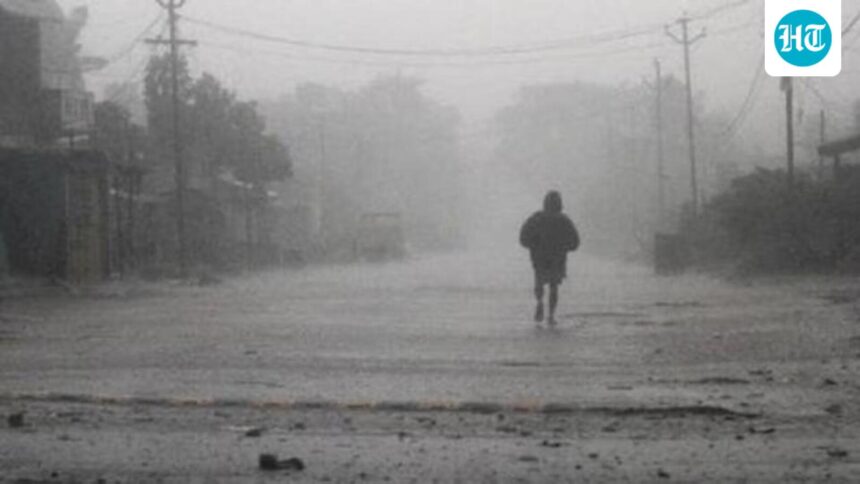
The India Meteorological Department (IMD) on Friday officially confirmed the emergence of El Niño over the tropical Pacific Ocean, warning that the weather phenomenon is expected to intensify during the ongoing southwest monsoon season and could lead to further cessation of rainfall across the country.

In its latest bulletin on the El Niño Southern Oscillation (ENSO) and the Indian Ocean Dipole (IOD), the International Meteorological Institute said on Friday that sea surface temperatures in the central tropical Pacific have crossed the El Niño threshold, while weather conditions have also begun to respond to warming ocean waters.
“Currently, El Niño conditions exist over the equatorial Pacific Ocean, and are expected to intensify further during the southwest monsoon season. The atmosphere has responded to rising sea surface temperatures, and the coupled ocean-atmosphere system now exhibits characteristics consistent with El Niño conditions,” the bulletin said.
This comes days after the Japan Meteorological Agency announced on Wednesday that distinct El Niño conditions have been observed in both the ocean and atmosphere in the equatorial Pacific, and that an event is currently underway. The Indian Meteorological Office has not yet made the same announcement, but said as of Friday that the threshold is close.
The IMD, even before this confirmation, was predicting a weaker monsoon. In its updated forecast on May 29, the International Meteorological Institute forecast monsoon rainfall this year would reach 90% of the long-period average — down from the 92% it forecast in April — and El Niño is expected to suppress rainfall, especially in the second half of the season. The long period average (LPA), based on data for the period 1971-2020, is 87 cm.
The forecast also indicated a 60% chance of weak monsoon.
The IMD said the announcement came despite the advance of the southwest monsoon on Friday – in other parts of West Bengal, Bihar and some parts of Odisha and Jharkhand. Under the influence of the Western Disturbances, rain spell is likely to continue over northwest India till June 13, while heat wave is very likely in isolated pockets of Marathwada, Rajasthan and Telangana till June 13 and over Vidarbha till June 16.
The International Meteorological Institute on Friday also noted that after a La Niña phase that lasted from August 2025 to February 2026, neutral conditions returned in March and continued into May. However, as of June, the three-month average El Niño sea surface temperature anomaly of 3.4 exceeded the El Niño threshold of 0.5°C.
Forecasts from the Monsoon Coupled Mission Forecast System (MMCFS) indicate that warming in the Pacific Ocean is likely to become more severe in the coming months. According to the International Meteorological Institute (IMD), positive sea surface temperature anomalies are expected to occur over the central tropical Pacific during June-August, and are likely to intensify and expand across the central and eastern Pacific from July to September onwards. “The latest MMCFS plume and forecast forecasts indicate moderate to strong El Niño conditions during the southwest monsoon season,” the bulletin stated.
In India, El Niño is historically associated with weaker monsoons and harsher summers; The current season follows this pattern in some ways, with delayed onset of cyclones in Kerala and June weather expected to be below normal.
Despite the emergence of El Niño, the IMD emphasized that neutral Indian Ocean Dipole conditions currently prevail over the Indian Ocean and are likely to persist through the monsoon season. While a positive IOD can help offset the effects of El Niño to some extent, bringing much-needed moisture to the Indian subcontinent, neutral IOD conditions allow El Niño to negatively impact the region, making the monsoon weaker.
With a neutral IOD scenario ahead, El Niño will remain strong, an IMD official said. “Having a positive IOD offsets the effect to some extent, but in current conditions, El Niño will still be strong. That’s why we expect 90% LPA. While monsoon advance is around normal at the moment, further advance may also be affected by the onset of El Niño.”