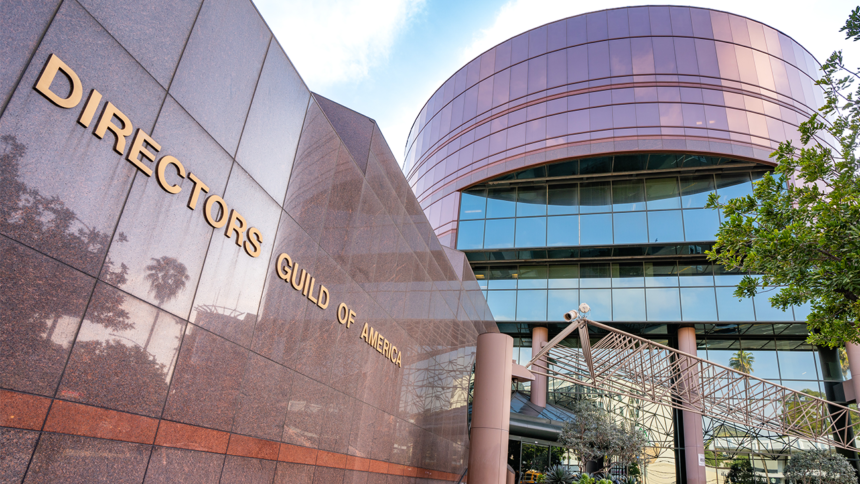
The Directors Guild’s new four-year tentative deal with Hollywood studios includes a commitment from producers to push for federal tax incentives and new protections for artificial intelligence. The largest ever increase in employers’ contributions to the union’s health plan in its history.
The union revealed these details in a letter to its members on Friday, which included a letter from union president Christopher Nolan, who praised the work of the committee negotiating the deal as “remarkable.”
“We entered these negotiations with three main priorities: securing our health plan, protecting jobs, and making sure our members stay safe as AI continues to impact our industry,” Nolan said. “We have been successful in these areas and have made gains in many others.” “With these gains, a four-year agreement was appropriate and necessary to provide stability and growth potential at a time when the industry was experiencing a downturn.”
The DGA was greatly concerned about the decline in organ function. This came after TV employment fell by 35 percent and film employment fell by 8 to 12 percent in 2024, DGA Chairman Christopher Nolan said. Hollywood Reporter Before negotiations begin on May 11. (At that time, data for 2025 was not yet available.)
On this front, the union has secured commitments from studios and broadcast companies to send their top executives to lobby for a federal tax incentive in the United States, along with the industry’s usual lobbying body, the Motion Picture Association and unions. The union is also trying to boost job opportunities for members by introducing contract language that would place restrictions on “affiliated employees,” or people who already have a production role but want to direct TV shows in addition (and have no directing experience). In other words, a TV actor who wants a cocky directing credit may have a harder time achieving that than before.
As part of the deal, the parties also agreed to meet to discuss the issue of non-US directors (DGA members and others) who operate abroad and are appointed by US companies outside the DGA agreement. From the union’s point of view, this creates an unfair situation where union members can be hired at cheaper rates in the UK, for example, than in the US. They obtained a job bulletin prohibiting the practice of employers and talent agents not explicitly considering DGA managers for a non-U.S. or Canadian position.
The union revealed the terms of the deal just three days after announcing a tentative deal between the labor group and the Alliance of Motion Picture and Television Producers (AMPTP). The union’s National Council unanimously approved the contract language, meaning the terms will now go to members for review before the ratification vote, which ends June 25.
The contract also includes a significant boost to employer contributions to the union’s health plan: nearly 25 percent over the life of the deal. The caps on employer contributions to the plan will also be raised in various categories (caps for film directors will increase by 62.5 percent, for example, while UPMs will see a 37 percent increase).
Like the Writers Guild of America, the DGA also agreed to make changes for the health plan to receive these benefits and help the plan weather health care inflation. Its health plan lost $43 million in fiscal years 2023 and 2024, according to tax filings. Unlike the WGA, the exact changes that will occur in collective bargaining are not covered but will be addressed by the DGA health plan trustees. These “some modest changes” will include “increases in earnings eligibility thresholds, monthly premiums, deductibles, and other areas,” the DGA wrote in its summary of the agreement.
Regarding generative AI, the consortium has renewed and built on its inaugural 2023 side letter addressing the technology. The union created new contractual language that juxtaposes any footage created using generative AI with footage captured on camera, stipulating that both fall within the purview of the creative director. The union won some transparency language (if managers are expected to use AI in a job, the employer must tell them) and licensing regulations (the union must get notice and the freedom to schedule a meeting if their business is licensed to train a commercial AI system with the goal of creating output).
Finally, AMPTP agreed to fund a “skills enhancement” program to help guild members transition to generative AI workflows.
When it comes to wages, the DGA received a 2.5 percent raise in the first year of the deal and three percent for the next three years of the agreement plus certain remaining increases. Other interesting details in the deal include a clause that requires the TV series to include a “pilot directed” credit in every episode of the series. The guild and AMPTP also agreed to meet within 90 days to negotiate a custom documentary agreement covering docuseries, which until now had only occasionally been covered by the Freelance Live and Tape Television agreement.
For its part, AMPTP entered into dealmaking with the goal of convincing directors to agree to what the writers and actors already had: an unusually long contract. As their industry peers had done before them, the DGA agreed to a four-year deal instead of the typical three-year deal to receive extraordinary benefits. in contrast.
Now, the union’s 19,500 members will determine whether the agreement meets their concerns. DGA National Executive Director Russell Hollander led negotiations for the guild and AMPTP President Gregory Hessinger led discussions on major studios and streaming companies.