Under ICAO Annex 13, a state must publish a final report within a year of the accident.

The Aircraft Accident Investigation Bureau (AAIB) is expected to issue a status update on Friday on its investigation into the crash of Air India Flight 171, nearly a year after the accident, according to officials who requested anonymity. But the document will not specify the cause of the plane’s crash, as its engines are still being examined.

By their account, the update will outline the work done to date, areas still under investigation, and a little further beyond. What he may stop doing is resolving the question at the heart of the case: whether fuel in both engines was cut off by human hand or by a fault in the plane. This question has divided investigators, pilots and lawyers since the first weeks of the investigation.
“It is basically an update that investigating authorities are expected to provide when a final report cannot be issued within a year,” a ministry official said, adding that the update was not, specifically, even a status report or an interim report. “It will provide an idea of where the investigation took place and what work was done. But it should not be viewed as a document that will determine the cause of the accident.”
Under ICAO Annex 13, a State must publish a final report within a year of the accident or, if this is not possible, issue an update on progress; The official said the document was shared with international stakeholders.
The Indian Pilots Association on Thursday urged the Civil Aviation Ministry not to issue the update at all, warning that it would deepen the confusion rather than ease it. One member of the Indian Pilots’ Association put the objection plainly: The AAIB’s single sentence in the cockpit version, in last year’s initial report, was enough to launch a series of theories – most alleging human intervention – and a new update that again stops short of why will only fuel more.
What is known is this. The AI-171 took off from Ahmedabad shortly after lunchtime on June 12 last year, bound for London’s Gatwick Airport with 242 people on board. In the last thirty seconds or so of being in the air, the cockpit voice recorder captured one pilot asking the other why the engine was being cut off from fuel; The other said he didn’t. “In the cockpit audio recording, one pilot is heard asking the other why he cut the plane. The other pilot responded that he did not,” the AAIB’s initial report released in July said. The accident led to the deaths of 241 of the 242 people on board and 19 people on the ground. One passenger survived. The initial report, published a month later, recorded what happened in the cockpit and went no further, and no cause was established or a sound identified. The investigation remains open.
With no official explanation, the families of the dead had no choice but to focus on one theory or another. “There are different stories, but there is no clear answer,” said Muktiben Fansadia, who lost her parents. They had never been on a plane before; The trip to the UK to see her older sister was their first. She said that a man from her village Kusamba who had earlier been on the plane to Ahmedabad told the family that there was a technical problem with it and that she wanted to know what had been checked before it was allowed to fly. “We still don’t know what exactly happened,” she told HT from Surat.

The contestation over what happened, from the beginning, has spilled over from that single conversation on the tape recorder. On the one hand, there are the representatives of the pilots, who have argued from the first weeks that the crew is tasked with responding to a fault in the aircraft. On the other side, there are Western investigators: According to the Italian daily Corriere della Sera, experts with access to black box data concluded that the captain “almost certainly” moved the fuel switches from on to off in the seconds after take-off, while the first officer, who was flying the plane, tried to retrieve it. The same report described ongoing friction between the Indian and US sides over how to manage the investigation – at one point, the US National Transportation Safety Board was said to be considering withdrawing from the investigation entirely.
The pilots’ side did not leave this reading standing. The Indian Pilots Association, which represents more than 5,400 members and has already approached the Supreme Court for a judicial inquiry, used a press conference on the eve of the anniversary to press the request again, arguing that the investigation was too easily tilted towards the crew. “The Western media immediately built a suicidal theory around a short cockpit script,” said its president CS Randhawa. “It’s too early to blame the pilots.”
Mike Andrews of the US law firm Beasley Allen, which represents more than 150 victims, pointed to the early deployment of the Ram wind turbine – an emergency device that only spins when engine power is completely lost – as a sign of a possible technical fault. He added: “If the reason is clear, there will be no delay in the report.”
Read also: The pilots body opposes the interim report on the AI171 crash and demands a judicial investigation
No one will say when the final report will come. The last pending step is an inspection of the engines by GE Aerospace at its facility in Ohio, and officials said the report cannot be released until it is completed.

While the case remains open, the families have been asked to treat the matter as closed. HT has witnessed the receipt, discharge and compensation model provided as part of the final compensation to Air India, under which $35 thousand — $25 lakhs have already been paid as interim relief plus additional amount $10 lakh – it is treated as complete and final. Signing it releases not only Air India, but Boeing, General Electric, GE Aerospace, Safran, Honeywell, government agencies and the airport operator from liability, and obligates the family to indemnify them against any future claim – before any outcome proves what those parties did or failed to do. Air India said on Wednesday that the offer did not carry any deadline and was open to all families who preferred not to wait for the investigation.
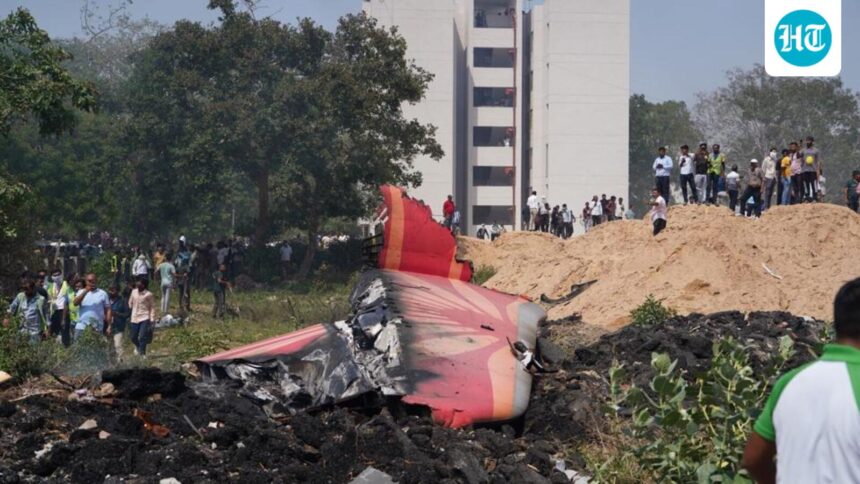
A year later, the site still bears the signs. The four buildings of Atuliam Inn stand empty and dark, their walls cracked and blackened, their windows broken, and the trees of the complex bare and burned. Grass grew over the debris and no one removed it. Ashabeen Parmar, a rag picker who works on the nearby land, still brings up plane fragments on her daily rounds; She stands next to the hardest-hit building, pulling twisted pieces of aluminum from her bag. She was on campus minutes before the accident and headed to the water kiosk seconds before the plane went down. She said those seconds saved her life. The death toll on the ground – 19 dead – could have been much worse had it not been for the cleansing campaign that took place weeks ago, which moved between 40 and 50 families out of the area. The Gujarat government now plans to demolish the buildings and rebuild the complex at a cost of Rs $103 Crores, $53 crore of which is from the Tata group.
Among those killed were Vijay Rupani, the former chief minister of Gujarat, who was heading to London for a Puja holiday; His wife had already arrived, and the family spoke to him shortly before the flight. His son Rushabh said they had confidence in the investigation and urged others to wait for its results.
“When you have an umbrella, it protects you from everything,” he said. “Once it’s gone, you’re exposed.”

Neha LM Tripathi is a special correspondent for the National Political Bureau of Hindustan Times. It covers the ministries of aviation and railways, and writes A Also about travel directions. Her work spans national developments, with a focus on politics, people and the evolving travel landscape. She has 13 years of experience. Before moving to Delhi, she was based in Mumbai, where she began her journey as a journalist. Outside of the newsroom, Neha enjoys touring and traveling.Read more