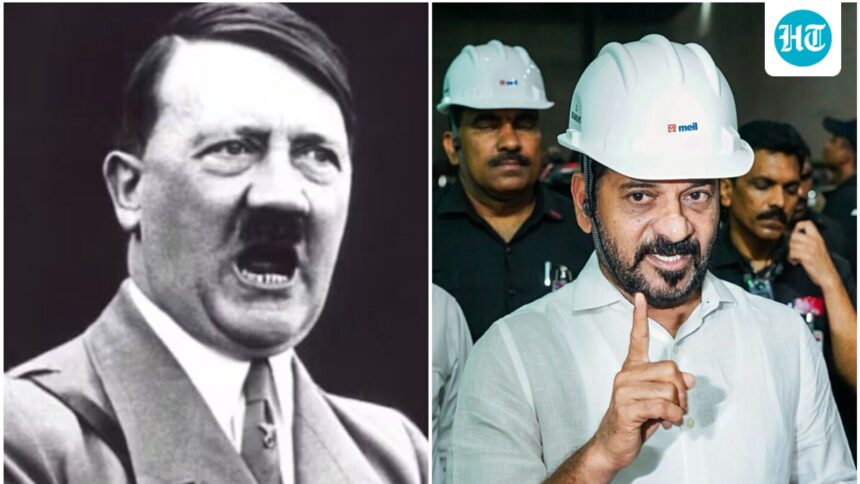
A political defense of demolition engines. Adolf Hitler cameo. A fictional Nazi-linked organization from the Marvel Universe. A monster from ancient Greek mythology.

These are not the makings of a superhero crossover movie. They are parts of the controversy that erupted after Telangana Chief Minister Revanth Reddy spoke about HYDRAA, or Hyderabad Disaster Response and Asset Protection Agency, earlier this month.
Explaining the inspiration behind the body’s name and function, Reddy said he was inspired by Hitler, and noted that the Nazi Germany leader’s primary assassination squad was called “Hydra.” These statements quickly sparked outrage: opposition parties accused him of summoning a dictator to justify strict rule, while historians and social media users pointed out that no such Nazi organization was known to exist.
Read also| ‘City of the future’ will drive Telangana’s economy: CM Revanth
The incident has since sparked a broader discussion about “the hydra” — a term that has moved across centuries and cultures, from Greek mythology to comic books and blockbuster films.
What is hydra?
Long before there were comic books, political speeches, or social media memes, Hydra was a monster.
In Greek mythology, the Lernaean Hydra was a huge, multi-headed water serpent that lived near Lake Lerna, and was fearsome enough to appear as one of the twelve laborers dedicated to the hero Heracles – better known as Hercules. What made it terrifying was not just the number of its heads, but also its ability to regenerate: cut one off, and two more will grow in its place. The story goes that Heracles finally defeated the monster by burning each neck stump immediately after cutting off the head, thus denying the new monster the opportunity to emerge.
Over time, the hydra escaped mythology and entered dictionaries. The Oxford Dictionary defines it as: “something that is very difficult to deal with, because it continues for a long time or because it has many different aspects.” It’s a metaphor that governments, corporations, military organizations, and fictional franchises have borrowed over the years.
So, did Hitler have a band called Hydra?
no.
This is the real problem at the heart of this controversy.
It was never known that Hitler had an assassination squad, a secret police wing, or a special military formation called Hydra. The Nazi regime’s terror apparatus was based on three main bodies: the SS (Schutzstaffel), Hitler’s elite paramilitary force; Gestapo, the secret state police; and the Einsatzgruppen, the mobile killing squads responsible for mass executions during World War II. These organizations carried out surveillance, repression, arrests, and mass killings on behalf of the Nazi state. None of them were called hydra.
So why does the name sound so familiar?
Because for millions, Hydra belongs not in the history books but in Marvel.
In the Marvel Comics and Marvel Cinematic Universe, Hydra is a fictional totalitarian terrorist organization with origins in Nazi Germany. Led by villains, including the Red Skull, they appear throughout the Captain America franchise, and their motto comes straight from Greek myth: “Cut off one head, and two will take its place.”
Marvel’s Hydra is designed to be resilient, secretive, and nearly impossible to destroy – just like the monster that inspired it. Decades of films, television shows, and comic books have since made it one of the most iconic fictional organizations in popular culture.
It’s possible, then, that Reddy accidentally mixed Nazi history with Marvel lore.
Why the political storm?
The debate is about more than just historical confusion.
This comes against the backdrop of HYDRAA’s anti-encroachment operations in Hyderabad, which have drawn both praise and criticism. The authority has carried out demolition campaigns targeting alleged encroachments along lakes, water bodies, government lands and public properties since its establishment in July 2024, and recovered lands worth $1.10 lakh.
Supporters say illegal encroachments have damaged the city’s lakes and sewer systems, that strict enforcement is necessary to protect public lands, and that previous governments have failed to act. Critics argue that some demolitions were sudden and disruptive, that property owners received insufficient notice, and that the authority’s powers require stronger safeguards and oversight.
Against this background, Hitler’s reference to the opposition gave an opportunity to shift the discussion from transgressions to the style of government. The BJP and BRS took advantage of these comments, accusing the Congress government in Telangana of displaying an authoritarian mentality.