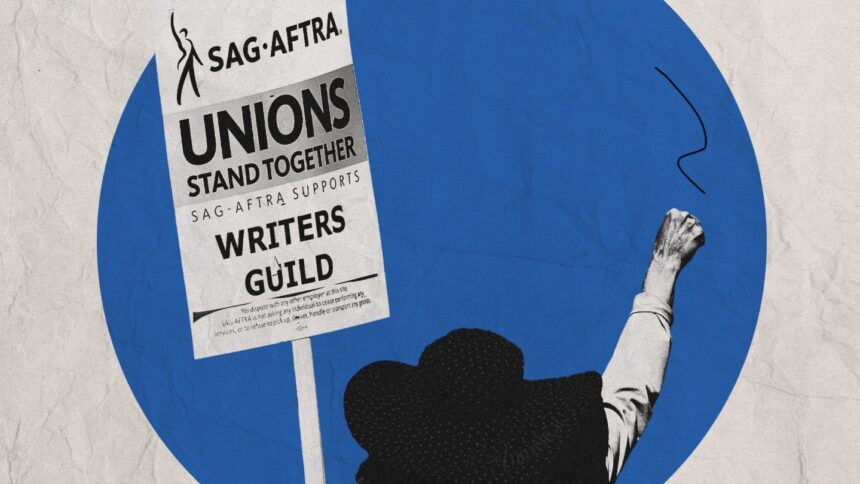
What a difference three years makes. While 2023 was the hottest year in recent memory for Hollywood workers, with two major unions on strike for more than 100 days each, 2026 was perhaps the sleepiest.
On Tuesday evening, to little fanfare and little public sniping, the Directors Guild of America became the latest guild to strike a deal in 2026 with Hollywood studios and streaming companies. While the agreement (the details of which have not yet been revealed) is still provisional and could theoretically be rejected by its National Council or its members voting to ratify it, no one expects them to do so.
The DGA is certainly not exactly known for its fiery nature (it has a larger-than-life personality and considers itself the most responsible in the family), but the unions with an aggressive side have also opted for low-key negotiations in 2026. SAG-AFTRA negotiations: Very quiet, despite the fireworks some expected from their generative discussions about artificial intelligence. WGA TALKS: Too cold for a union whose 2007-08 strike saw its members form the words “WGA” with their bodies to news helicopters on Pico Boulevard, and this is just one of many examples of the organization’s colorful advocacy over the years. (Ironically, the most intense labor battle this year was not between the WGA and the studios, but rather between the WGA and its unionized workers.)
The year was relatively quiet despite all unions agreeing to terms of an unusually long deal of four years instead of the usual three. Longer deals have been a major issue for studios and streamers, which are negotiating under the auspices of the Association of Motion Picture and Television Producers (AMPTP) and wanted some labor stability at least through 2030. The unions were willing to agree to this in order to extract additional generous benefits for their members.
So far, these members have not rebelled against this strategy: more than 90 percent of participating members have approved the WGA contract, while more than 91 percent have approved the SAG-AFTRA contract.
But what made this year only So mellow? Perhaps the most important factor is the ongoing fallout from Hollywood’s downturn. It is no small feat that since 2022, studios have been tightening their belts and downsizing their rosters, reducing the job opportunities available to ordinary workers in the industry. Corporate consolidations that led to significant layoffs, such as the merger of Paramount Global and Skydance Media in 2025, haven’t helped matters.
A 2025 Otis College of Art and Design report found that between 2022 and 2025, entertainment jobs in Los Angeles declined by 25 percent. The Wall Street Journal It reported that employment at the business was down 30 percent since late 2022. In a risky industrial environment, unionized entertainment workers were in no position to risk another strike.
Moreover, two of the three unions that went to the negotiating table in 2026 needed vital funding for their health plan. As business has slowed over the past few years and health care inflation has taken its toll, WGA Health Plan has cumulatively lost $122 million in fiscal years 2023 and 2024. Meanwhile, the DGA lost $43 million during that period, according to tax filings. A union can only become so aggressive when it extends its hand, demanding significant investment in important benefit plans that many depend on. Thanks to its easy-going approach this year, the WGA received at least $321 million in its health plan.
And then there were the characters she plays. AMPTP had a new leader at the table in the form of President Greg Hessinger. The dealmaker, who takes over in 2025 from former longtime Labor chair Carol Lombardini, brings experience from both sides to the negotiating table, having previously served as national executive director of the American Federation of Television and Radio Artists (AFTRA) and the Screen Actors Guild (SAG) before their 2012 merger.
Union negotiators say they saw a difference. Danielle Sanchez Witzel, a member of the negotiating committee in 2023 and co-chair of the committee in 2026, said: Hollywood Reporter In an interview, “The big difference in 2026 is that they… [the AMPTP] They are ready to talk about what we really need and what they need. Sean Astin, president of SAG-AFTRA, said Hessinger “helped reset the relationship between our organizations.”
On the labor side, too, new leaders took charge. In 2025, former Vice President Michel Mulroney became President of WGA West and Tom Fontana was elected President of WGA East, succeeding strike-time leaders Meredith Stem and Lisa Takeuchi Cullen. Blockbuster director Christopher Nolan has taken over from veteran TV director Leslie Lenka Glatter as head of the DGA. Astin was elected president of SAG-AFTRA in the fall of 2025, after former leader Fran Drescher, who consistently made headlines during the 2023 strike, decided not to run again.
From an early stage, Astin struck a diplomatic tone about the negotiations. Bargaining contracts are “a regular and structured way for unions and companies to address our employment relationships,” he said in a joint statement with the union’s chief negotiator Duncan Crabtree-Ireland ahead of the talks. “It doesn’t have to be a dramatic process,” Astin and Crabtree-Ireland added.
That wasn’t the case this year, but now that everyone has proven they can play nice in a difficult time for the company, don’t count on friendliness being the new normal. 2026 was a very special moment in entertainment, and the WGA’s Mulroney said, at the very least, she wants to return to a three-year deal in the future. The moment one party feels the need to change things for their side of the table, expect them to do so. People in the entertainment industry know how to put on a show.