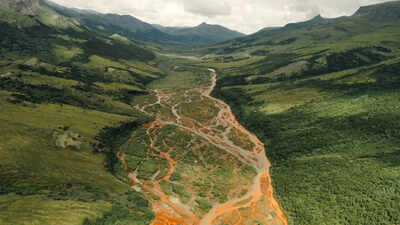
On a late-summer flight over the Brooks Range in northern Alaska, stretches of river suddenly appeared like glass, stained the color of iron oxide. From above, it looks like rust spreading through the cracked engine block.
On land, the change is even more alarming: clear tributaries turn murky orange within a few bends, with fish habitat disappearing beneath soft sediments and acidity changes.That’s the truth behind Alaska’s rivers turning rusty orange, a turn linked not to a spill or mining accident, but to the thawing of permafrost that has remained frozen for thousands of years. A study published in the journal Communications Earth & Environment, titled “Permafrost thaw controls iron flux from wetlands and sulfide-bearing rocks into Arctic rivers and streams,” links the phenomenon to iron release, sulfur chemistry, and microbial activity unleashed as temperatures rise in the Arctic.
What was once a stable geological “freezer” is now rewriting river chemistry across vast, remote watersheds.
Why does the color change of an Alaskan river begin deep below the surface?
Permafrost is often described as frozen soil, but this understates its role. It is like a long-term storage vault for minerals, organic materials and sulfide-rich rocks. When kept frozen, these components remain chemically quiet.As the Natural Resources Defense Council (NRDC) reports, in iron-rich areas of Alaska, melting ice exposes minerals such as pyrite (iron sulfide commonly known as fool’s gold) to oxygen and water.
Once this happens, the chain reaction begins. Pyrite oxidizes and produces iron, sulfate, and sulfuric acid. The chemistry is simple but powerful: once-inert rocks become reactive, and water becomes a transport system for dissolved minerals.The misconception here is that discolouration always indicates pollution from industry. In fact, many of these watersheds are located hundreds of miles from any artificial drainage.
This is driven by the interaction of climate warming with geology that was never meant to be revealed in modern surface conditions.
The chemistry behind the formation of rust stain Arctic rivers
At first glance, the discolouration looks like clay or icy flour. But laboratory analyzes show something more specific: iron in both its dissolved and particulate forms precipitates when it hits oxygen-rich surface waters.This is what creates the rust color, as the iron oxidizes as it moves downstream. What makes the system more complex is that the process is not standardized.
At high elevations, rock weathering dominates. In lowland areas, wetlands slow the availability of oxygen, shifting chemistry toward microbial pathways. Romain Dial, one of the researchers involved in the study, compared it to reverse breathing. Instead of oxygen driving metabolism, microbes in saturated soil begin using iron as an electron acceptor.
The microbial iron cycle produces soluble iron which subsequently oxidizes when it reaches open water, amplifying the orange staining.
Why are Alaska’s orange rivers growing faster than expected?
Satellite and field data from the Brooks Range have identified more than 200 orange-colored bodies of water. In some areas, the frequency of clearly discolored rivers has nearly doubled over the course of a decade, from about a third of observations in the early 2000s to nearly three-quarters in the 2000s. Thawing permafrost does not release its chemical load all at once. Instead, it runs on a lag. Materials released one summer may not fully reach waterways until the following year or later, depending on groundwater movement and seasonal freeze-thaw cycles.This is why Alaska’s rivers turn rusty orange. This is best understood as a moving front rather than a static situation. They expand gradually and are shaped by trends in temperature, soil composition, and hydrology.
What this means for fish, food webs and downstream communities
The environmental impact is not cosmetic. Iron particles can travel long distances, covering riverbeds and clogging up gravel areas that salmon rely on to spawn. Young fish are particularly sensitive, as fine sediment reduces the flow of oxygen through the nesting beds.Even more worrying is the chemical shift in the water itself. As sulfuric acid forms in localized areas, pH levels can drop enough to stress aquatic insects and alter the microbial communities that form the base of the food chain.