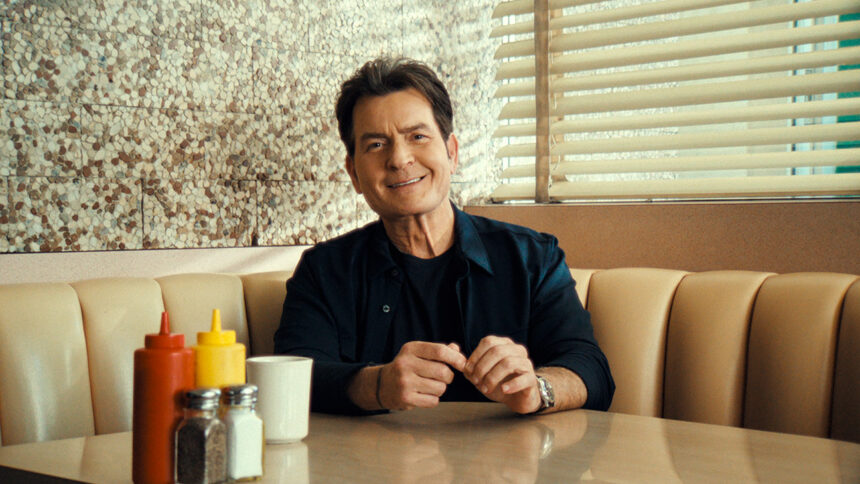
Charlie Sheen wouldn’t be “on that damn call” if he wasn’t sober.
the Platoon, Wall Street, Spin City and Two and a half men The star tells Hollywood Reporter Equally as he discussed his Netflix documentary, as well as his and Martin Sheen’s reaction to the final product — which he described as a “love letter” to his father — alongside director Andrew Renzi.
in Also known as Charlie Sheenthe sober (and sober) actor looks back on his formative—and party—years with surprising clarity. He does not dismiss questions about his drug use, HIV diagnosis, or gay sex. With Charlie, stories that seemed too wild to be true were just an appetizer for really crazy things.
Part of Renzi’s mission was “to find out the truth about this feverish dream of life,” he says. THR. He had some help.
A trove of archival footage, including Super 8 films from Charlie’s childhood, featuring older brother Emilio Estevez and their best friends, actors Sean and Chris Penn, helped Renzi put the pieces together. But mostly it was Shane’s “virgin mind” that filled in the blanks where there definitely should have been more.
“Calling Charlie is like nothing I could have ever imagined,” Renzi admits. Even Sheen admits that his memories “shouldn’t be intact and available” after decades of difficult living. However, they turn this embarrassment of outrageous riches into a 181-minute documentary split into two halves – “Part One,” which tells the story of Sheen’s idealistic youth in Malibu, his rise to stardom and his prominence in the Heidi Fleiss sex scandal; And the perfect title “Part Deux” is a nod to Sheen’s Hot shots! The second part, which sees him in and out of rehab (and sitcoms), deals with discovering he is HIV positive – the real challenge of filmmaking.
“There’s another version of this movie that I think about a lot, where we spend an hour and a half set in the ’70s and ’80s with the earlier Super 8 movies [Sheen] Until he makes a movie. Where Chris Penn becomes a main character. “I fell in love with this stuff,” Renzi says. “Ain Facts.” [Sheen’s] The story should make it difficult to spend that much time on it. So, we had to strike that balance.”
Renzi and Sheen are virtual good friends, even if the latter is a bit bothered by questions about his health — “I think my presence answers those questions,” he says — as well as finances: “Are you asking me that question at a dinner party in front of my parents?” Shane replied, “I’m fine.”
The first meeting between Renzi and Sheen went much smoother, which is why the actor eventually agreed to his documentary offer.
“I’ve been contacted several times, but have never been able to get to an in-person meeting,” Shane says. “It was just a couple of phone calls, or I read a detailed exposition of how someone thought they should document my history, and none of that spoke to me at all.”
Renzi was different. “I saw a man who wasn’t interested in much [tabloid] Shane explains. “I saw a guy who wasn’t there to exploit anything, who was there to celebrate the cool shit and be sensitive — but honest and inclusive — with the not-so-cool shit.”
One day before the movie premiere Also known as Charlie Sheen On September 10, Sheen’s autobiography, Sheen’s Book: A Memoir It is published by Gallery Books, an imprint of Simon & Schuster. It also contains both cool shit and not-so-cool shit, like decades of drug use and the ridiculous era that wasn’t even “Tiger Blood.” The timing was not a coincidence, nor was it a special coincidence for the artist.
Sheen says he sought to create “some space” between the release of his memoirs and the docuseries. He only got 24 hours. “Netflix spent all this money to get this amazing project,” he says, expressing his understanding of the business decision.
Although the book came in first place artistically, it was the docuseries that “hurt the book.” [sales]“And not the other way around,” Shane says. Shane’s book became a New York Times best seller. He points out that the audiobook, which Sheen read, outsold the memoir by a ratio of 3 to 1.
Emilio, Charlie’s brother, and Martin refused to participate in the documentary series, although Renzi did his best. He brought a rough copy of “Part One” to both of them in hopes of getting them to change their minds. It didn’t happen, but not for lack of quality.
“Dad had a definite reaction to it,” Charlie recalls. “He said, ‘You don’t need me.’” “You don’t need my personality today. I’ve got my really beautiful and interesting personality. This is how I want it to be in the document.
Instead, it was Sean Penn who represented his younger days in Malibu and his more recent days in Los Angeles. Renzi says that that interview served as his “anchor” and that Ben’s vision was so comprehensive that he immediately stopped communicating with other people in Hollywood.
The document received generally positive reviews, although it was… Battle after battle The Oscar winner who gave Renzi his favorite reaction.
“Sean Penn texted me and said, ‘You made something I’ve never seen before,’” Renzi says. “He’s as unique and unique as Charlie Sheen.” ”
This story first appeared in the June standalone issue of The Hollywood Reporter magazine. To obtain the magazine, click here to subscribe.