

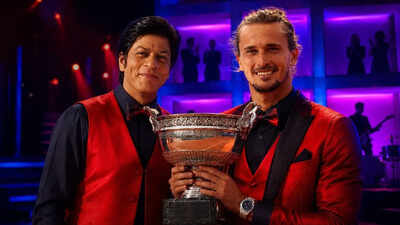
Shahrukh Khan, Alexander Zverev. (Image generated by artificial intelligence)
If SRK fans were objective, which is a tough question considering they are SRK fans and thought Pathaan was a great film, they would admit that Om Shanti Om was the last time King Khan was at the top of his game. The film was both a classic and revolutionary in Bollywood in the sense that it was the first crossover of Bollywood stars long before the Avengers existed and were even predicted to take over the five cities of Dard-e-Disco (of which two are included). In the film, Shah Rukh Khan’s character says: “Kehte hain agar kisi cheez ko dil se chaho, toh polli kainaat usse tumse milane ki koshish mein lag jaati hai” (“They say that if you want something with all your heart, the entire universe is trying to get it for you”). It’s the same philosophical idea in Paulo Coelho’s The Alchemist: “When you want something, the universe conspires to make sure you get it.”
The universe finally conspired to give Alexander Zverev his first Grand Slam title when he defeated Flavio Copoli at the 2026 French Open.Zverev’s nickname is Sasha, a diminutive of Alexander in Russian, and he may have been wondering if he was suffering from some kind of reverse name. In his prime, Alexander conquered a large portion of the land area known to the ancient Greeks, which was still only 3-4% of the actual land area of the world, and he supposedly cried because there was no land left to conquer. On the other hand, the player with the same name had another reason to cry: his inability to overcome the only region that continued to defeat him, a Grand Slam.
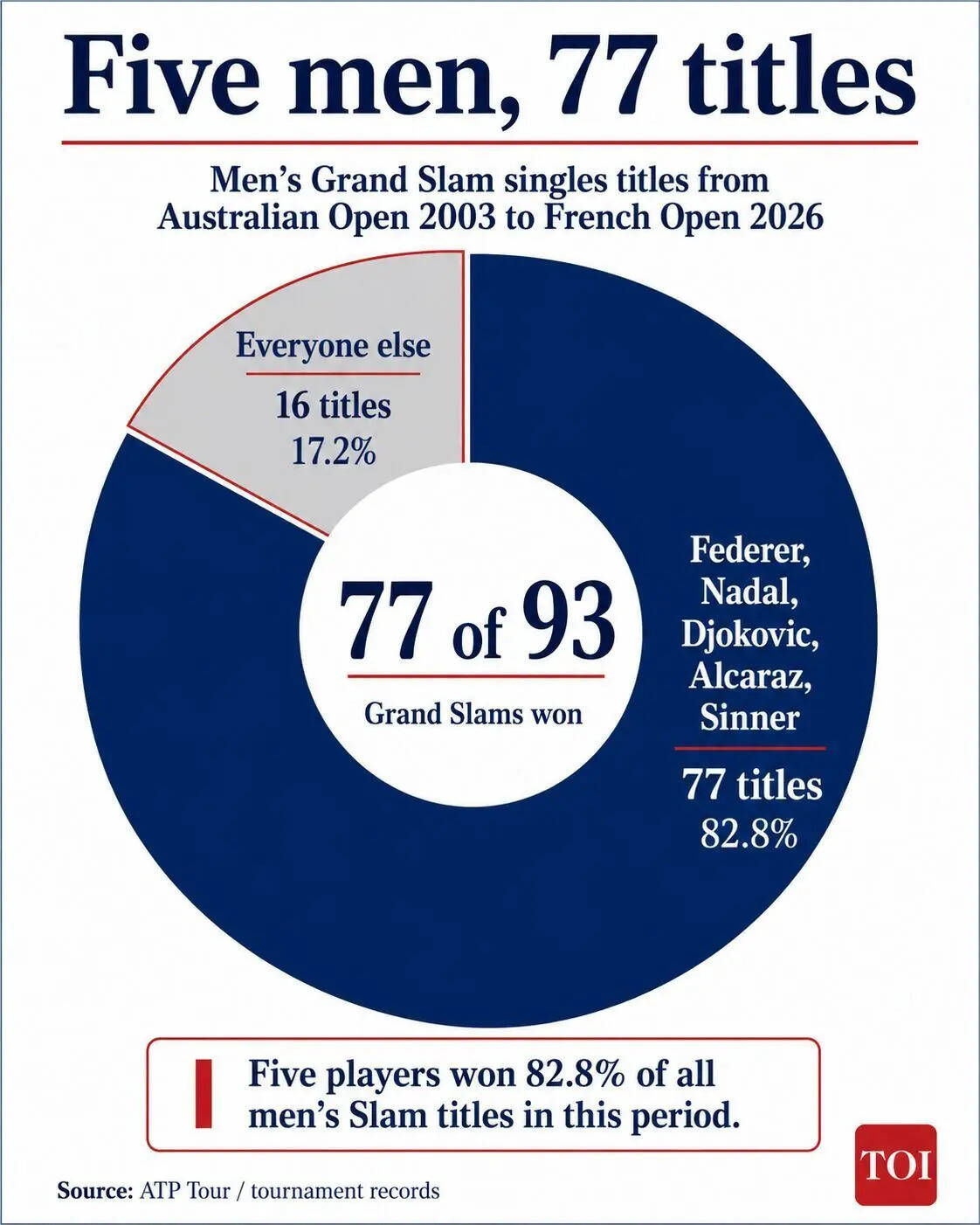
Of course, any footnote on major individual titles needs a Jupiter-sized asterisk. It was the kids of the 90s who had to move from the analog world to the digital world, from landlines to smartphones. Tennis players born in the 1990s, on the other hand, first had to navigate the 1980s era of Federer-Nadal-Djokovic dominance before confronting 2000s-born freaks of nature like Carlos Alcaraz and Jannik Sinner.Between the five of them, they won 77 of the 93 men’s Grand Slam titles from 2003 to the 2026 French Open. From 2003 to the 2026 French Open, there have been only 17 different winners. In the previous period from 1978 to 2002, there were 99 Grand Slam titles, which produced 31 major winners.Of these 17 winners, five are Messrs. Federer, Nadal, Djokovic, Alcaraz and Sinner. Zverev is seventeenth. In other words, becoming a new Grand Slam winner in this era was less a career milestone than a breach in a gated community.
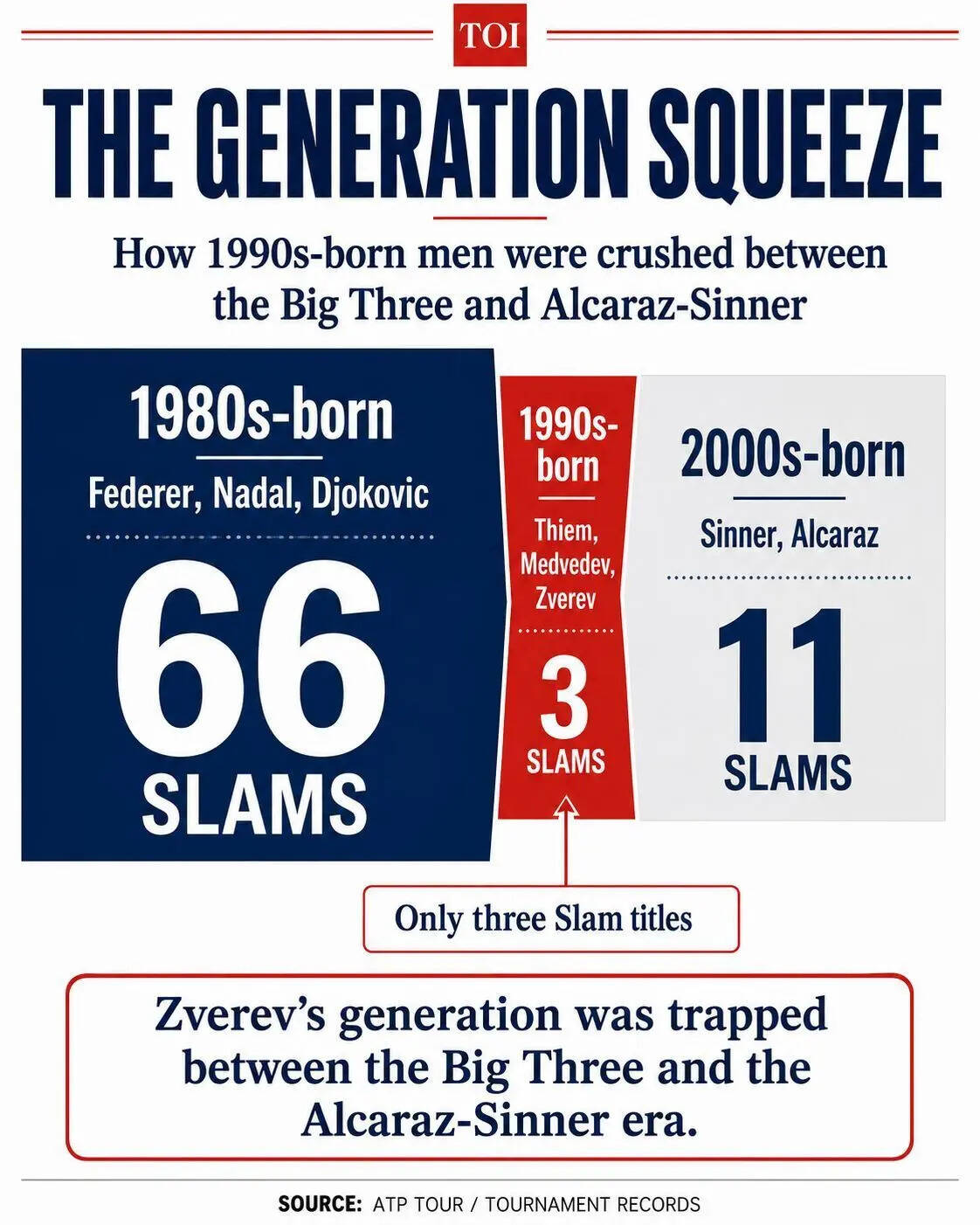
Only three men born in the 1990s have won Grand Slam singles titles: Dominic Thiem, Daniil Medvedev and Zverev.Zverev, unlike Suits’ Harvey Specter, isn’t naturally close, so the universe had to conspire to help him close.However, Zverev’s stumbles similar to Karna’s, where talent and fate remain unmatched, only come at the Grand Slams. He has won at all other levels: winning the Masters 1000 and twice in the ATP Finals.
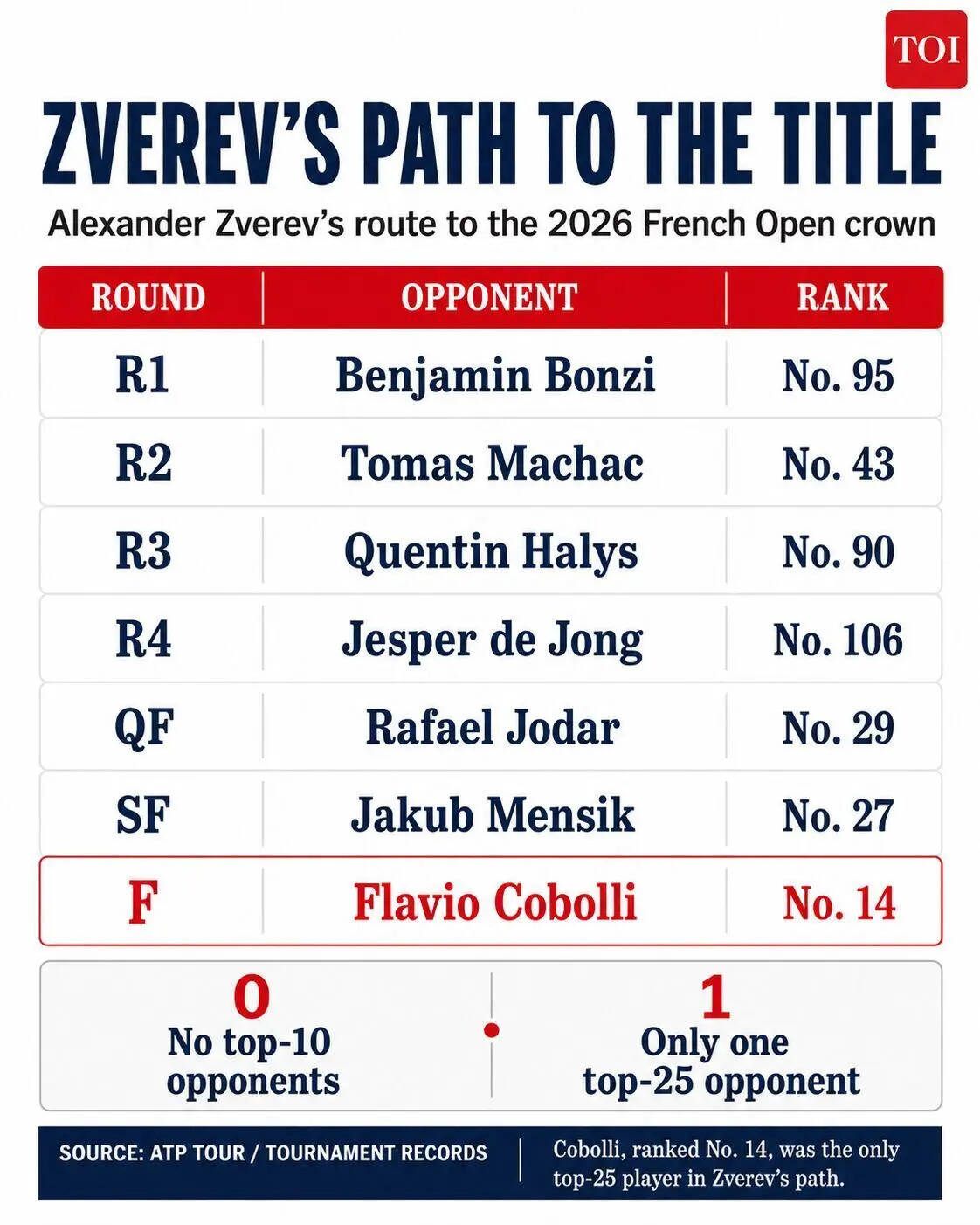
He won an Olympic gold medal in Tokyo 2020. But the Grand Slam still eludes him.In How I Met Your Mother, Ted Mosby’s love life depends on signs from the universe. There were many signs from the universe that this was Zverev’s year. The first was Carlos Alcaraz, missing due to injury. Alcaraz famously defeated Zverev in the 2024 French Open final.Then Jannik Sinner, everyone’s favorite to win the trot even if he played with one arm behind his back, collapsed in the second round against Juan Manuel Cerundolo, falling like Lucifer displaying a free will in heaven after two sets.Finally, Novak Djokovic, the man who broke the monopoly of Federer and Nadal and continues to be a thorn for Messrs. Alcaraz and Sinner, also had to lose.On his way to the final, it looked as if Zverev had consumed Felix Felicis, a good luck potion from the world of Harry Potter, as he beat World No. 95 Benjamin Ponzi, World No. 43 Tomas Machak, World No. 90 Quentin Hales, World No. 106 Jesper de Jong, World No. 29 Rafael Godard and World No. 29.
No. 27 Jakub Mencic before facing world No. 14 Flavio Copoli, the only player in the top 25 on his way.Of course, none of this detracts from the fact that Zverev won a Grand Slam. There are no fake grand slams handed out by Khap Panchayats. But it’s a bit like Greece winning Euro 2004: completely legitimate, historically enduring, and still remembered mostly for how strange the route was.However, because it was Zverev, the whole world had to work overtime in Paris.
He won the opening set 6-1, but his familiar problems returned again. His forehand shots began to falter with the return of the philosophical crisis that afflicts him in every final return. Copoli reorganized his ranks and Zverev committed a double fault when the score was 3-3 in the second set, and it seemed like one of Zverev’s strange evenings, where tennis became less a sport and more self-sabotage.On the other hand, Coppoli also struggled, both men retreated at the same time, but the Italian managed to win the fourth set tiebreak.
For a moment, it seemed as if Zverev was about to add another chapter to the most Zverev saga: the great player who could win everything except the most important thing.But Copoli ran out of energy in the fifth set, and Zverev won it 6-1.It may be difficult to call it a gift from the universe. But the stars have certainly aligned to remove Alcaraz, Siner, Djokovic and all the other top 10 players from his path. It gave him a finalist who had never reached a Grand Slam final.
And in the final, she conspired to make sure he would eventually cross the finish line.None of this makes winning a Grand Slam easy. It’s a daunting task. The International Tennis Federation’s World Tennis Report 2024 indicates that there are 106 million tennis players around the world. Only 59 men have won Grand Slam singles titles in the Open Era. Even using the current number of tennis players in the world as a rough denominator, the odds underscore the point: a men’s Grand Slam title is absurdly rare.
You are more likely to be struck by lightning in your life than to become one.

As Zverev said after the win: “I’ve had the best moments of my life on this court. I’ve had the worst moments of my life on this court. I was lying in that corner over there with seven broken ligaments and two broken bones. I lost a Grand Slam final here two years ago. But now, finally, it’s a happy ending.”In Om Shanti Om, the protagonist had to be reincarnated to fulfill his destiny and he also needed some supernatural help.
Fortunately, Zverev did not need to be reincarnated to fulfill his destiny in this life. But there is a second part of the speech: “Hamari filmo ki Tarah, Hamari Zindagi mein bhi end tak sab kuch thik hi ho jaata hai. Happy ending. Aur agar end mein sab kuch thik na ho, toh woh the end nahi hai dosto. Image abhi baaki hai mere dost” (“Like our films, in our lives too, everything becomes fine” by the end.
Happy ending. And if all is not well in the end, it’s not the end, my friends. The image still remains, my friend.”For Zverev, the image was still there. Now the question remains: Was this a temporary hiatus in the Alcaraz-Siner era? Or will Zverev be in the conversation next?