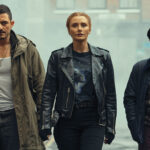
MOnster: The Ed Gein StoryThe titular serial killer and Chad PowersDisguised fictional footballer Ross Holiday is not automatically registered as having anything in common. But beneath the artificial mask of each character is an actor usually known for his exceptionally good looks.
Transforming Charlie Hunnam into the notorious “Butcher of Plainfield” wasn’t as difficult as one might think for Head of Hair Barry Lee Moe and Head of Makeup and Prosthetics Designer Corey Castellano. “I don’t think Ed was unattractive,” says Moe. “He had an interesting shaped head, bigger than some, but overall he was a handsome guy. I could see his easy-going demeanor attracting people in town. Charlie was, in a way, a perfect person because he’s this gentle giant, so attractive.”
Early conversations with executive producer Ryan Murphy about achieving historical accuracy also focused on moving away from making Jane physically unattractive. “Ryan was really intent on creating an all-American version of Ed Gein in Hollywood,” Moe adds. “It serves two purposes. It’s beautiful to look at, but there’s a second part to it, where you’re drawn into the story in a way you wouldn’t have been if these characters seemed like normal people at the time. The show is disturbing, but it’s amazing.”
Mo explains that the hair and makeup department aimed for real-life accuracy with Jane’s signature haircut. “Although it’s very clear that the inspiration for this haircut is rooted in SS soldiers in Nazi Germany, on Charlie it looked almost modern,” he says. “And that’s when the conversation about the eye came up. How do we increase the creep factor enough?”


Castellano looked to real life to mimic Jane’s hooded eye using a piece of prosthetics the size of a little finger. “The way Charlie approached it was that he could use it to seem a little imperfect, or with the right little shift in his expression, it was kind of malevolent and dark,” Castellano says. “He really used it to great effect. Combining that with Ed’s signature hairstyle made him the character.”
The duo’s biggest hurdle was portraying Jane and other characters over a 40-year time period from the 1940s to the 1980s. “TV is about maximizing time, and one of the most effective ways is to show a series,” Mo explains. “On this show, we would sometimes shoot movies in the 40s in the morning, 60s in the afternoon, and 70s later. You have to have the knowledge and ability to focus during those three periods quickly and efficiently.”
This involves removing medical prosthetic glue from someone’s face at any time, which is not an easy process at all. “Trying to do it in the middle of the day and get Charlie’s face back to its happy place where little Ed could be was a challenge,” Castellano says.
A more welcome test for the two was to recreate scenes from films inspired by Jane’s crimes, such as Infamous. mental patient The shower scene in the second episode and Texas chain saw massacre In the fourth episode. “Everyone was really proud,” Mo says. “You say, ‘Wow, this is really special.’” Even though it’s a dark story, recreating something that’s part of cinematic history isn’t something you have to do often.
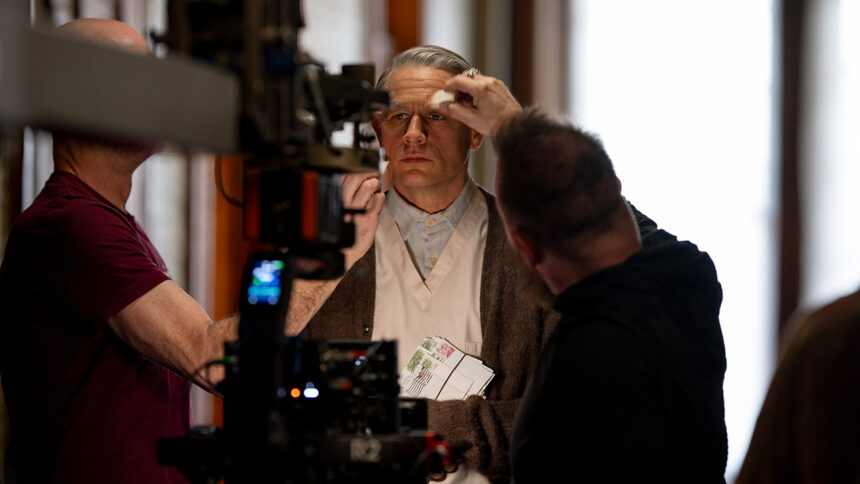
Chad Powers It was also inspired by a cinematic icon, albeit a much less terrifying one. In the Hulu comedy series, Glen Powell portrays a disgraced professional football player who takes a page from… Mrs. Doubtfire Playbook to hide his true identity. For makeup department head Alexei Dmitry and hair department head Ally Vickers, the task of coming up with just the right amount of camouflage for Powell was a matter of trial and error. “[Prosthetic designer] Vincent Van Dyck created a range of different noses and chins. “We tried prominent teeth, small teeth, a moustache, no moustache, and bigger, bushier eyebrows,” Dmitri recalls. “When it all came together, Glenn said, ‘This is it.’ He felt like this was Chad Powers. When Allie first put on the wig, he started doing the voice and everyone was dying laughing.


But making Powell appear unrecognizable was only one part of a larger goal. “It has to go through the real world, so we needed to be able to see this as a person, not just a caricature,” Vickers says. Another consideration was that Powell’s character had to achieve the elaborate look quickly on his own, with the help of only one other person — trusted confidante Danny (Frankie Rodriguez), who’s also the team’s mascot — and a tube of party store glue. With a prosthetic nose, forehead, set of cheeks, and attachable upper lip, here subtlety takes a bit of a backseat. “We’ve skewed the reality, a little bit, about how long it would take someone to do this,” Demetriou says. “[In real life,] “We do it in about an hour and a half between the three of us.”
For the two industry vets, the show included some surprising career firsts. Creating an effect that looked homemade – even shoddy – was initially unthinkable for Vickers. “I had to change my way of thinking because we’re so trained to think, ‘I want it to be perfect and undetectable,’ and here it’s like, ‘No, we want the helmet to come off with the wig, so his blonde ends are showing,'” she says.
Meanwhile, Dmitri made his first on-screen appearance, as he and lead prosthetic makeup artist Kevin Kirkpatrick played Ross’s father, Mike (Toby Huss), and Danny, as they applied Chad’s makeup together in the season finale. “I’ve never been able to do anything like this in my career,” he says. “We had our actors, Frankie and Toby, right next to us and I would mix a part of it and then we would give the instrument to our actor and say, ‘Okay, now you’re going to do it.’” It was the most realistic shoot ever of us putting makeup on someone in front of the camera, and that was really special.


This story first appeared in the June standalone issue of The Hollywood Reporter magazine. To obtain the magazine, click here to subscribe.