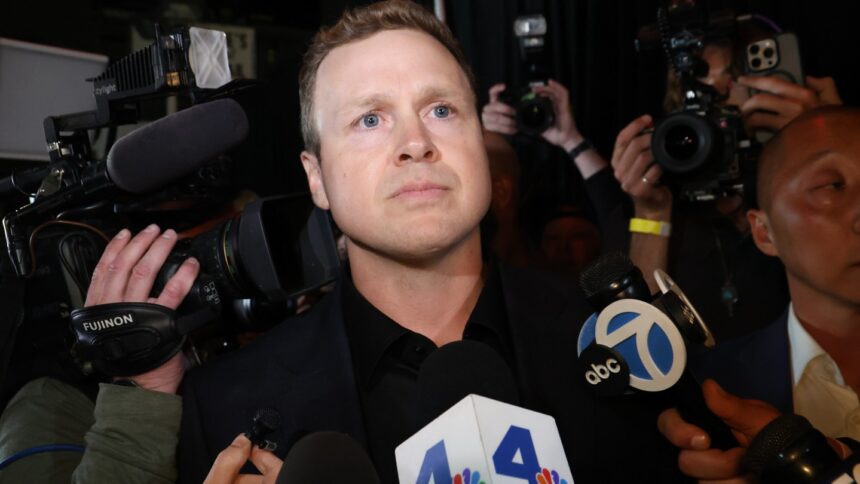
Ever the cunning and adventurous, reality TV villain Spencer Pratt has forced his way into the Los Angeles political conversation with a tumultuous mayoral bid that now appears to have failed to make it past the primary contest. Instead, incumbent Democrat Karen Bass appears likely to face off in next November’s general election against progressive City Councilwoman Nithya Raman.
Pratt’s apparent loss was no surprise to anyone with any idea of the city’s political demographics. Not only does he have no leadership experience and a checkered personal history, which he boasted about in his best-selling memoir published shortly after he announced his candidacy. He’s a registered Republican who tried to run for office in left-leaning Los Angeles as an independent, even after President Donald Trump named him a “big MAGA guy.”
However, Pratt’s arc of redemption as a crusader became an object of fascination, even fan fiction, for conservatives and unconventional types across the country who saw his reformist focus on municipal ills as a potentially winning strategy in deep blue districts. Then, when it didn’t work — in the last election cycle, well-intentioned and well-intentioned local conservative Rick Caruso spent more than $100 million on the same wishful thinking — many of his supporters claimed the election was rigged, despite having no proof. “Forget it, Jake. It’s Chinatown,” prominent right-wing activist Christopher Rufo of the Manhattan Institute posted on June 7.
In the event of defeat, Pratt’s next move will likely be a pivot as a right-wing media personality, hybridizing the roles of news critic and unscripted character. For years he has been searching for a suitable hook to get him and his family back on television. Exile and resurrection in the red may finally secure him the green light. Paramount+ or Fox Nation would be a natural fit.
Despite his unexceptional loss, Pratt should be recognized as one of the most important local political figures in recent memory. His improbable campaign, which cast Clegg in the national spotlight on the race, ushered in the era of the influential candidate in America and reshaped the narrative around the city’s major, intractable social issue: homelessness.
The 42-year-old digital creator launched his bid for city council after losing his family home in the 2025 Pacific Palisades wildfires — a disaster he blamed on government incompetence. His grievance-fueled populism has resonated with a large group of disillusioned voters who increasingly view Los Angeles as a dystopia amid constant street encampments, property vandalism and runaway film and television productions.
Pratt’s main character energy proved attractive to donors (primarily out-of-state) as well as meme makers, who were drawn to his mix of righteousness and anger as well as irreverence. His distinct sensibility—theatrical, satirical, anarchic, and heartfelt—was rooted in the Internet. This is a guy who spent decades jabbering into his front camera, and now he’s invested his campaign money in online cutting services to promote his appearances on the podcast circuit.
Perhaps most important was Pratt’s approach to homelessness, which ran counter to the local liberal establishment consensus on policy making and enforcement. Other candidates, including his main rivals Bass and Raman, spoke of “unhoused neighbors” and the accompanying need to build affordable housing units to help them. Meanwhile, Pratt has called for tough action by law enforcement to remove “zombies” from public places, arguing that they pose a danger to themselves and others due to mental health problems and drug addiction (which often occur).
A lot of politics is about framing. Just ask the professionals who cooked up “death tax” for estate tax, “illegal immigrants” for illegal aliens, and “safety net programs” for welfare. Pratt, who uses dehumanizing language, was first and foremost a storyteller who intuitively understood how to manage perception and messaging — just like fellow vet Trump, who a decade earlier set the terms of his own agenda on immigration and deportation.
Paradigm shifts are rare in Los Angeles politics. The last truly transformative figure was the city’s first black mayor, Tom Bradley, who governed for two decades beginning in 1973. He secured the 1984 Olympics, expanded Los Angeles International Airport and helped orchestrate the rise of the downtown Financial District’s skyline. However, his broadest influence was in the pioneering electoral coalition that carried him to victory across five terms – a mix of black and Jewish voters, white yuppies, union members and key corporate leaders. (At the time, Los Angeles was less associated with Latinos and Asians.) This was the plan that Barack Obama later followed to reach the presidency.
Pratt’s candidacy and use of homelessness may be a passing weapon, or it may be something more. Just look at former left-wing radical Tom Hayden, who lost his bid for mayor in the 1990s to Richard Riordan, the most recent Republican to hold the office. (Hayden was Jane Fonda’s longtime partner, and in 2020, Eddie Redmayne portrayed him in the film Chicago 7 trial.Hayden, a California state senator, then campaigned on an ardent anti-urban sprawl and transit-oriented political platform that was at the time considered marginal in the city. Now that’s conventional wisdom.
Fast forward to today. Bass’s first line of attack after Pratt v. Raman was about how her campaign was looking to “win a contest against an opponent who allows camps near schools.”
The precedent for Pratt and his supporters was the San Fernando Valley secession movement of the turn of the millennium, which arose out of similar anger and resentment over negligent, even dismissive, local governance. As secession disintegrated, reactionary energy in the valley led to structural reforms in the city council. Most notable is the establishment of neighborhood councils, which, despite their flaws, remain a source of enormous pressure. A quarter century later, the valley is being taken seriously in political debates as well as elections.
Pratt was no match for the Democratic political machine in Los Angeles. But his civic legacy remains unwritten.