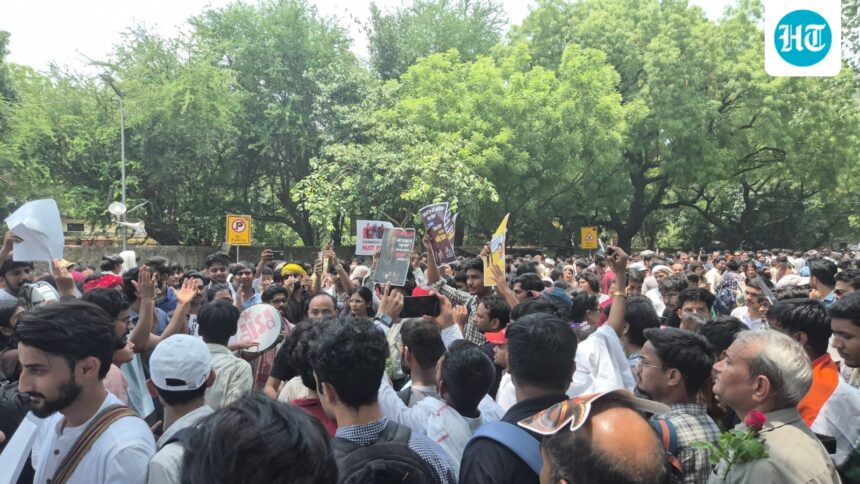
For students and parents, the CJP protest was more than just paper leaks

As hundreds of protesters gathered in the sweltering heat in New Delhi on Saturday, the Sarsoor Janta Party and its supporters raised their voices against the ongoing examination irregularities. Citing the leakage of NEET papers, the on-screen grade for CBSE, the cancellation of SSC exams, and the recent delay in CUET UG, the protesters called for a better education system for students in India, speaking in particular about how pressured and unfairly individual students feel.

The Sarsour Janta Party, an online satirical group that began as a response to Chief Justice Surya Kant’s remarks, held its first public protest on June 6. Besides demanding a better education system, party supporters also called for the resignation of Education Minister Dharmendra Pradhan.
The call for the protest was given by CJP founder Abhijit Debke, who led the crowd at Jantar Mantar a few hours after landing from the US. Debki was accompanied by the group’s three spokespersons, representatives of the All India Students Federation, and climate activist Sonam Wangchuk, who also attended to show support for the movement.
While it was assumed that the participants would be mainly Gen Z students from across India, HT also interacted with teachers, parents, activists and others who did not fit into this category.
Students are the most affected
“Humare bachchon ke saath galat ho raha hai, unke saath nainsaafi ho rahi hai,” was a phrase I heard repeatedly from Jantar Mantar participants, speaking of “the injustice that children are exposed to, facing an unjust system.”
A teacher from Pune spoke to HT about the plight of students affected by what he described as “persistent” irregularities.
“Students are already under pressure when they appear for competitive exams like NEET, JEE and other government exams. This pressure only increases when they hear about paper leaks. We are here today to support our students, to ensure that when they study hard, the least the agencies and the government can do is to ensure that there are no delays or leaks,” Ramadan told HT.
Another protester, Vikas, told HT that they were there to demand accountability from the government and an improvement in the system. Nitish, former president of JNUSU, also highlighted the findings of 17-year-old Sarthak Siddhant, who pointed out alleged discrepancies in the tenders issued by CBSE to Coempt Edu Teck amid the ongoing OSM row, and called for a systemic change.
Read also | When roses, anger and cockroaches gathered together in a summer swarm at Jantar Mantar
“The youth of the country are here, the constitution is in our hands, we will take it back,” he told HT.

While the sentiments in the protest extended beyond education, the overall focus remained on creating a better system for students — one not marred by paper leaks, delays, or sudden cancellations.
Anger takes priority
“To think that a protest like this came out of a cynical reaction shows how angry we are and that we are done with injustice,” said Vanshika, a mental health doctor in Delhi. “We are all very angry. Listening to the news every day, whether it is press leaks, violence against women, student suicides, or infrastructure failure, we have reached a point where we are simply done and want change,” she told HT.
Read also | Lack of trust in the media emerges as a major theme among Sarsour Janta Party protesters
In the run-up to the protest, several student suicides were reported across India. The latest case was reported on May 20, when a 20-year-old woman died by suicide after the NEET UG exam was cancelled.
“I had high hopes of getting good grades in NEET, but now there is no guarantee that I will do well if I have to take the paper again. I’m sorry mom and dad. I’ve ruined everything,” she wrote.
Another NEET student from Rajasthan was found dead amid distress caused by cancellations. The student’s father told the media that his child was hoping to score at least 650 marks in the NEET UG exam, but the stress following the paper leak may have prompted him to take the extreme step. In Karnataka too, an 18-year-old student died by suicide after the NEET exam was canceled due to a paper leak.
Stating that students are “devastated,” Vanchika highlighted the ongoing impact of the COVID-19 pandemic and the rapid rise of artificial intelligence, which she said has created uncertainty about the future, especially among young people.
“Students cannot die by suicide at the age of 17,” she said, adding that the sharp increase in student suicides reflects the country’s impending public health crisis.
Speaking about the cockroach movement, Vanchika said that she did not know if there would be immediate change, but added that she had hope, and upon seeing the public support for Dibek and the movement in general, the mental health expert felt that “it may be time for a change.”

Danita Yadav is a Senior Content Producer at Hindustan Times. Danita is based in New Delhi and serves as a pivotal voice in international reporting within the team. Operating under a mandate to deliver services ‘without the noise’, Danita excels at distilling complex geopolitical developments into clear, objective narratives that prioritize factual accuracy over sensationalism. At HT, Danita was honored for her breaking news efforts and time-bound coverage of the Air India plane crash, which drove over 2 million users to the site with reliable and factual coverage of the incident. Thanks to her success in high-pressure editorial environments, Danita has also earned a reputation for navigating the nuances of global diplomacy and cross-border politics. With over four years of experience in the journalism industry, Danita has spent her years deep diving into covering international relations and global conflicts. She previously worked with the news teams at Outlook India and Times Network, where she covered a wide range of topics and topics, from education curriculum and student protests to Indian politics and international conflicts such as the Ukraine, Gaza and Sudan wars. Danita holds a bachelor’s degree in journalism from Kamala Nehru College, Delhi University. Aside from the newsroom and her love of international relations, you’ll find Danita “obsessed” with books, music, and BTS. Her appreciation for global popular culture and storytelling also added to her unique perspective on the “soft power” dynamics that have increasingly shaped international relations in an ever-changing global order.Read more