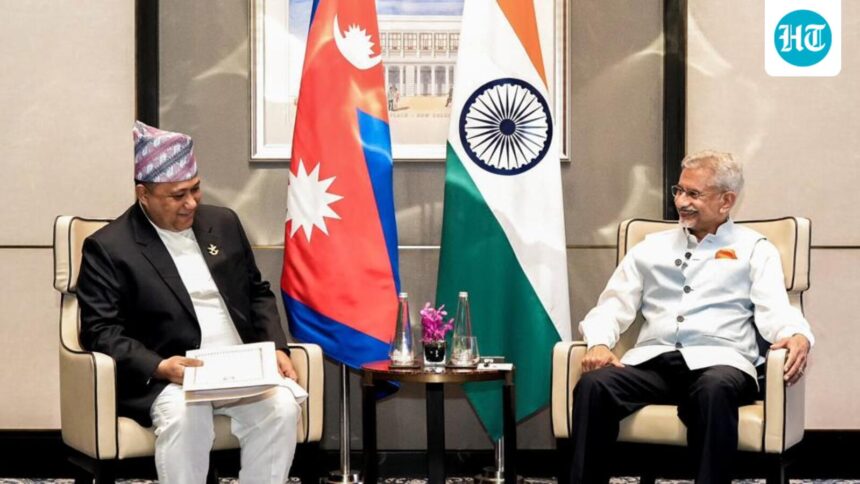
Nepali Foreign Minister Shisir Khanal said on Sunday that Nepal wants to address its border disputes with India through existing bilateral mechanisms and without any mediation from others, supporting New Delhi’s rejection of any third-party interference in the matter.

Khanal, who was speaking to reporters at the end of the visit that saw him hold talks with External Affairs Minister S Jaishankar to reset bilateral ties after Nepal’s general elections in March, explained his government’s resolve to shift Indo-Nepal relations “away from geopolitical friction” and root them in development diplomacy.
He said that the bilateral partnership should not be “constrained by concerns of the past”, but rather be driven by the prospects of a shared future.
The visit was preceded by a dispute over the border regions of Limpiyadhura, Lipulekh and Kalapani, which Nepal has long claimed, and statements by Nepalese Prime Minister Balendra Shah that seemed to hint at a role for China and the United Kingdom in settling the dispute.
India ruled out any role for third parties and said all undefined parts of the border should be settled through existing bilateral mechanisms.
Khanal said Nepal had sent diplomatic notes regarding its land claim in Kalapani district after India and China reached an agreement on resuming the Kailash Mansarovar Yatra to Tibet via Lipulekh.
In his remarks, Shah referred to Nepal’s “historical claim” and the impression that many of the border disputes are part of a “long historical legacy” dating back to British rule in the region.
Khanal said that since the origin of the dispute goes back to the Sugauli Treaty of 1816, Shah cited Nepal’s desire to access historical evidence and documents that may be available in the UK.
He pointed out that Shah stressed that this matter would be resolved by both sides through talks and diplomatic mechanisms. “Our position was not that we were asking for mediation,” he said.
“True independence means that our shared borders serve as highly efficient bridges, not frustrating barriers,” Khanal said. “Rather than engaging in hyper-nationalistic grandstanding, we seek calm, data- and evidence-based debate to resolve challenges in good faith.”
He insisted that there would be no “too complicated” border if “both sides sit down with an open heart, a rational mind and mutual respect.”
Highlighting the “unique origin” of Nepal’s ruling Rastriya Swatantra Party, which emerged from the so-called Generation Z uprising last year, Khanal said: “We are not burdened by the past at all, and refuse to look at India through the distorted, hypersensitive lens of 20th century geopolitics.”
He said the RSP represents “a completely new political reality” in Nepal and has been given an “extraordinary mandate” centered around good governance, strict meritocracy and direct accountability. “We look at India with an open heart, clear eyes and one transparent agenda – Nepal’s economic transformation,” he added.
The two sides now need to “bridge the gap between old promises made on paper and the physical reality delivered on the ground,” and move from “abstract political statements to achieving measurable, life-changing results.”
Khanal said that he and Jaishankar discussed activating several existing mechanisms that deal with issues of trade, energy, flood management, irrigation and borders, and that the new government in Kathmandu wants to build a relationship based on issues of common concern.
“We value connectivity through road, railway and airline networks. We want to be connected through our energy transmission lines,” he said, adding that the two sides are also focusing on joint development of the energy sector and smooth trade.
Asked about the Nepali Prime Minister’s pledge not to travel abroad for a year, Khanal said that Shah is currently focusing on finalizing the budget as he is keen on achieving early results for the people who have given the RSP a strong mandate. “He is very focused on showing results at the local level. When the time is right, he will start traveling,” he said.