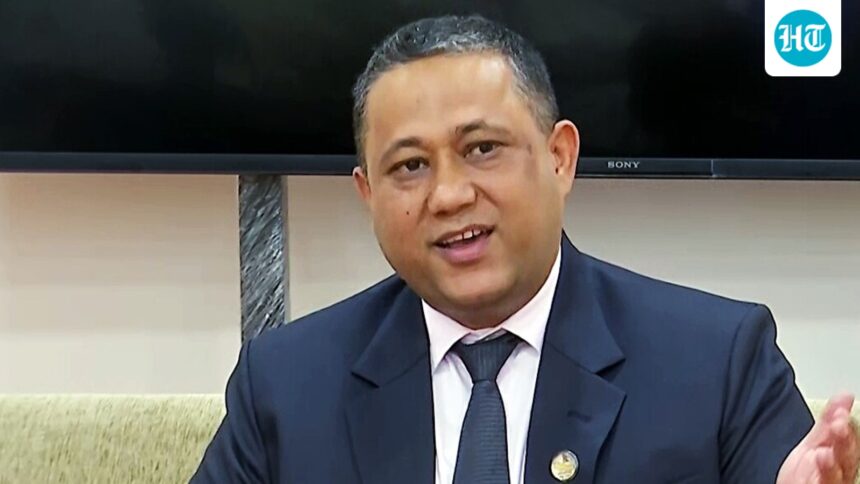
Nepal wants to resolve its border dispute with India through existing bilateral mechanisms because “no problem is too big and complex” when the two sides meet with an open heart, rational mind and mutual respect, Nepali Foreign Minister Shishir Khanal said on Sunday, effectively endorsing New Delhi’s rejection of any third-party involvement.

Khanal said Kathmandu refuses to view New Delhi through the “distorted, hypersensitive lens” of 21st century geopolitics, and instead aims to look at India “with clear eyes and one transparent agenda for Nepal’s economic transformation.”
The Nepalese Foreign Minister was speaking to the media a day after holding wide-ranging talks with his Indian counterpart S Jaishankar that focused on ways to expand ties in various sectors, including trade, biotechnology, connectivity and energy.
His three-day visit to New Delhi from Friday comes against the backdrop of the heated controversy sparked by Nepali Prime Minister Balendra Shah’s recent statements on the border dispute between the two sides. Shah also suggested the involvement of China and the UK to solve the problem.
Read also | ‘They can’t…’: Nepal minister raises concerns over India-China border trade amid Lipulekh row
The Nepalese Foreign Minister, who acknowledged India’s transformation into a rapidly growing global economic and technological power, expressed Nepal’s desire to engage with this “dynamic neighbour” by contributing its ambitious energy to the partnership.
He said: “Our primary responsibility is to bridge the gap between the bold promises made on paper and the material reality presented on the ground, and to move away from abstract political statements to achieve measurable, life-changing results.”
Khanal added: “Let us build a partnership that is not constrained by the concerns of the past, but rather a partnership fueled by high hopes and promising prospects for our common future.”
Referring to the border issue, the Nepalese Foreign Minister said that “true interdependence” means that shared borders act as “highly efficient bridges, not frustrating barriers.”
Nepal and India have had an ancient border dispute over Lipulekh, Limpiyadhura and Kalapani. India has consistently maintained that these lands are part of the state of Uttarakhand.
Late last month, Nepalese Prime Minister Shah sought to engage China and the UK in addressing the long-standing border dispute between India and Nepal. Days later, New Delhi categorically rejected any role for third parties in resolving the dispute.
The Nepalese Foreign Minister said that the UK’s participation was intentional in the context of benefiting from historical documents and details from British libraries and museums.
“We want to resolve our disputes through diplomatic processes. We just want to see if we can access some documents that may be in libraries or museums in the UK. It has not been our position that we are asking for mediation,” he said.
“Instead of engaging in hyper-nationalistic displays, we are pursuing calm discussions based on data and evidence to resolve challenges in good faith,” the Nepali Foreign Minister said.
Khanal said 2026 offered “the most appropriate and most compatible window” for the two countries in decades to “fully elevate and transform” their relations.
“No problem is too big, and no border is too complex, when we sit with an open heart, a rational mind and mutual respect,” he said.
In response to a question about Nepal’s objection to the Kailash Mansarovar Yatra passing through Lipulekh district, Khanal said that Kathmandu’s concerns stem from the understanding between India and China to use the route for pilgrimage without consulting Nepal, claiming that the area belongs to his country.
“Our concerns relate to the renewal of the agreement between India and China on the Kalapani and Lipulekh area, as we have said for a long time that the land belongs to us, and without Nepal’s consent, the two countries cannot conclude those agreements on their own,” he said.
“We have made this very clear through our communications, including the diplomatic notes of both countries,” he said.
Meanwhile, the Nepalese Foreign Minister stressed that Nepal seeks to resolve the issue with India through existing bilateral mechanisms.
Khanal said that the new government in Nepal has a strong desire to deepen relations with India.
Read also | Nepal PM’s statement on borders and space for serious talks
“When we look across borders, we see a rising India – an India that has fundamentally and beautifully redefined itself on the world stage as a fast-growing, dynamic, technological and economic powerhouse,” he said.
“We want to engage with this India of intense ambition, cutting-edge technology and relentless execution. In return, we bring the energy of ambitious Nepal,” he said.
Khanal also spoke about the historical relations between India and Nepal, saying that the people of the two countries are children of the same rivers, the same mountains and the same ancient wisdom.
“Every time during the journey from Kathmandu to New Delhi, when I look at the majestic Himalayas edging towards the vast and fertile plains of the Ganges basin, I am reminded of a profound truth,” he said.
He said: “We are not just neighbors linked by political lines drawn on a map. Rather, we are children of the same rivers, the same mountains, and the same ancient wisdom.”
The Nepalese foreign minister declined to give a direct response when asked about the youth-led “Generation Z” protests in Nepal in September 2025 and the Cockroach Janta Party’s protest in New Delhi on Saturday.
“There was a movement in September, and the political transformation that took place brought us to power,” he said. “I don’t want to comment on what is happening in India.”
In response to another question regarding US customs duties on Nepalese goods, he said: “We are in constant dialogue with the Americans.”