The Indian Army expects to induct the Zorawar light tank in 2028-2029 after fixing issues reported during its development and trials, a move that will significantly enhance the speed of deployment and combat response of armored regiments in the mountains, Army Chief General Upendra Dwivedi said.

“Issues observed during development and testing are being addressed through the regular design improvement cycle. Based on current timelines, Zorawar is likely to be operational in the 2028-2029 timeframe, subject to successful completion of trials, user evaluation and readiness for production,” Dwivedi said in an interview with HT.
The tank – which was earlier expected to be operational in 2027 – will strengthen the army’s hand against Chinese forces along the disputed Line of Actual Control (LAC). The tank has been jointly developed by the Defense Research and Development Organization (DRDO) and Larsen & Toubro under Project Zorawar to meet the Indian Army’s requirement for 354 light tanks – a capability enhancement that is likely to cost around 354 light tanks. $17,500 crores.
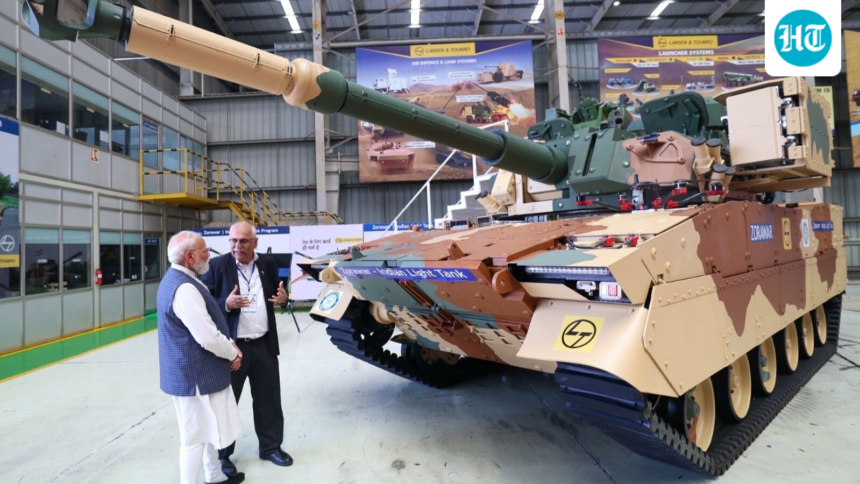
The Army Chief said that the 25-ton Zorawar tank is a big step towards indigenous capabilities and reflects the spirit of Atmanirbhar Bharat. “It is designed as a light, agile, technologically advanced armored platform tailored to our terrain, especially high altitude terrain. The requirement is for a protected, mobile, manned and unmanned, team-enabled platform with significant firepower, surveillance and communications capabilities.”
Dwivedi made the comments in the interview on June 4, a day before Prime Minister Narendra Modi reviewed the prototype of the tank at L&T’s Hazira facility in Gujarat and was briefed on its capabilities. “The role played by L&T in promoting self-reliance in the defense sector is commendable,” the Prime Minister said on Friday.
Of the 354 tanks ordered, DRDO-L&T will supply 59 tanks and the remaining tanks will be built under a separate program for which other companies will also compete. The light tank can be airlifted, conduct amphibious operations, and fire at high elevation angles to serve as limited artillery.
The People’s Liberation Army of China has fielded and deployed several modern tanks, including light tanks with a high power-to-weight ratio, along the Line of Actual Control. The Indian Army has deployed dozens of heavier Russian T-72 and T-90 tanks in the Ladakh theater, but they have their own limitations as they are designed for operations in plains and deserts.
The need for light tanks with adequate firepower and protection, surveillance and communications capabilities became clear after the start of the border row between India and China in 2020 – with the disengagement of rival forces from all friction points in eastern Ladakh being completed after four years.
The tank is named after legendary General Zorawar Singh, who led Dogra forces six times, between 1834 and 1841, to victories in Ladakh and Tibet. In May 1841, he led a 5,000-strong Dogra force into Tibet and within weeks overran Chinese forces and captured the flag of Mantalai.
“We need Indian solutions to Indian challenges because our terrain, threat matrix and operational requirements are unique,” Dwivedi said, adding that indigenization is key in the Army’s modernization journey.
The Army Commander said that India’s geography and security environment is unique, extending across mountains, deserts, forests, plains, riverine areas, island lands and long, unstable borders. “This requires preparedness across all five generations of warfare, from traditional contact battles to hybrid, non-contact, technology-based, and cognitive warfare,” he added.