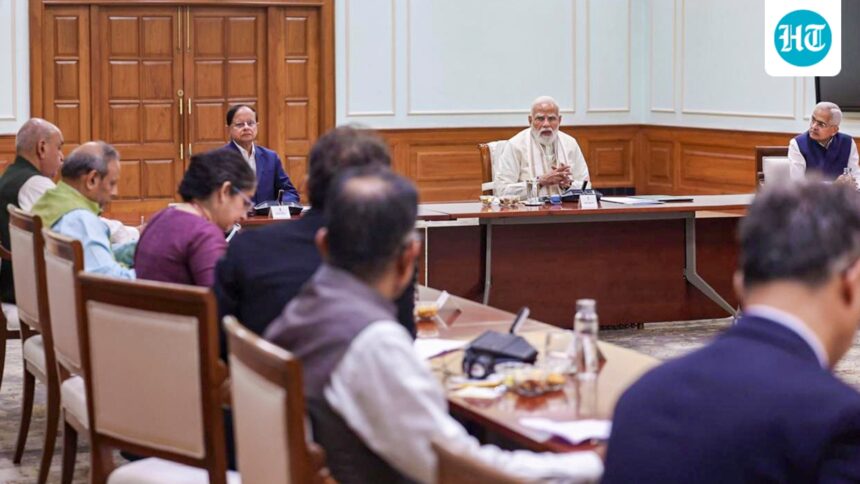
Prime Minister Narendra Modi on Saturday chaired a meeting of his Economic Advisory Council to discuss India’s economy and long-term development priorities, a day after official data showed the economy grew by 7.7% in 2025-26 and the government unveiled a package of foreign investment reforms.

“He chaired a meeting of the Prime Minister’s Economic Advisory Council. He deliberated on a wide range of issues related to India’s economic transformation and India’s long-term development priorities,” Modi said in a post on X, adding that he shared views on “adding more impetus to the reforms journey and ensuring ‘ease of living’ as well as ‘ease of doing business’.”
The meeting came against a backdrop of criticism from opposition parties, which pointed to the deterioration of the rupee against the dollar and rising retail fuel prices as evidence of policy failure.
Modi and members of the EAC discussed various ideas and measures to further boost economic growth in the ongoing unstable global environment, said people familiar with the matter, requesting anonymity.
The Finance Ministry on Friday announced measures to expand investment options for foreign individuals and portfolio investors in Indian stocks and make government bonds more attractive with tax concessions, while the Reserve Bank of India has taken monetary measures, including hedging cost support for foreign commercial loans and opening a concessional swap window for FNR(B) deposits to boost foreign exchange inflows and support the rupee.
These measures were aimed at addressing structural flaws that made Indian government securities less competitive compared to similar sovereign instruments in emerging market peers, people familiar with the matter said. The rupee rose by 56 paise after the announcements on Friday. They added that further gains in the rupee are expected.
Saturday’s meeting was also against the backdrop of the Office for National Statistics’ provisional GDP estimates for 2025-26. The economy grew by 7.7% for the full year, with fourth-quarter growth of 7.8%. Reacting to the GDP data, Modi on Friday said: “We will not leave any stone unturned to promote ‘ease of living’, ‘ease of doing business’ and increase opportunities for our youth.”
According to a PTI report, two of the Prime Minister’s principal secretaries – PK Mishra and Shaktikanta Das – attended Saturday’s meeting, along with members of the East African Community.
The Prime Minister’s Economic Advisory Council is an independent body set up to advise the government, specifically the Prime Minister, on economic and related issues. Its powers include analyzing issues referred to it by the Prime Minister, addressing macroeconomic issues on its own or based on a referral from the Prime Minister or others, and performing any other tasks that the Prime Minister may assign.
The Council currently includes a Chairman, three full-time members, and 11 part-time members. Prof. S. Mahendra Dev is the Chairman. The full-time members are Sanjay Kumar Mishra, Sanjeev Sanyal and Shamika Ravi. The 11 part-time members are Rakesh Mohan, Sajid Z Chinoy, Neelkanth Mishra, Neelesh Shah, TT Ram Mohan, Soumya Kanti Ghosh, KV Raju, Chetan Ghat, Pami Dua, Pulak Ghosh and Gaurav Vallabh.