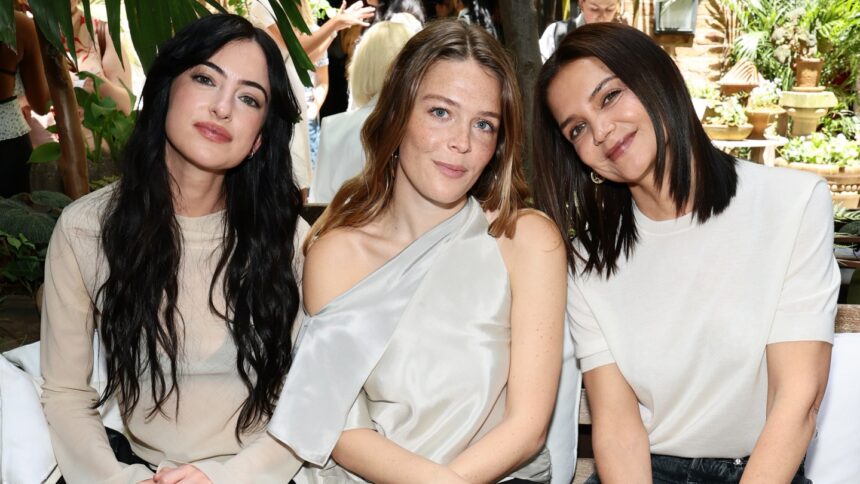
On Friday, a number of established and emerging Hollywood creatives — including Meg Ryan, Jodie Foster, Katie Holmes, Catherine Hardwicke, Mihala, AnnaSophia Robb, and Tommy Dorfman — joined Tribeca Festival co-founder Jane Rosenthal at the Greenwich Hotel to celebrate “Through Her Lenses: The Tribeca Chanel Women’s Filmmakers Program” as part of its annual luncheon.
The star-studded event saw guests dressed in their best summer Chanel looks as they mingled on the first floor of the hotel with the main festival, courtesy of Her Lens and led by Tribeca Enterprises. This included CEO Rebecca Glashow, who celebrated the festival, the company and the program’s history in women’s work. “In Tribeca, I’m happy to say that more than 70 percent of our team is made up of women,” Glashow said to cheers. “Beyond numbers, it reflects a culture built on the belief that diverse voices make things stronger, more creative and more connected to the world around us. This is the belief at the heart of everything we do at Tribeca, and what makes Through Her Lenses so special.”
Glashow passed the mic to Rosenthal, who began by congratulating director Quinn Whitney Wilson on Netflix’s acquisition of the Tribeca Film Festival’s world premiere and documentary debut, Jean-Michel Basquiat. After a round of whoops, cheers and a little dancing, Rosenthal focused on thanking Chanel for continuing to support the event before delivering her authoritatively rousing speech.

Standing alongside Glashow, through Her Lens advisory board member Patty Jenkins, Tribeca Festival Executive Vice President of Artist Relations and Special Events Nancy Lefkowitz, and Tribeca Enterprises Vice President of Studios and Artist Development Bryce Norbitz, Rosenthal recalled how “Tribeca was born out of the belief that culture could help rebuild what fear and hate tried to tear apart. Twenty-five years later, I believe it as strongly as she did.” “I.” And then, through her lens is a big part of that vision.
Inside the hotel, as the crowd — which also included Maggie Rogers, Cazzie David, Ella Beatty, Ari Graynor, Kerry Kinney Silver, Debi Mazar and Francesca Scorsese — spilled into the courtyard, Rosenthal got candid. “Let’s be honest about what’s really at stake. It was never just about representation. It’s about power. Who gets the funding? Who gets the microphone? Who gets to share the narrative? Who do people remember?” She said. “History is erased when contributions are never recognized, when achievements are never credited, and when stories are never funded, produced, or preserved.”
She continued: “It changes what we think is possible. That’s why the work you do is important.” “Not just because you make movies, but because you shape culture. You help us understand each other; you challenge what we think we know; you create empathy in a world that increasingly rewards anger.”

Days earlier, at the Perelman Center for the Performing Arts across from the World Trade Center, Rosenthal and Tribeca co-founder Robert De Niro shared similar sentiments in honor of the festival’s 25th anniversary and former New York Mayor Michael Bloomberg’s contributions in launching it with 1,300 volunteers just 120 days after 9/11. Denis Leary and Marcus Samuelsson.
“The opening day of the festival came when lower Manhattan was still reeling. There were so many uncertainties, and many people believed the area might never recover,” Bloomberg noted in his speech Monday evening. “Few people thought the neighborhood could become stronger and more vibrant than ever before. But I know Bob and Jane did.”
“We would not have reached number one without Mike’s innovative and passionate support,” festival co-founder Robert De Niro told the special gathering. “Tonight, this hall is full of people who have given so much to the festival. I don’t want to say that Mike Bloomberg outshines us all, but let’s just say he stands out.”
Rosenthal was clear in her praise of Bloomberg and his administration’s role in helping to revitalize Lower Manhattan through the festival, along with the contributions of other politicians like former Governor George Pataki, who “walked with me and Liam Neeson to every firehouse in Lower Manhattan to hand out tickets” in 2002. Rosenthal specifically noted how Bloomberg’s personal contributions brought the city back “from the brink.” “Mike’s predecessor is a self-proclaimed America’s mayor, but we are lucky to have Mike Bloomberg as mayor of New York.”

Both events embraced the authenticity, resilience, perseverance, innovation and sense of community that drives the festival. At a luncheon through her lenses, twilight and thirteen “Opening night,” Helmer Hardwick recalls, “they explained [the festival’s] Date to September 11 and accumulation. It’s so unbelievable [Rosenthal] And Robert had a vision to do such a wonderful seismic thing to change the neighborhood. How can anyone not admire the hell out of her?”
“Everything about this festival seemed completely impossible in 2001,” Drina De Niro said in a separate conversation on Friday. “I’ve watched Jen drive all of this with passion, getting my parents involved, getting everyone in the neighborhood involved. It’s emotional and amazing. Jen is one of the most focused people I know. She doesn’t spend time on all the things that get in the way of making it happen, and I’ve really admired that drive and confidence.”
The result, says De Niro, is a festival and event with Chanel “not a competitive environment, and that’s what’s so great. You realize we all want the same thing. We all want to tell our story, we all want respect, we all want connection. Here we’re all together as one celebrating the same goal.”

The festival’s goals are unsurprisingly similar to those of the Through Her Lens festival, Glashow says, as an intentional community and creative development effort. “My biggest focus is to continue to grow the audience as we see the next wave. How do we make sure they respond, that they know this is a place where they can tell their stories and get support?” She said.
“I definitely see it expanding. There’s a question about whether it might emerge at other times of the year in different ways, as we get deeper into one of the sectors we’re getting into?” It continues. “Taking it internationally is a very big priority. The brand means a lot. It really translates because of our unique approach to people’s festivals – we see it resonating in Portugal and having the same impact as it had in New York, both in connecting with locals, but also in bringing in industry and doing a lot to support the city’s economy.”