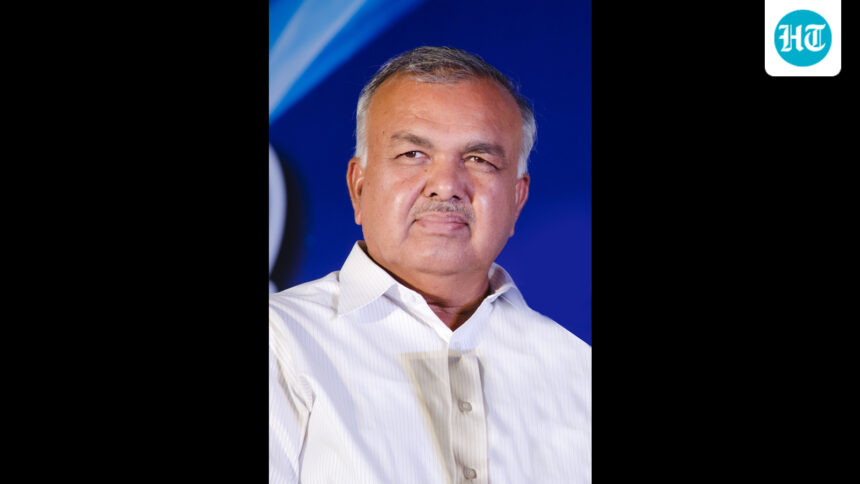
The resignation of R Ramalinga Reddy from the newly formed government in the state after being denied the Bengaluru Development portfolio has reaffirmed the importance of the portfolio which is seen as one of the most influential centers of power in the state government, party leaders said on Friday.

Reddy’s resignation came at a stage when Bengaluru is gearing up for much-awaited civic elections and a new phase of urban governance.
“This is no longer a traditional urban development portfolio,” said a senior Congress leader involved in the discussions surrounding government formation. “The Minister is actively engaging with the future Congress government.”
Krishna Bair Gowda took charge of the department on June 3.
Under the current structural allocation, the Bengaluru Development Minister directly supervises the Greater Bengaluru Authority (GBA), the Bruhat Bengaluru Mahanagara Palike (BBMP), the Bangalore Water Supply and Sewerage Board (BWSSB) and the Bangalore Metropolitan Corporation Limited (BMRCL). This focus on local governance distinguishes it from the broader urban development portfolio.
As the state’s economic engine and largest urban centre, Bengaluru receives disproportionate political attention. “In Bengaluru, development decisions are political decisions,” said a party leader familiar with the matter. “Roads, planning, infrastructure, mobility, civil administration, housing – everything ultimately comes back to this administration.”
“There is a reason why prime ministers have historically kept this portfolio for themselves,” another Congress leader said. “The administration addresses every major issue in the city and gives the government a direct role in shaping the future of Bengaluru.”
As Bengaluru emerged as a global technology hub, the city became closely associated with the administration of former chief minister SM Krishna, who held the position between 1999 and 2004, and is seen as having effectively led its urban transformation.
While previous chief ministers, including Siddaramaiah, BS Yeddyurappa and Basavaraj Bommai, have historically held the portfolio to exercise direct control, it has sometimes been divided as an exclusive ministerial assignment for heavyweights. This includes KJ George during mid-2010, and more recently DK Shivakumar, who headed the department alongside his role as deputy chief minister under the previous Siddaramaiah-led administration.
This shift has added an advantage to the existing friction. Party insiders indicated that Ramalinga Reddy was expecting to fill the vacancy created by Shivakumar’s elevation, citing an understanding that oversight of the city would return to the veteran urban hand once the leadership shifts.
“The upcoming civic elections have changed the political calculations,” a senior party leader said. “Whoever oversees Bengaluru’s development will have an important role in how the government delivers its work in the city.”
“Ramalinga Reddy has decades of political investment in Bengaluru, while Krishna Bair Gowda has emerged as a young Turk in the government’s plans for the city’s future,” said another Congress leader familiar with the Cabinet discussions. “From the party’s point of view, they both had a case.”