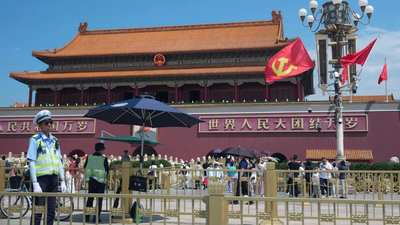
Chinese authorities are restricting any public remembrance of the 1989 Tiananmen Square crackdown, preventing victims’ families from visiting graves and intensifying efforts to erase the event from public memory, on the 37th anniversary of the military action.Police told relatives of the victims that they would not be allowed to visit a cemetery in Beijing on the anniversary, according to a person familiar with the matter who spoke on condition of anonymity, the Associated Press news agency reported.For more than three decades, members of the “Mothers of Tiananmen” group have been visiting the site annually to read commemorative statements under police surveillance, Amnesty International said.
Preventing families from visiting cemeteries
Hundreds, perhaps thousands, were killed when troops moved into Beijing in 1989 to crush student-led pro-democracy protests in and around Tiananmen Square.The crackdown remains one of the most sensitive events in China’s modern history, with official discussion subject to severe restrictions inside the country.The decision to block access to the cemeteries is seen as part of a broader, long-term campaign to suppress public remembrance.Amnesty International described the move as a “cruel act”, saying repression appeared to be escalating as authorities tightened control over commemoration efforts.
The crackdown shaped China’s political trajectory
Military intervention marked a turning point in China’s modern development, as it ensured that rapid economic reforms were not accompanied by political liberalization.Since then, discussion of the events has remained tightly controlled on the mainland, with limited or no official commemorations permitted.In Hong Kong, where candlelight vigils have attracted tens of thousands, authorities have banned public celebrations since 2020 after imposing a national security law, according to Agence France-Presse.Security measures have also been tightened around major public places to prevent any gatherings.
Global reactions and ongoing restrictions
The anniversary also sparked diplomatic reactions abroad. US Secretary of State Marco Rubio said, in a statement marking the anniversary, that “no amount of censorship can erase the past.”The Chinese Foreign Ministry rejected these comments, and accused Washington of “distorting the Chinese political system” and interfering in its internal affairs, according to Reuters.Human rights groups say commemorations are increasingly being pushed to private or outdoor venues, with small gatherings continuing to be held in cities such as Taipei and others around the world, while mainland China continues to strictly censor information.Beijing still officially describes the Tiananmen crackdown as a political disturbance that has already been “resolved,” while public discussion remains tightly censored across media and online platforms.