Computer: Guinness World Records
In a limestone cave on Muna Island in southeastern Indonesia, a faint set of marks on stone has quietly passed through academic circles and into record books. The surface is not interesting at first glance, just weathered rock with pigment pressed onto it in a way that only becomes clear when light catches it from the right angle.
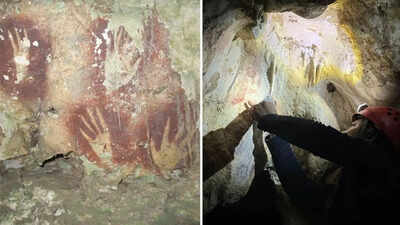
What’s there is a hand stencil, formed tens of thousands of years ago, and now placed at the center of a debate about how early humans actually thought in abstract terms.
Old hand stencils in Liang Metandono Cave reveals Symbolic behavior of early humans
The cave lies within a wider area of limestone where erosion has done most of the shaping. Inside, the markings are sparse and untidy, with the hand stencil attracting the most attention due to its age and preservation. Liang Mitandono Cave, on Mona Island, has become a reference point in discussions of early symbolic behavior in Southeast Asia, not because it looks spectacular today, but because it preserves faint mineral traces.Throughout Sulawesi and nearby islands, similar sites have been recorded over the years, many of which have been studied by teams linked to the National Research and Innovation Agency (BRIN) and international partners. The wider area slowly revealed a pattern of early human existence expressed through rock surfaces that were in use long before writing or sedentary life.
Inside the timeline of 67,800-year-old rock art at Liang Mitanduno Cave, Indonesia
Determining the age of the pigment trapped in the stone is less straightforward than it seems.
The hand stencil from Liang Metanduno Cave has not been dated directly by one step. Instead, layers of mineral growth above and around the pigment were analysed, constructing a reverse timeline. This work, partly led by archaeological specialists, including Dr Adhi Agus Oktaviana, involved repeated sampling and cross-checking across different cave surfaces.Many of the technical improvements have come through collaboration with researchers at Griffith University, where methods for dating rock art deposits have been tested and modified over many years.
The number that emerged, at least 67,800 years ago, places the stencil deep into the Pleistocene era, long before agriculture or permanent settlement appeared in the area.The finding falls into a category that is still debated in parts of archaeology, not because measurements are poor, but because findings from this era remain relatively rare and difficult to compare across sites.
How Indonesian and international teams pieced together early cave art in Sulawesi
The work on the caves across Sulawesi was not done in a straight line.
Early surveys began more than a decade ago, initially focusing on different parts of the island before moving towards the southeastern peninsula and nearby islands such as Mona. Field teams navigated dense forests, karst formations, and unstable cave systems where access was often limited by weather and terrain rather than planning.Researchers involved in the project include Adam Broome and Maxime Aubert, along with Indonesian colleagues Adhi Agus Octaviana and Budianto Hakim.
Their roles ranged from excavation, documentation, laboratory analysis, and dating procedures. Much progress has been achieved in stages, often years rather than months apart, as cycles of funding and technical development dictate the pace.Discoveries of cave art in this region have already appeared in peer-reviewed work, including one published in the journal Nature, although previous findings were younger than the Mona Island stencil.
Each new site added another piece to a broader picture of how early humans marked surfaces across this part of the world.
What the hand stencil suggests about early cognition
A hand pressed to stone and marked with pigment does not record an event as written language does. It is located somewhere else, closer to presence than description. Liang Metanduno’s stencil is non-figurative, meaning it does not depict animals or human scenes, but instead refers to the fact that a hand was there.Archaeologically, this type of marking is often treated as evidence of symbolic thinking. It involves an intention that goes beyond immediate survival, a decision to leave a mark that will last after the person is gone. Figurative and abstract images have been found across sites in Sulawesi and surrounding areas, suggesting that early humans in the region were experimenting with different forms of visual expression.There is still uncertainty as to whether these marks are part of organized cultural practices or are more spontaneous actions. The material record does not provide much context beyond the surfaces themselves.
Cave art preservation in Liang Metandono Cave, Indonesia
Cave art is often in unstable condition once exposed. Crusty rocks, moisture, and human interference contribute to the gradual loss. In Liang Mitandono and other nearby caves, some surfaces have actually deteriorated compared to previous documentation.
This has led to increased interest in digital preservation, including high-resolution recording and 3D modeling of sites.Teams working in the area also discussed how to manage access. Remote locations do not always prevent damage, and even occasional visits can alter the microenvironment within the cave. The balance between study and protection remains unresolved in practice, especially when sites are spread across multiple islands and jurisdictions.At one point, Dr. Adi Agus Octaviana, reflecting on the broader importance of studying such ancient relics, said: “Take time, as much as you can, to read or think about how wonderful it is to be human and the extraordinary journey from our first beginnings as upright apes to the amazing creatures we are today.”