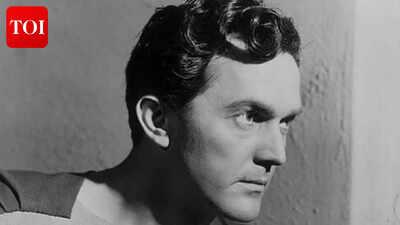
Kirk Allen didn’t just become an actor. Become a pioneer. From “Superman” to “Black Hawk” to “Atom-Man vs. Superman.” He has been in some of the most historically significant productions in the history of American cinema.
He was the first actor to ever portray Superman in a live-action film. He worked in an era before green screens, before CGI, before modern special effects of any kind. He made the series He Did the West. He did his own stunts, on real sets, with real physical danger, and with nothing but his own conviction. He stepped into a role that no one had ever attempted before, playing a comic book character at a time when Hollywood didn’t have a roadmap for how to do such a thing.
And through it all, he learned something essential about what separates a performance that tanks from a performer that tanks. Therefore, he once said: “If you’re going to do something, you have to believe in it. If you don’t believe in it, the public won’t believe in it either.”
Today’s quote is from Kirk Allen
“If you’re going to do something, you have to believe in it. If you don’t believe in it, the audience won’t believe in it either.”Kirk Allen spoke these words during promotional interviews for his 1974 autobiography “A Job for Superman,” later known as “A Man Beyond Superman,” and while speaking onstage to fans at early Comic-Con conventions during the retrospective boom of the 1970s.
At the time of these interviews, Allen is in his sixties, looking back on his youth with the clarity that only distance and experience can provide. He was explaining to a new generation of fans what it was actually like to film the original Superman series in 1948, at a time when nothing the role required had been done before.
No rules of play in the studio. There’s no superhero tradition to draw from. There is no technology to hide behind.
Just a man in a cape on set, asked to make the impossible seem completely real.
What does it actually mean?
Kirk Allen describes something that every artist, every creator, and every person who has ever tried to make something out of nothing instinctively understands. Faith is not an ornament. This is the basis. Without it, nothing else works.When Allen walked onto that set in 1948, the odds were almost comically against him. Superheroes were almost a foreign concept in Hollywood.
They were considered children’s entertainment, pulp material, unworthy of serious artistic attention. Adult audiences were not expected to take the man in the cloak seriously. The producers themselves were unsure whether making the man fly on screen was technically possible.
Everything around him was in doubt. The only weapon he had against all this doubt was his decision not to share it.He explained that clearly. If he had walked onto the set feeling embarrassed, silly or insecure, that doubt would have been transmitted directly through the camera to every seat in every cinema.
The masses are unusually sensitive to hypocrisy. They may not be able to articulate what is wrong, but they feel it immediately when a performer doesn’t believe in what they are doing. The whole illusion collapses. And with a character like Superman in 1948, where the illusion was already fragile and untested, even a glimmer of self-awareness would be fatal.So Allen made a choice. He fully committed. He plays Superman not as a lively cartoon character, not with a wink to the audience, and not with the protective sarcasm of an actor who wants you to know he knows this is ridiculous.
He played him straight. He played it with complete seriousness and complete faith. Because it was safe, the public believed. Because the audience believed it, the series succeeded. Because the series succeeded, it laid the foundation for what would eventually become one of the most dominant forces in modern cinema.There is a broader truth here that extends beyond acting. In any endeavor, the person doing it sets the emotional temperature for everyone around them.
A leader who is not particularly convinced about the direction communicates this uncertainty to his team without saying a word. A teacher who finds his subject boring produces students who find it boring. Faith is contagious. And also his absence.What Allen understood, and what this quote captures so accurately, is that commitment is not just an emotional state. It is a professional responsibility. When you take on something, whether it’s a role, a project, a relationship, or an idea, the people around you and the people watching you need to be along for the ride.
Halfway is worse than not trying at all, because midway creates confusion. It signals to everyone that they shouldn’t be fully invested either.
Who is Kirk Allen?
Kirk Allen was born in Oxford, New Jersey, on October 8, 1910, and first began performing on stage and dancing before moving on to film. He appeared in minor parts in various productions steadily through the 1930s and 1940s, perfecting his art before the turn of his career came along.In 1948, he was cast as Superman, a 15-act theatrical miniseries based on the DC Comics superhero, according to IMDb. Superman was the first time he had been played by an actual actor on screen, and Allen was as physical and serious as he had been in those early days. The series proved a commercial success and was followed by a sequel titled “Atom Man vs. Superman” in 1950 with Alyn reprising the role. He also appeared in another popular sitcom, “Blackhawk.”He later appeared in a memorable cameo role in Richard Donner’s 1978 film “Superman,” playing the father of young Lois Lane in the train sequence, a quiet, dignified nod to the man who first made the character real. He documented his experiences and musings in his autobiography “A Job for Superman” and spent years connecting with fans at conventions, sharing the story of how a man in a cape with nothing but faith began something that the entire world eventually came to love.