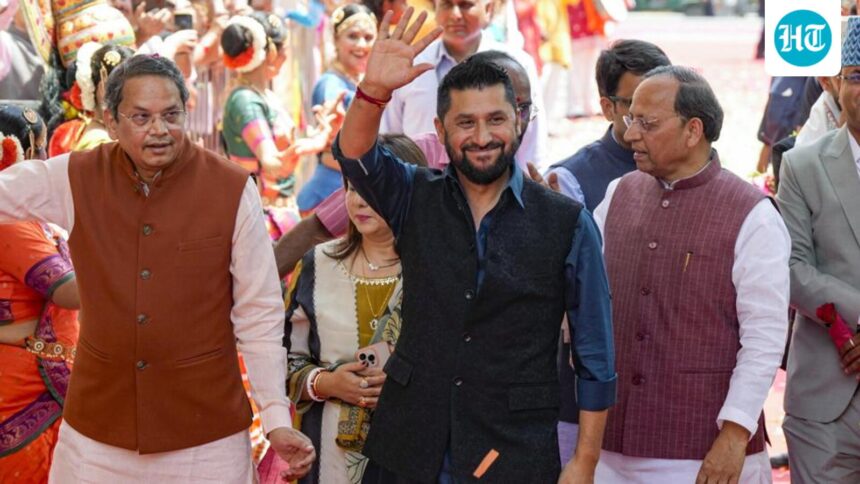
The Bharatiya Janata Party (BJP) and the Ministry of External Affairs on Tuesday rolled out the red carpet for Nepal’s ruling Rastriya Swatantra Party leader Rabi Lamichhane, the first senior political leader from the neighboring country to visit the country after the change of government in Kathmandu.

BJP president Nitin Nabin met a delegation led by RSP chief Lamichhane at the party headquarters and discussed ways to strengthen people-to-people ties of the two countries and the need to engage youth constructively to strengthen democracy, people familiar with the talks said.
Read also: How ambitious Nepal can be reconnected with rising India, writes Rabi Lamichhane
Later in the day, Lamichhane visited the Ministry of External Affairs and met External Affairs Minister S Jaishankar, who was accompanied by Foreign Minister Vikram Misri. Jaishankar said on social media that he and Lamichhane discussed bilateral development partnership and people-to-people relations. “It has a crucial role in promoting growth and prosperity,” he said.
Lamichhane is visiting India at a time when the two sides are recalibrating their relationship after Nepal’s general elections in March, which swept the Revolutionary Socialist Party and led to the emergence of rapper-turned-politician Balindra Shah as prime minister. The visit also assumes importance as RSP leaders said that Shah does not intend to travel abroad for at least a year.
The RSP leaders are visiting New Delhi at Nabin’s invitation, and the meeting was part of the ‘Know BJP’ initiative. The above-mentioned people said that the two sides discussed ways to enhance engagement between the two political parties through visits and discussions on issues of common interest.
“Lamichhane was keen to understand how the BJP works, the strength of the cadre and how it functions. He also said that unlike the BJP, the BJP came to power for the first time and is now focusing on building the party at the grassroots,” said a senior official familiar with the details.
Nabin and Lamichhane also spoke about the need to reach out to young people, or “Gen Z,” as they are colloquially called. “The leaders said there was a need to channel their energy, which has huge potential if used constructively,” the person cited above said.
Generation Z is credited with bringing about a political revolution in Nepal, paving the way for the election of Shah, the youngest prime minister.
The official also said there was no discussion about the Kokroch Janta Party (CJP), a satirical youth-led political movement that is being compared to the Gen Z movement in Nepal. The Indian government has maintained that the CJP cannot be seen as representative of Indian youth, even as it suppressed it by imposing a ban on its social media platforms.
The CJP or other youth movements like those in Bangladesh cannot compare to Generation Z’s push for change in Nepal as this culminated in the formation of a democratically elected government, the official said. “The transition in Nepal was different from other places like Bangladesh. While there was violence and unrest in the beginning, all political parties eventually chose to participate in the elections. In Bangladesh, the Awami League led by former Prime Minister Sheikh Hasina was banned from participating in the elections,” the employee said.
Vijay Chothaywale, head of the BJP’s external affairs division, said Nabin highlighted the close and historical ties between India and Nepal rooted in common civilizational heritage, cultural ties and strong people-to-people ties. “He said such interactions help in strengthening democratic dialogue and deepening bipartisan engagement between the BJP and the RSP,” Chothaywale said.
The meeting was followed by an interactive lunch joined by Delhi Chief Minister Rekha Gupta.
External Affairs Ministry spokesman Randhir Jaiswal said in a regular press conference that Lamichhane’s visit comes within the framework of communications between the political parties in the two countries. “These communications are equally important because we have a multi-faceted partnership with Nepal. We have a government-to-government partnership [and] “The people-to-people relations…we appreciate these contacts in strengthening our partnership with Nepal,” he said.
Informed sources said Lamichhane’s visit also comes in the wake of the foreign minister’s cancellation of a planned trip to Nepal last month after authorities in Kathmandu did not agree to a meeting between him and Prime Minister Shah.