Saying sorry, and doing so authentically, is not easy. But apologies can change relationships and, in the case of political apologies, redefine history. Documentary film by Belgian director Christophe Belsen Defenderwhich he wrote, directed, and produced, now explores what the act of atonement can do for victims, sinners, and witnesses alike—and how it can reshape lives.
The film has its world premiere in international competition at Sheffield DocFest, which runs from 10 to 15 June, on Thursday 11 June, and feels timely in an era when not a day goes by without a politician or well-known figure issuing a public apology, being invited to make an apology, or failing to apologise.
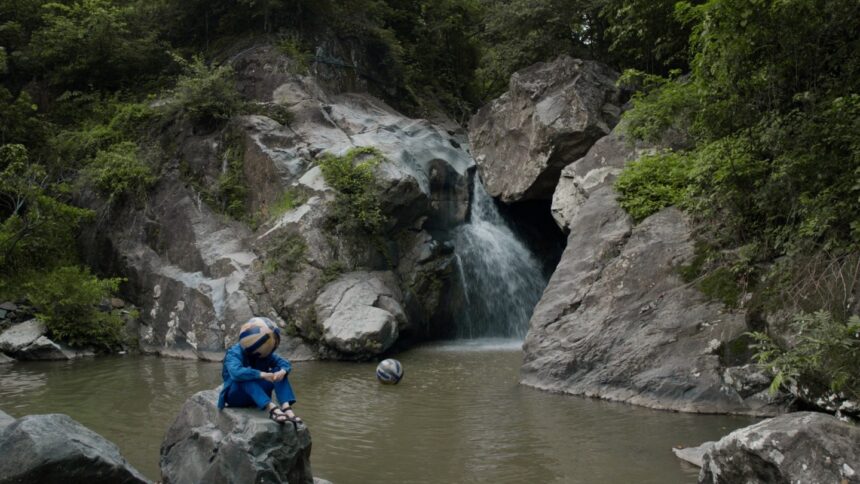
The hybrid documentary, which features actress Musia Mwankumi and actor Valentijn Dhaenens as they develop a play and explore the art and pitfalls of apologetics, features cinematography by Joachim Philippe, Pilsen and Deren Agbaba, with editing by Luca Mattei and co-edited by Aaron Menebo. Co-written by Zane Márquez Caneda.
The result is an emotional cinematic journey across continents, personal and collective events, trauma and responsibility that moves between personal reflection, performance and ritual. Bilsen worked on set with trainer and regular supervisor Ria Verlinden to discover how many things are interconnected and cannot be seen in isolation. The document also includes scholars such as Professor Juliet Schaafsma of Tilburg University, who has cataloged political apologies since the March to Canossa in 1077, widely considered the first ever public apology, and Professor Roland Zahn of King’s College London, whose research explores guilt and self-blame and their relationship to empathy and apology.
Defender It is produced by Bilsen’s Limerick Films in co-production with Tangerine Tree, Warboys Films and Wrong Men. Limerick handles sales.

“As a child, I was bullied, and the lack of resolution or apology continues to affect me. I never felt like things were truly resolved, let alone given an apology, and this continues to affect me later in life,” Bilsen shares in the director’s statement. “This personal experience reflects a broader societal trend, as many people and societies today wait for apologies, sometimes for events that are decades or centuries old.”
He adds: “In the context of current social movements like Black Lives Matter, #MeToo, and reckonings with the colonial past, Defender It addresses the timely question: Can public apologies lead to forgiveness, understanding, or change? …We challenge you to reconsider the meaning of apologies and pave the way for a deeper understanding of true reconciliation and recognition.
Check out the trailer for Defender here.
Ahead of Sheffield DocFest, Pilsen spoke to Hollywood Reporter About a six year journey to make the DefenderThe weight of trauma and why saying sorry is much harder than it seems.
What was the original idea for the film? You mentioned in the doc that you had to adjust its direction as you began your cinematic journey.
The initial idea was to make this very intelligent archival film based on public political apologetics. But then it evolved from there.
What can you share about why you chose the title? Defender for your document?
I think midway through the process, I realized that the concept of apologetics had a Christian religious connotation. And then, of course, there is also Plato’s theory apology [or:[or:Socrates’ apology]. The whole idea of an apology is a nice thing, but at the same time, there’s this complete irony in the title DefenderThis kind of friction between self-awareness and defensiveness.
how Defender Does it fit with previous filmmaking?
My training is to look deeply, observe, listen and be humble as a director, and I made my first two films that way.
It was my first one Elephant dreamwhich premiered in 2014 at IDFA in Amsterdam and was about public sector workers in the Democratic Republic of the Congo, a former Belgian colony. That was really very uncomfortable. Going to a former colony as a white Belgian director, or going there as a former oppressor in some way, or acquiring the legacy of the oppressor.
My second film also premiered in Sheffield in 2019 and is titled the mom. The film is about a single Thai mother who cares for Europeans with Alzheimer’s disease. This was a profound observation of the universal dilemma of love and care. What do we do with our elderly people here in Europe and how? We try to find a better life for them, and one of the most ridiculous things is to bring them to Thailand to spend their final years. How selfish! Again, that was a note of friction and something that is very problematic in many ways, but also deeply human.

In the middle of COVID, I wasn’t able to monitor [directly]So I thought I’d keep an eye on the archival material. It was the time of George Floyd, who died at the hands of police violence in the United States, and of the entire Black Lives Matter movement, which, unfortunately, some of us have already forgotten. Then suddenly I heard that our Belgian government said that it should set up a commission into Belgium’s colonial past with the ultimate goal of issuing apologies.
To me, it seemed like performance, insecurity, uncertainty, all coming together in one image. Then I had to trust the process, which is quite a challenge with such a huge subject. So the film took six years to produce.
Was there any key lesson you had to learn in the production process?
The big step for me was giving up control of the project and process. We live in a very dualistic world in terms of control – good, evil, and positioning. But what about the power of uncertainty and the dark and shadowy sides in all of us? So, the big moment was when I realized that a film that’s about public apologies is also about something more, something else.
What is this “something else”?
We’re basically starting to dig deeper into systemic and planetary work – starting with the whole idea that we’re all part of the family and [other] Systems. Even if we are orphans, we are still biologically descended from a mother and father. Their fathers succeeded them, and their grandfathers and great-grandfathers succeeded them. They’ve all won or lost, they’ve all had their doubts and successes, they’ve all committed things and they’ve all committed things. So, we stand on the shoulders of our ancestors, and this helped me see the world and the film systematically.

Yes, we crave control, and we live more and more in a time in which we have the illusion of control, including politically. Through the media and [technology]you feel like you can check and control who did something right or wrong. It is the era when we can watch live broadcast of every war and every conflict in the world.
But responsibility is not limited to the individual only. You have to deal with it collectively. You have to support each other as a community, which can easily seem hesitant and tree-hugging. But in exploring good and bad apologies, we also had to delve into our own contradictions, doubts, doubts, fears, and ghosts of the past. Weakness, fragility and uncertainty is exactly what we need to confront here, now. Things are very uncertain and shaky.
I addressed this topic about how complicated things can be, even when they seem simple, and how we may all have to step out of our comfort zones. Is there any key information you think viewers might leave the document with?
For me, the big, big lesson from the movie is to stay in a state of discomfort. Relationships are hard. I am the father of a six-year-old daughter, and the film is dedicated to her. First, we have to acknowledge what we have left behind and think about our ancestors. It is humbling to accept that you are on a timeline, and that your ancestors are there with you.
Is this why you, Musia and Valentijn address your own perspectives on key issues and how your personal backgrounds and biases come into play?
Yes. everyone [I just said] It also applies to the idea of a documentary filmmaker. You cannot tell stories without yourself, without your perspective, without questioning your perspective, and without being humble before the process of investigation and inquiry.

Obviously there is an opportunity for discussions or other activities related to the film screenings Defender. Is there anything unusual you are planning in Sheffield?
Of course, classic questions and answers and discussions are one way, and we will do that at the festival. But the danger is that words take over and silence and physical awareness disappear. The world premiere will be preceded by a reflection in cinema.
People shouldn’t feel afraid. If you just want to be present in the room and wait a few minutes, you will be able to watch the movie you purchased a ticket for. Don’t worry! But we want to offer you a space where you are welcomed even when it’s hard. It’s the first of several specials.
We are exploring building an impact campaign around this topic, specifically on the principles of awareness and systemic action. It is nothing magical, but simply an invitation to remember and (re)connect with our consciousness as ways to process grief, acknowledge, and find ways to explore together.
I heard that some TV networks are partners in… Defender?
Yes, I think it is very hopeful that this kind of film will be jointly produced by four broadcasters – NDR [in Germany] In cooperation with [European culture channel] Artie, Vice President [in the Netherlands] and
VRT and RTBF [in Belgium]. It’s amazing, especially since there is uncertainty painted throughout the film. It’s not your classic character driven movie and it’s pretty safe.

If you had to simplify things significantly, what would your headline be? Defender Is your own work on it for people who are thinking about watching the film?
It didn’t start with you. And: It’s not just about you. It’s about the humility of standing on the shoulders of your ancestors, which has really big implications and is not romantic. You have to look at the pressure of the system that people are part of and what is expected of them.
Is there anything else you would like to share?
There is a very good line of [Swiss psychologist] Carl Gustav Jung. “I would rather be a perfect person than a good person,” he said.