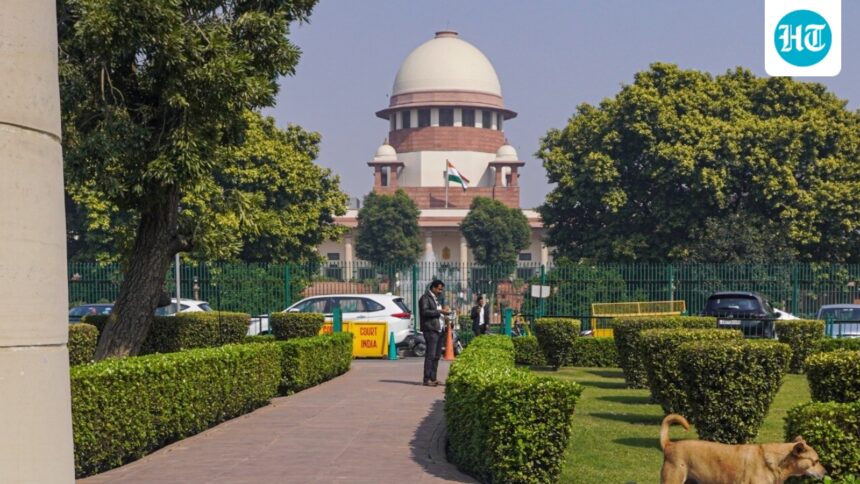
Four chief justices of the Supreme Court and a senior advocate in Mohana were sworn in as judges of the Supreme Court on Tuesday, raising the top court to almost full strength and marking one of the most significant rounds of appointments in recent years after the court’s sanctioned strength was expanded.

Chief Justice of India (CJI) Surya Kant administered the oath of office to Justices Shail Nagu, Shri Chandrashekhar, Sanjeev Sachdeva, Arun Bali and Senior Advocate Mohana.
The appointments were notified by the Union government on Monday, four days after the Supreme Court recommended they be lifted. Union Law Minister Arjun Ram Meghwal announced the appointments through a post on X.
The names were recommended on May 27 by a CJI Kant-led Supreme Court panel comprising Justices Vikram Nath, JK Maheshwari, PV Nagarathna and MM Sundresh.
The appointments came days after the Union government increased the scheduled strength of the Supreme Court from 33 to 37 judges, excluding the ICJ, through the Supreme Court (Number of Judges) Amendment Act, 2026. The move was aimed at addressing the growing pendency, which has crossed 92,000 cases, and facilitate regular formation of larger courts.
With the swearing-in of the five new judges, the Supreme Court’s workforce has risen to 36 judges, excluding the International Court of Justice, leaving only one vacancy against the approved strength of 37 judges.
The latest round of appointments reflects the body’s attempt to find a balance between regional representation, seniority, merit, and gender diversity in the composition of the country’s highest court.
Justice Nagu, who was Chief Justice of the Punjab and Haryana High Court, began his judicial career at the Madhya Pradesh High Court and was elevated to the position of Judge there in 2011. He was appointed Chief Justice of the Punjab and Haryana High Court in 2024 and handled a wide range of matters relating to constitutional, service and administrative law.
Justice Chandrashekhar was serving as Chief Justice of the Bombay High Court at the time of his elevation. He was appointed as a judge of the Jharkhand High Court in 2013 and later served as acting chief justice before being transferred to head the Bombay High Court.
Justice Sachdeva, who was recently appointed Chief Justice of the Madhya Pradesh High Court after a long stint as a judge of the Delhi High Court, has extensively dealt with disputes relating to constitutional, commercial and criminal law. Before his elevation to the bench in 2013, he had a significant practice before the Delhi High Court and the Supreme Court.
Justice Bali, who presided over the Jammu and Kashmir and Ladakh High Courts, joined as an advocate in 1988 and practiced primarily before the Punjab and Haryana High Court. Appointed as a senior advocate in 2007, he was elevated to the position of judge in 2013 and was later appointed Chief Justice of the Supreme Court.
Mohana’s appointment is of great importance as it increases the representation of women on the Supreme Court bench. Until now, Justice Nagaratna has been the only female judge of the Supreme Court.
Mohana is a distinguished member of the Supreme Court Bar and is the second woman lawyer to be elevated directly from the Bar to the Supreme Court after Justice Indu Malhotra in 2018. Graduating from the first batch of five-year law courses at Coimbatore Law College in 1988, Mohana began her career under Advocate M Panchabhakisan before moving to Delhi, where she worked with former Supreme Court judge Justice Indu Malhotra and Senior Advocate CS Vaidyanathan.
After passing the Registered Bar Examination in 1996, she established independent practice before the Supreme Court, the Delhi High Court, and various tribunals and panels. During her career, she has appeared alongside some of the country’s leading legal figures, including Kapil Sibal, KK Venugopal, P Chidambaram, Arun Jaitley and TR Andhyarogena. She was appointed as a senior advocate by the Supreme Court in April 2015 and has also served as an advocate for the Union government.
The appointments come at a critical time for the Supreme Court, which is expected to witness a series of retirements in the coming months. Justice Pankaj Mithal is scheduled to retire this week, followed by Justice JK Maheshwari later this month, Justice Sanjay Karol in August, and Justice Satish Chandra Sharma in November.
The new inductions are expected to help stabilize the court’s workforce and improve its ability to handle growing attachment while enabling more regular sittings of the benches during the tenure of CJI Kant, who is scheduled to retire in February 2027.