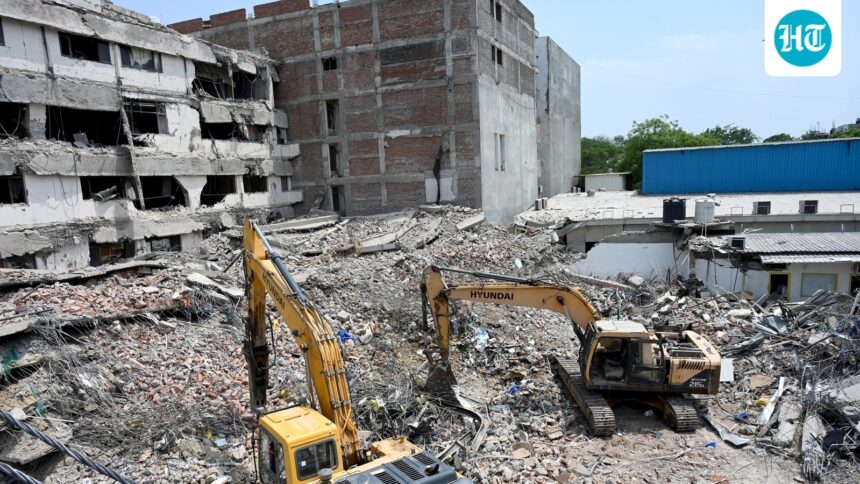
The six-storey building that collapsed in Sidhulagab on Saturday was one of more than 125,000 properties that were “seized” by the Municipal Corporation of Delhi (MCD) – a classification the civic body gives to buildings found to have flouted regulatory norms – but against which the authorities have taken little or no action, HT has learnt.

At least 125,755 properties had been seized in Delhi as of May 31 this year, according to MCD records, and these buildings and their owners are vulnerable to a range of penalties, including stopping further construction, restricting future transactions and the possibility of further action.
But in November 2025, the Delhi government allowed power connections to be restored to these buildings – a key penalty for illegal construction that had been in place for decades. The government cited “public interest” reasons and pointed to long-standing court cases.
A building collapsed in a canteen, killing 6 people
This comes even after it emerged that the Delhi Police had written to MCD in March about the conspiracy and asked it to “verify whether the construction is in accordance with a prohibited plan or otherwise”. The police informed that a fifth floor has been built in the building, according to a letter seen by HT. However, MCD took little action on the notice.
This building collapsed on Saturday evening and fell on a nearby cafeteria, killing six people and wounding nine.
Police said on Monday evening that they had arrested the owner of the building, 71-year-old Karamveer Zildar of Church Road in Vasant Kunj, and detained him on charges of culpable homicide not amounting to murder, negligent conduct in relation to the premises and causing hurt.
What are “reserved” properties?
“Foreclosed properties” are constructions that have been flagged as unauthorized structures or violations of building codes, zoning laws or land use regulations. This status means that the property is on the list of possible actions, such as demolition. Constructions without approval or deviations from the approved plan can often call for a “reserved” tag.
A senior MCD official said the property had been seized due to illegal construction, but confirmed that punitive action against it was still pending.
Read also: A phone call helped rescue a man trapped under rubble in Sidulagap
“In many cases of seizure, we face legal issues and delays, and effective action is in about a third of cases. The property in question has been seized, but this action may have been taken recently,” the official said.
A senior MCD official said that demolition of unauthorized structures on private land is being dealt with under Section 343 of the Delhi Municipal Corporation Act. “Private properties are seized, notices are issued and legal action is taken. Once the property is seized, the owners are asked to demolish or regularize the sections. Depending on the response, other actions – including writing to power disks to cut off electricity supply, sealing procedures, and finally demolition – are taken. In some cases, where the courts are monitoring the matter, action is taken on priority basis,” the official said.
Last year, the Delhi Urban Development Department informed the council that Delhi’s 12 zones had registered 76,465 cases against illegal construction between 2015 and 2025. However, enforcement proceedings were initiated in only 35,842 cases – less than half.
The council was also informed that 11,903 properties had been closed, with only 683 being released after their owners made the required corrections.
Most violations were recorded in the western, central and southern regions. Saidulagab falls under the latter.
Read also: ‘He was going home for the holidays’: Dreams shattered when building collapse in Delhi kills two friends
Data from the MCD database showed that the Western region had the most booked units with 18,603, followed by Central (17,698), South (16,612), Najafgarh (11,430), City SP/Old Delhi (8,272), Karol Bagh (7,233), Rohini (6,701), Keshavpuram (5,872) and Civil Lines (5,260).
These properties were earlier deprived of power under Delhi’s municipal building provisions.
But on November 17, 2025, the Delhi government said it would lift restrictions on electricity connections in reserved properties.
The state government issued an official order after Prime Minister Rekha Gupta’s approval on November 11, 2025. The government said the decision was taken “in the public interest” to ensure “access to basic services in all circumstances”.
“There have been public complaints about denial of electricity connections on the grounds that the properties in question have been ‘reserved’ by the Ministry of Building and Construction for unauthorized construction. In many such cases, it has been found that even years after the demolition orders issued by the Muscat Housing and Development Company, no action has been taken for various reasons. Even those reserved properties will be eligible for electricity connections,” Gupta said at the time.
“Thousands of people have been living in these properties for years, but are deprived of electricity connections due to their ‘seized property’ status – causing inconvenience and, in many areas, increasing electricity theft. Depriving consumers of basic amenities is not justified under any circumstances,” she added.
To be sure, as per the Central Government Act, all construction in unauthorized colonies from June 2014 is illegal, but those before this cut-off date are protected. However, all protections cease if any new construction is built on these properties. Police informed MCD about the construction of a fifth floor in the Saidulagap area earlier this year, automatically qualifying it for booking.
In her March letter, addressed to the MCD district commissioner, the Mehrauli police station officer mentioned the address of the building – Kasra No. 261, Lane No. 5, West End Marg – in a schedule and wrote: “Please verify the fact whether the construction is as per the approved plan or otherwise. Necessary police assistance will be provided as and when required.”
A senior police officer said that sending reports on new constructions in their areas to MCD officials – to ascertain whether the work is legal or not – is a routine practice.