Authors and screenwriters Joshua John Miller and Marc Fortin, local and professional partners, move out of Chateau Marmont, under a Salvador Dali print, and with their dark hair and bushy beards, it’s hard to tell them apart. It’s even more difficult when listening to a recording of the interview, since they have similar woods, finish each other’s thoughts and talk with equal passion about the subject of their wonderful new book, Marilyn Monroe century. The visually stunning book, coinciding with Marilyn’s centennial, chronicles the friendship and creative collaboration between Josh’s grandfather Bruno Bernard, a German-Jewish immigrant who became a legendary showbiz photographer, and Hollywood’s most famous movie star. Many of Bernard’s images from the book are on display in the Academy Museum’s new exhibition, Marilyn Monroe: Hollywood icon.
The story begins on Sunset Boulevard in 1945, when Bernard — described by Fortin as “shockingly unproblematic” — whistled uncharacteristically at an unknown teenager named Norma Jean Dougherty and invited her into his studio for a photo shoot. Bernard, whose photographs appeared on the covers of numerous magazines, became a close friend of Norma Jeane and something of a manager, a camera-wielding Virgil who guided her into the hell of Tinseltown as she developed the character who would become Marilyn Monroe.
The book draws heavily from Bernard’s detailed diaries. But it is also “haunted,” as Miller puts it, by the experience of Bernard’s daughter — Miller’s mother — Susan Bernard Playboy Playmate and star of B-movie exploitation films such as Hurry pussy! Kill kill (1965) and The deadly type (1963). Miller and Fortin, who co-created television Queen of the South He co-wrote the slasher comedy Final girlssee themselves as following David Lynch’s legacy by telling stories of “women in trouble”—which leaves them in Los Angeles with no shortage of source material. But while Marilyn, who died of an overdose in 1962 at the age of 36, is often portrayed as a tragic victim of Hollywood exploitation, Fortin and Miller’s book presents her in a more complex light, as “an architect of her own image.” As the writers told me in our interview, she knew exactly what she wanted and how to get there.
I’m sure you see the cinematic potential of your grandfather and Marilyn’s story.
Joshua John Miller We just had a very important meeting with one of the studio’s favorite production companies who had their hand up for the book. And we all collectively agreed that Norma Jeane’s story has never been told. We all know the story of Marilyn – that legend is so obvious and well known – but the early days of who Norma Jeane really was, and the kind of corrupt deals that had to happen for her to become Marilyn, no. What is also unknown is how much power she had on that flight.
sign Fortin Yes, it’s tempting for some people to look at Marilyn’s story as, isn’t it wonderful? Or it’s Rob Zombie’s House of Horrors. Regarding both aspects, what gets lost in the confusion is that she was very much the architect of her own image, the persona she created. She was very skilled with the cameras, and knew how to mold herself into something undeniable. None of it was accidental.
Miller The movie will really focus on this romantic friendship between Marilyn and Grandpa. I think it would be good for the actors because a lot of actors would be afraid to play Marilyn Monroe, but we’re all internally determined: You won’t see “Marilyn” until the last frame of the movie.
She looked very different from Norma Jeane at that point. There were reports that she had work done.
Miller That’s right, that’s all in the book. I did the work, on the advice of Johnny Hyde, vice president of William Morris. The quick short story is that she was dropped for the third time by the studios, and this was Columbia, and she called it hysterical. She was always up to something. and [Bruno] He said, “Let’s go to the desert. I have an assignment in Palm Springs.” red book, Why don’t I take you there, take some pictures, and introduce you to some of the people at the Racquet Club? That weekend was a great formative of their friendship, but it was also the turning point, when they were sitting by the pool, and Johnny Hyde asked my grandfather….
Fortin “Who is this lady?”
Miller And Johnny was very Machiavelli. He immediately assigned it to his nephew, Norman Brokaw, who, as we know, would become William Morris’s boss after Johnny’s death. Marilyn was Norman’s first client. He got her first contract at twenty, I think, for $125 a week with a $20 bump, and then he had her straighten her chin and nose. Norman told Grandpa that he didn’t want to take any more pictures of her in a two-piece bathing suit, it was too revealing, just in a full bathing suit.
For the stars of that time, the photographer was, as my grandfather said, their best friend, their mentor, their confidant, their designer, their career manager, because a lot of the pictures were in magazines, and that’s what caught the attention of 20th Century Fox in Marilyn’s first contract. All sponsored by Bruno along with Marilyn – Norma Jeane at the time. Clothes, look, makeup… Nowadays you have a team of 50 people managing a certain celebrity or Instagram star? This was all handmade, it was all in-house, and it was managed by photographers. Bruno was also deeply invested, how could you not be?
To what extent do you think Marilyn was a self-invention? How much was being imposed on her by all these powerful men around her?
Fortin In fact, this was not something that was forced on her. By the time she meets Johnny Hyde, she has already thinned her hair. With Bruno’s help, she studied the gait of burlesque star Lily St. Cyr, who was nicknamed Miss Swivel Hips, and so changed the way she walked. She also started taking elocution lessons and started to develop the Marilyn Monroe voice that we know so well, which was not Norma Jeane’s natural voice, so she was definitely the one who was at the forefront of creating the character that she eventually became incredibly famous for.
Miller It’s interesting, because, you know, we look at these things through a post-me-too lens, right? And for example, the Academy was using one of the pictures that my grandfather had taken of her in a two-piece bathing suit on this kind of green barrel, the green barrel, and they published it, and one person commented, “How can the Academy publish a picture of Marilyn in a two-piece bathing suit? That’s taking advantage of her again!” And of course the truth is a two-piece swimsuit? Marilyn walked into my grandfather’s studio—this was probably their fourth or fifth session—and said, I’ve got these new clothes, I’ve got this new hair, and I’m working on this new sound. Bernie, I want you to take more sexy pictures of me.
Fortin It was Bruno who resisted. He was pushing to keep her as the girl next door, a nice secretary, a schoolgirl, that kind of thing. And it was Marilyn who said, no, let’s escalate it.
Miller Were there wolves? Yes, it’s Hollywood, it’s the 1940s, post-World War II, wolves are everywhere, and they still are. But there are two things that could be true, I think she was making it up, but I also think other people were imposing it in different ways as well. But what I think is lost in the mythology – or if you look at this movie blondhe only paints her as a victim. It’s trying to tell a story about how she was exploited, but in the end, the lack of any agency she had in her life, or not talking about all the groundbreaking and wonderful things she did, is never addressed in this film, and as a result it feels like a victim narrative.
Fortin As beautifully made as it is.
Miller It felt like trauma porn, honestly.
Fortin Focusing on Marilyn and the swimsuit, and describing this type of exploitation, shifts the conversation away from where it actually belongs. He was exploited. She was tapped by her studio, Fox. She’s been exploited before [20th Century Fox studio head] Darrell Zanuck. [Columbia Pictures chief] Harry Cohn apparently made a pass on her and her contract with Columbia was canceled when she resisted the couch.
Miller And then 20 really tortured her, tortured her because she broke the 20 contract and talked about it, and then when she had shot two films with her own production company, which was quite avant-garde at the time in New York, she then went back to 20 to direct the last film[theunfinishedfilm[theunfinishedSomething has to give]. They really tortured her, and they wanted to get back at her for speaking out against the studio, for breaking her contract, and then renegotiating a higher fee.
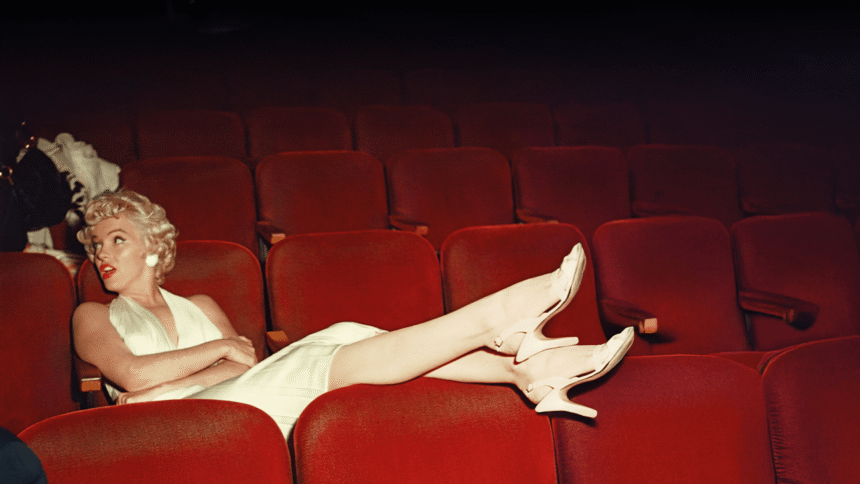
Below, Miller and Fortin have selected three of their favorite images from the book: