Technology has been the main driver of the music business in the digital age. But UK music technology companies face a funding crunch as they enter their growth phase, according to the second annual Sound Investments report from trade union Music Technology UK (MTUK), which was unveiled on Monday and will be discussed at SXSW London 2026 later on its opening day.
The trade group highlighted that financing for growth-stage companies declined by 90% between 2020 and 2025 and that generative AI continues its rapid rise, stressing that “AI increases the risks of government action.”
The study, titled Sound Investments 2026: Supporting the Sector, produced by MTUK in partnership with research firm Beauhurst and support from lead sponsor consultancy KPMG UK, is based on an analysis of six years of investment data across 922 music technology companies in the UK.
Music technology includes the likes of streaming infrastructure, pricing, subscription and fan systems, data and other services that enable rights holders to better engage with fans, including through premium access, commerce and community features. On the live music side, ticketing, venue operations and touring logistics are among the areas that benefit from technology solutions. “Technology is the infrastructure on which the modern music economy runs – an infrastructure that includes live and recorded streaming, publishing, sync, licensing, education, hardware, creator tools, and more,” the MTUK report notes. “Growth is driven not only by increased consumption, but also by new ways of packaging, distributing and monetizing music. Without them,
And innovations in infrastructure, this growth will undoubtedly fail.”
Not surprisingly, one key challenge has been highlighted. “The UK music technology industry is facing a structural funding crisis with funding for growth-stage companies falling by 90 percent, from £101 million ($136 million) in 2020 to £10 million ($13.5 million) in 2025,” according to a summary of Monday’s report. “The main challenge facing the UK is not creating businesses, but scaling them up.” Growth-stage companies need capital to move from product and market fit to international expansion mode.
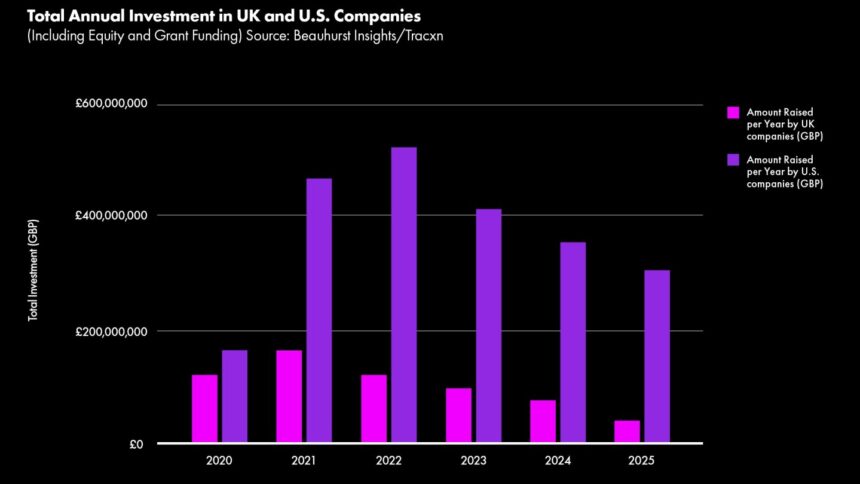
Among other data included in the MTUK report, the sector attracted more than £809 million ($1.09 billion) in total investment between 2020 and 2025, peaking at £183 million ($246 million) in 2021. Since then, annual investment has fallen sharply to £68.8 million ($92.6 million) in 2025. This represents a decline of 51 percent during that period, “a much steeper decline than the broader decline.” Overall UK technology funding fell over the same period – down just 4.4 percent.
Compared to the US, in 2020, UK investment in the music technology industry is equivalent to 76% of US funding. But by 2025, that number had collapsed to 21%.

While investment in seed-stage companies more than doubled over the six-year period, from £8.4 million ($11.3 million) in 2020 to £22.1 million ($29.7 million) in 2025, financing for growth-stage companies has been decimated. “This lack of growth-stage investment is forcing many UK companies to look abroad for investment and, in some cases, consider moving their operations to markets with greater access to capital and liquidity,” the Sound Investments 2026 report stressed, also noting the need to “enhance their visibility and attractiveness within international investment ecosystems.”
The study indicated that among international investors, the United States was the largest source of external capital, participating in 14 percent of all deals. But too often, the report says, UK players are sold to foreign companies in “premature takeovers”.
The report is a call to action. “When we published our first Sound Investments report last year, we argued that music technology in the UK was undervalued, underinvested and underrepresented,” said Matt Cartmel, CEO of MTUK. “A year later, that’s changing — but not fast enough.”
Monday’s report described this as a “pivotal moment” for the sector, and identified three key initiatives required for future development.
The first is the impact of artificial intelligence on the market. “Generative AI has created a new type of music technology buyer: technology platforms with a pressing commercial need for licensed music data, rights infrastructure, and proprietary content pipelines,” the study noted. “British companies operating in these areas are increasingly becoming takeover targets before they have the opportunity to expand locally.” The report highlighted a particularly attractive sub-sector, saying: “AI is fundamentally changing the strategic value of music technology companies, especially those building at the intersection of rights and data infrastructure.”
Point 2 is about politics. With the UK Government’s support for the creative industries, MTUK urged that “the time has come to place music technology clearly within these frameworks”.
The third and final priority outlined in the report is related to competitive pressures. “In a global market with increasing competition for technology talent, capital and ownership, the UK must deploy strategies to support the music technology sector, so that the economic value it creates is retained in the UK,” the report said.
Creative Industries Minister Ian Murray said: “Music technology plays a vital role in driving economic growth, attracting investment and shaping the future of music and innovation. This report highlights the potential of the sector in the UK, but also the challenges facing many of our leading organisations. Through our Creative Industries Sector Plan, we are committed to turbo-charging high-growth creative businesses, fueling innovation, and ensuring the UK remains one of the best places in the world to work in creative technology.”
DDownload the full Sound Investments 2026 report here.